Wataru
Bullet TrainWataru is Yuichi Kimura’s young son, whose fall from a department-store roof leaves him in a coma and sets the novel’s central father-and-son conflict in motion. His vulnerability is exploited by the Prince to manipulate Kimura, but the story also gives Wataru a presence beyond that role: a child attentive to his father’s drinking, whose concern sharpens the cost of Kimura’s efforts to change.
Identity and Family
Wataru is six years old when the Prince and the schoolboys under his direction take him onto a department-store roof. The account presents him as a child who has not yet encountered deliberate cruelty and who is frightened in the presence of people he has no reason to distrust. That innocence matters to the circumstances of the fall: Wataru believes the Prince’s reassuring manner rather than recognizing the danger behind it.
His father is Kimura, whose attention to Wataru is shaped by both love and fear of failing him. The novel also places Wataru within a wider family network. His grandparents instruct him to hide the alcohol in the apartment when Kimura’s dependence becomes difficult to manage. Kimura’s mother later sees Wataru unconscious in the hospital and is overwhelmed by the sight. These details make the child’s safety a concern shared across generations, even as Kimura feels the immediate responsibility as his father.
Before the Fall
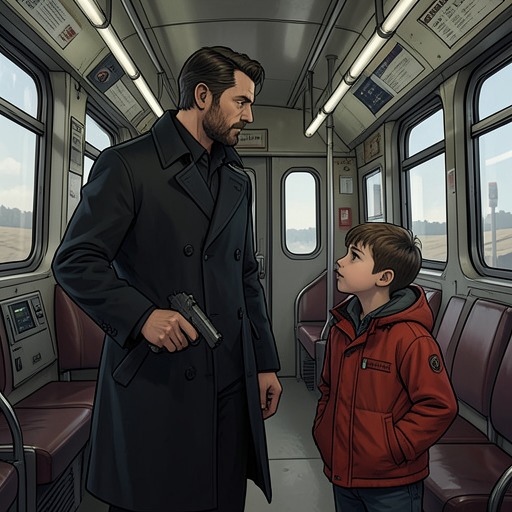
In an earlier encounter, Kimura finds Wataru by the escalators holding hands with a boy in a school uniform. Kimura rushes over in alarm and pulls his son away. The scene registers the father’s anxiety before the full danger is understood: he has lost sight of Wataru, imagines the judgment of his ex-wife, and is overcome with relief when he finds him. Wataru’s ease beside the other boy contrasts with Kimura’s fear, while the episode shows how readily a child can trust someone who appears calm and approachable.
Wataru also notices what Kimura tries to conceal from himself. When Kimura speaks with schoolboys who are troubled by the Prince, Wataru’s attention settles on the flask in his father’s hand. Kimura realizes that he has opened it and drunk without noticing. Wataru looks at him with concern and sadness. His response is not an accusation, but it makes visible the effect of Kimura’s drinking within the family: the child is watching, and the father’s attempt to excuse the lapse cannot erase that knowledge.
The grandparents’ instructions that Wataru hide the alcohol reveal how much responsibility the household has placed around Kimura’s dependence. Kimura remembers searching desperately for bottles when Wataru had put them away, and feels relief that he never became violent toward his son. The recollection does not make Wataru responsible for managing his father; instead, it shows the painful proximity between Kimura’s illness and the child’s everyday life.
The Fall and the Prince’s Account
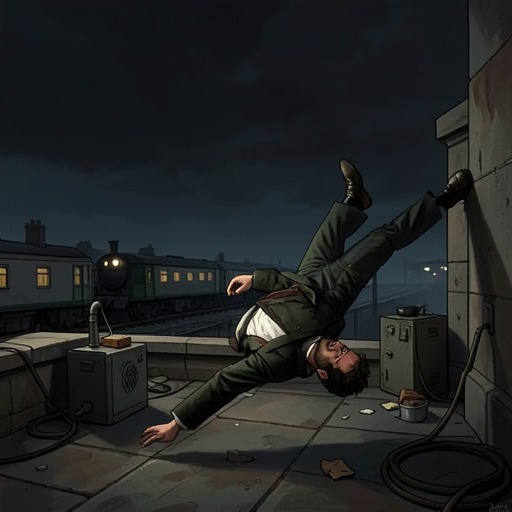
The Prince first describes Wataru’s presence on the roof as accidental. He claims that Wataru followed him and his friends, wanted to join them, and fell after being warned away from a dangerous area. Kimura rejects this explanation and asks directly why Wataru was hurt. The Prince then admits that the act was meant to get at Kimura. The two accounts expose the gap between the Prince’s self-protective story and the deliberate use he makes of Wataru.
The fuller account identifies the boys accompanying the Prince as classmates who followed his orders. Wataru is frightened because cruelty is unfamiliar to him. The Prince speaks to him with a warm smile and presents the approach to the railing as safe, leading the child to believe him. The sequence makes trust itself part of the mechanism by which Wataru is placed in danger: he is not described as understanding the threat, but as believing the person who reassures him.
The fall leaves Wataru unconscious and unresponsive in a hospital bed. Kimura’s mother, seeing him there, cannot reconcile his appearance with what has happened. For Kimura, the image of his son lying as though asleep repeatedly returns amid the crowded station and the journey on the Hayate. Wataru is physically absent from those scenes, yet his condition governs Kimura’s attention and gives his anger its personal focus.
Wataru as Leverage and Measure of Change
After the fall, the Prince threatens Kimura by invoking Wataru’s condition in the hospital. The threat forces Kimura to ask what the Prince wants and makes clear that the child remains within reach of the Prince’s power even while hospitalized. Wataru’s injury thus becomes the means of coercion in the conflict between the two men: the Prince can compel his father by threatening the person Kimura most wants to protect.
Kimura’s memories of drinking deepen that pressure. He recalls that Wataru hid the alcohol at his grandparents’ request, while Kimura searched the apartment and became desperate when he could not find it. He is relieved he never struck his son, but recognizes how close his dependence brought him to conduct he could not have forgiven himself. His later sobriety is therefore not an abstract achievement. It is a change that matters in relation to Wataru, even when Wataru is in a coma and cannot witness it.
The resulting separation gives Kimura’s recovery a painful reversal. He has struggled out of alcoholism, yet the son for whose sake that change carries meaning is absent from ordinary life, unconscious in the hospital. Wataru’s condition prevents the scene from becoming a simple account of redemption: Kimura can change, but he cannot make that change undo the harm already done to his child.
Narrative Significance
Wataru is central to the novel’s moral and emotional stakes without being given extensive independent action in the evidence presented here. His trust, his attention to the flask, and the concern in his eyes are small but consequential details. They show a child registering the instability around him, while the roof episode shows how that same trust can be exploited by someone who understands its power.
His coma also binds the novel’s external conflict to Kimura’s private struggle. The Prince’s threat, Kimura’s rage, his memories of dependence, and his attempt to remain sober all converge on Wataru. The child is not merely a reason for Kimura to pursue the Prince; his vulnerable condition tests what Kimura’s recovery can mean when the person he most wants to protect cannot yet respond. The available account leaves Wataru unconscious in the hospital, with his fate unresolved.