Wataru Is Attacked and Rescued at the Hospital
Bullet TrainWataru Is Attacked and Rescued at the Hospital is the episode in which a planned assault on Wataru’s life-support system is stopped before it can take him from his family. Its decisive turn comes through two very different interventions: Morning Glory intercepts the fleeing attacker, while Shigeru Kimura, sent to check on Wataru, accidentally wakes the boy. The sequence makes rescue both deliberate and inadvertent, and answers Kimura’s fear with news he had scarcely dared hope for.
The Threat at the Hospital
The danger begins with a man waiting inside the hospital, dressed as a nurse and eager to act against Kimura’s son. The Prince has arranged the attack and gives the man a condition for proceeding: if the Prince does not answer a call after ten rings, the attacker may go ahead. The rule leaves the decision suspended between a signal and its absence, while the attacker’s impatience makes clear that he is ready to exploit the opening.
The Prince’s reflections expose the assailant’s self-justification. He imagines the man telling himself that altering medical equipment would not really count as murder, even though doing so could destabilize a child’s condition. That rationalization gives the threat its particular character: Wataru is not approached in an open confrontation, but endangered through the machinery keeping him alive. The attacker’s apparent professional role could make his actions look ordinary in the room, concealing the violence inside a medical procedure.
Shigeru’s Warning and Morning Glory’s Search
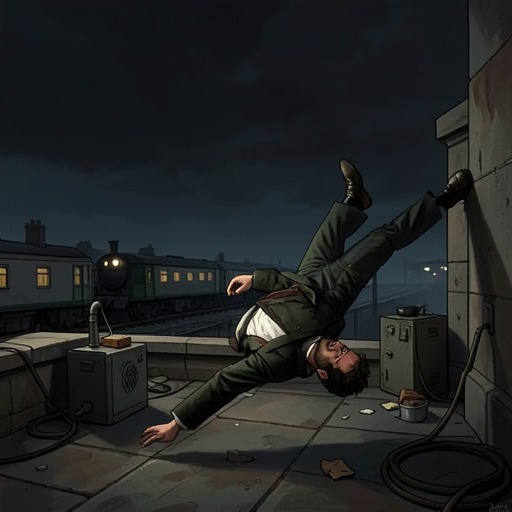
Shigeru Kimura goes to the hospital at the request of his friend, who has asked him to check on his grandson. Near the patient rooms, Shigeru sees a man in a white coat enter Wataru’s room and begin pressing buttons on the life-support machine. Unable to confront him openly, Shigeru hides beneath the bed among the cords, plugs, and wires. From there he notices the man’s muddy, stained shoes. The shoes are a small but telling discrepancy: they make Shigeru doubt that the supposed medical professional belongs there.
Shigeru contacts Morning Glory and explains what he has seen. The instruction is not merely to guard Wataru; if anyone tries to hurt the boy, Shigeru has been told to show no mercy. Morning Glory initially points out that protecting the patient does not necessarily require catching the attacker. But the man’s escape from the hospital changes the problem from a vague warning into a visible pursuit. He runs out carrying a white bundle that proves to be his hastily removed coat, and Shigeru identifies him as the suspect.
The setting turns the earlier clue into confirmation. As the fleeing man crosses toward a traffic island, Morning Glory sees the mud on his shoes—the same detail that alerted Shigeru beneath the bed. The attacker has shed the white coat, but not the evidence of his passage. He stops to wait for the light and takes out his phone, momentarily exposed in the open rather than protected by the appearance of hospital authority.
The Interception
Morning Glory approaches without making a sound. He watches the man’s breathing and the traffic light, opens and closes his hand, slows and then stops his breath, and judges the speed and timing of the oncoming cars. The account renders the intervention as a sequence of controlled physical decisions rather than a sudden blur: watch, measure, focus, touch. At the same instant, a ladybug rises into the air nearby; then the brakes of a car shriek, and the attacker’s phone falls to the ground.
The collision leaves the attacker down in the street, run over by a car. Later, Shigeru tells Kimura that the man who targeted Wataru has been taken care of, and clarifies that a professional—not Shigeru—did it. The distinction connects the hospital danger to the intervention without claiming more than the episode establishes about the attacker’s eventual condition. The immediate result is clear: the man who had tampered with Wataru’s life-support machine can no longer continue the assault.
Wataru Wakes
While Morning Glory deals with the fleeing attacker, Shigeru remains at Wataru’s bedside. He stumbles—or, as he describes it, flails—and wakes the boy, who had been sleeping peacefully. Wataru opens his eyes, mumbles, and smacks his lips. Shigeru apologizes because he knows Kimura hates waking people from sleep, but insists that he meant no harm. His clumsy mistake produces what the deliberate rescue alone could not promise: Wataru is awake.
The news reaches Kimura aboard the train. At first, Kimura misunderstands Shigeru’s apology and imagines that he may have knocked into or broken one of the machines. Shigeru then confirms that Wataru really woke up. Kimura replies that he is glad he asked for help, explaining that when he called Shigeru he could not even be certain whether Wataru was in danger. The account closes the distance between that uncertainty and the boy’s opened eyes, while preserving the relief as something discovered through a friend’s report rather than witnessed by Kimura himself.
Rescue and Contrast
The episode binds two forms of protection together. Morning Glory acts with practiced attention to breath, fingertips, and traffic; Shigeru hides beneath a bed, notices dirty shoes, and then wakes Wataru by stumbling. One intervention is calculated, the other accidental, but each changes the outcome: the attacker is stopped, and the child returns to consciousness. Shigeru’s account also makes the rescue communal. He follows his friend’s request, calls for help when he cannot handle the threat alone, and later tells Kimura what happened; Kimura answers with gratitude and an apology for having asked at short notice.
The ladybug gives Morning Glory a counter-image to his own work. He imagines its seven dark spots carrying sadness and its flight lightening that sadness, if only by a tiny amount. He recognizes that his work has the opposite effect: each person he pushes adds shadows to the world. The image does not erase the violence of his intervention, but it places the act beside his awareness of the harm he causes. Against the attacker’s attempt to disguise tampering as something short of murder, the sequence offers a rescue whose consequences are concrete: the threat is halted, Shigeru’s warning proves vital, and Wataru wakes.