Wataru's unconscious, life-supported condition
Bullet TrainWataru’s unconscious, life-supported condition turns the consequences of his fall from a department-store roof into an ongoing crisis: he lies unresponsive in a Tokyo hospital, dependent on equipment that keeps him alive. The condition shapes his father Yuichi Kimura’s response to the Prince and gives the Prince a way to threaten Kimura from a distance. The passages establish Wataru’s vulnerability and the danger surrounding his care, but do not reveal whether he later regains consciousness or recovers.
Condition and Background
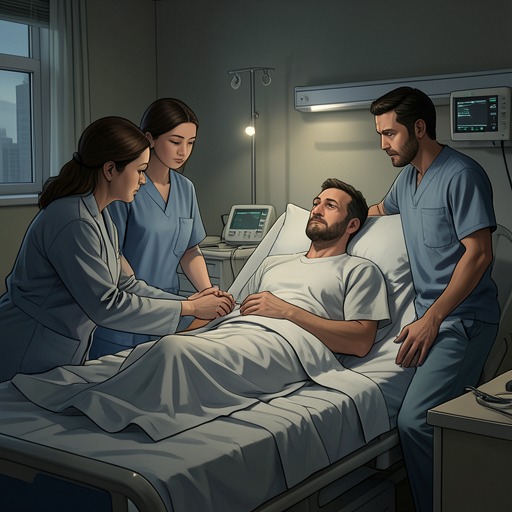
At Tokyo Station, a child passing Yuichi Kimura reminds him of his six-year-old son. Kimura pictures Wataru unconscious and unresponsive in a hospital bed. The image leaves him feeling emptied out; his anger at the person who pushed Wataru from a department-store roof is bound to the immediate reality of a child who cannot respond or protect himself. Kimura’s grief is not abstract: he is trying to reach the person he holds responsible while Wataru remains in the hospital.
Akiko Kimura’s reaction gives the family’s experience another dimension. When she sees Wataru, she remarks that he looks as if he is sleeping and wonders whether he might hear what the family says around him. This is her hope and impression, not confirmation that Wataru is conscious. The distinction matters: outward appearance offers his family a reason to imagine awareness, while the account identifies him as unresponsive and supplies no evidence that he can hear them.
The condition also entails dependence on medical equipment. The Prince identifies the hospital as the one in Tokyo where Wataru is being treated and threatens to use an accomplice to interfere with the machine supporting him. He claims the accomplice formerly worked for a medical-equipment company and would know how to tamper with the respirator. The threat makes clear that Wataru’s care depends not only on his condition and the hospital, but, in the Prince’s scheme, on the continued functioning of equipment that an outsider might target.
The Condition as Leverage
The Prince uses Wataru’s dependence to pressure Kimura aboard the train. He says an accomplice is waiting near the hospital and will act if the Prince gives the signal. The arrangement is tied to calls expected as the train reaches Omiya, Sendai, and Morioka: the accomplice is to check whether the Prince is safe, and a missed response can be treated as authorization to interfere with Wataru’s life-support equipment. The Prince adds another trigger: if the accomplice calls and the phone rings more than ten times without an answer, the accomplice is to go to the hospital and tamper with the respirator.
These conditions give Kimura little reassurance. The Prince says that he can also choose not to answer, leave the train at Omiya, turn off his phone, and allow the accomplice to interpret the silence as the signal. The threat therefore converts ordinary uncertainty—whether a call will connect, whether the Prince will answer, or where he will be—into danger for Wataru. Kimura points out that train tunnels may interrupt service; the Prince replies that antennas have been installed in tunnels, but still leaves the possibility of a lost connection hanging over him. What matters is not whether every contingency is technically certain, but that the Prince has arranged them so that Kimura cannot safely treat silence as harmless.
The threat is conditional rather than a report that the equipment has already been tampered with. The passages establish an accomplice, the alleged medical-equipment experience, the proposed signals, and the respirator as the target. They do not establish that the accomplice reaches Wataru, that the machine is disrupted, or that Wataru’s condition changes as a result. The distinction preserves the scene’s suspense: the Prince makes the possibility of an attack a tool of control before any such attack is confirmed.
Family Response and Vulnerability
For Kimura, Wataru’s unconsciousness makes the threat especially effective because his son cannot participate in the confrontation or report what is happening to him. Kimura can resist the Prince in person, but he cannot directly protect Wataru while separated from the hospital. The Prince exploits that distance, turning Kimura’s concern for his son into a means of dictating his conduct on the train.
The family’s uncertainty is equally important. Akiko Kimura’s impression that Wataru looks asleep sustains the possibility that he might hear the family, but it does not resolve what he experiences. The account gives no access to Wataru’s thoughts and does not translate his silence into consent, understanding, or recovery. His condition is presented through the reactions of those who care for him and the practical dependence on hospital equipment, rather than through an invented account of his inner life.
Narrative Significance and Limits
Wataru’s condition extends the conflict beyond the train carriage. The hospital becomes a second site of danger, even though Wataru is not present in the confrontation: the Prince’s calls and the accomplice’s proximity make his care part of the struggle between the two men. The respirator is therefore more than a medical detail in the threat. Its continued operation stands between Kimura and the possibility that the Prince’s coercion could reach his son.
The book also places this threat amid a wider pattern in which fear can make people feel unable to act. Kimura recalls the idea of learned helplessness when considering students who have repeatedly seen the Prince punish others and have come to believe they cannot oppose him. That reflection concerns the students, not Wataru, and the evidence does not say that Wataru shares their psychological state. The connection is instead structural: in both situations, the Prince’s power works by making another person’s suffering seem to depend on choices he controls. In Wataru’s case, the leverage is his reliance on life-support equipment and Kimura’s inability to be in two places at once.
These passages leave Wataru’s medical outcome unresolved. They establish the severity of his dependence, his family’s distress, and the danger the Prince attaches to his care, but provide no later medical update. His condition remains both a real emergency for his family and the pressure point through which the Prince attempts to govern Kimura’s actions.