Yuichi Kimura
Bullet TrainYuichi Kimura is a father driven onto the Hayate by the thought of his unconscious son, Wataru, and by the conviction that the person who put him there cannot be allowed to walk free. His effort to act on that conviction becomes another danger rather than a rescue: the Prince anticipates Kimura’s approach, takes his gun, and binds him. Kimura’s trajectory joins private grief to a wider pattern of violence, while memories of his childhood and his father’s former work illuminate the family history behind his own choices.
Identity and Background
Kimura is Wataru’s father. When he sees a child at Tokyo Station, the sight brings Wataru sharply to mind: his six-year-old boy lies unconscious and unresponsive in a hospital bed. Kimura also recalls his mother’s anguished response to seeing Wataru, who looked so much like he was sleeping that she wondered whether he might still hear what the family said around him. For Kimura, this image is not comforting. It leaves him feeling hollowed out.
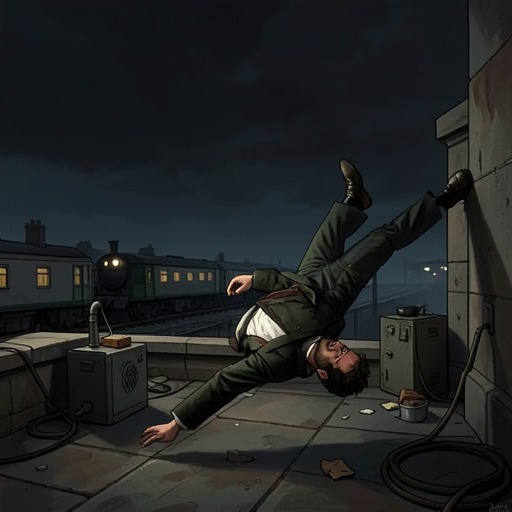
The immediate cause of his journey is Wataru’s fall from a department-store roof. Kimura believes the person who pushed his son remains at large, and his thoughts turn from sorrow to rage. He frames the situation as a breach in the world’s moral order: if someone can push a young child from a roof and continue living without consequence, something has gone badly wrong. That conviction is the emotional fuel for his actions, but it does not protect him from acting under pressure.
The Hayate and the Trap
At Tokyo Station, Kimura boards the Hayate carrying a gun in his coat pocket and a paper bag. He has information from former associates about where his target is sitting: the three-seat side of the fifth row in car seven. He intends to approach from the next car and come up behind the target. His plan is methodical in its imagined simplicity, a sequence of small, controlled steps. Yet his own body gives away the strain. At a mirror in the gangway, he notices his unkempt hair and rough appearance; while washing his hands, he finds them trembling and tells himself the cause is nerves, not alcohol.
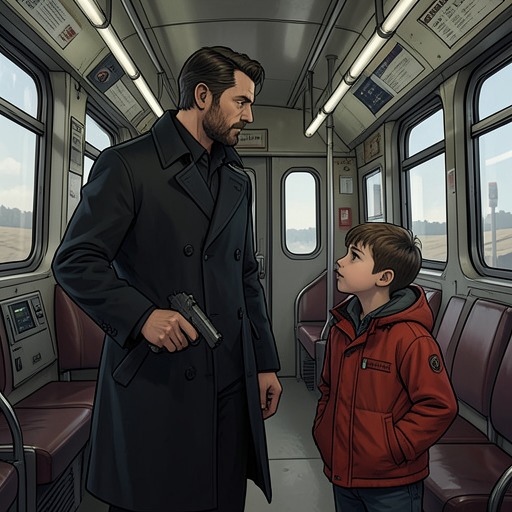
The encounter turns against him. By the time the Prince speaks to him aboard the train, Kimura is restrained with tape and unable to move freely. The Prince has taken Kimura’s gun and keeps it close between them, out of sight of the other passengers. He tells Kimura that he will regret it if he does not listen to the story through to the end. The warning settles Kimura after his initial struggle, but it also makes clear how completely the Prince controls the immediate situation.
The Prince presents the meeting as a trap that Kimura should have recognized. He points to the suspicious ease with which Kimura learned where he was sitting, and to the improbability of the Prince travelling alone. The contrast is stark: Kimura came intending to act from behind, believing that information and a steady approach gave him an opening; the Prince has already turned those conditions into instruments of control. The Prince regards adults and schoolchildren alike as predictable, and sees Kimura as an especially boring example of human behaviour. Kimura’s personal urgency does not make him inscrutable to his opponent.
Family Memory and Dangerous Work
While bound, Kimura remembers a childhood scene in which a man had been tied up in his family home. His father, Shigeru Kimura, and his mother laughed as the man challenged them to watch him escape; kindergarten-age Kimura joined in. The man was a younger former coworker of his father who still visited, seemed sincere and dashing to the child, and looked up to Shigeru Kimura as a mentor. The two men shared the first name Shigeru. Their conversations over drinks had also let young Kimura glimpse that adults had problems of their own and were not invariably as strong as they appeared.
The remembered escape attempt has a particular force in the present. The bound man had been imitating an escape artist on television and claimed he could get free. Kimura looked back at the television, and in the moments when he was not watching, the man untied the rope. Now Kimura is the one immobilized, trying to find a way out of heavy straps and duct tape. The old scene returns not as a guarantee that he can escape, but as a memory of a trick whose crucial work happened while the observers were looking elsewhere.
Kimura’s own work also links him to his father’s past. Shigeru Kimura had left a line of work that exposed him to people whose intentions he found repellent. He later learned that Yuichi had taken up the same kind of work. The news worried him enough that he considered following his son to keep watch. A former associate was also aware that Yuichi had entered that line and said he had helped him out of trouble several times. The family resemblance is therefore more than a likeness in temperament: it carries a practical history of risky work and rescue. Shigeru Kimura hopes the pattern will not extend to Wataru.
Relationships and Consequences
Kimura’s decisions are shaped above all by his relationship with Wataru. His son’s condition makes the journey to the Hayate feel urgent and morally necessary to him, but it also narrows his attention to the person he holds responsible. At home, his parents are left to imagine why he has gone. Shigeru Kimura worries about Wataru and wonders why Yuichi would leave the boy to board a Shinkansen; he considers whether his son might be coming to see them, then entertains the darker possibility that Yuichi has become tired of caring for Wataru and run away. Those fears show how little his family knows about the immediate crisis as it unfolds.
The journey leaves Kimura critically exposed to the train’s violence. Two months after the Shinkansen events, investigators discover him in a toilet, still alive. He is taken to hospital, where his condition is stabilized, but there is no further reporting about his case. The public account does not explain his part in the events or reveal what happened to the schoolchild and the older couple seen with him. His survival is thus confirmed, while the larger circumstances of his ordeal remain obscured.
Change and Narrative Role
Kimura begins this episode believing that he can convert grief into a direct act of justice: find the person responsible for Wataru’s fall and make him answer for it. The plan’s failure exposes the distance between moral certainty and practical control. He is not simply stopped by force; the Prince has read the circumstances of his approach and uses them to make Kimura listen while bound. Kimura’s determination remains clear, but determination alone cannot undo the trap or the wider dangers on the train.
His story also places the family’s history beside its present emergency. As a child, he watched an adult escape his father’s ropes; as a grown man, he is bound while trying to reach someone he believes must be confronted. Meanwhile, his father recognizes in Yuichi a return to the dangerous work he had abandoned and fears that Wataru could inherit the same pattern. Kimura’s survival keeps open the possibility of a reckoning, but the available account gives no resolution to his recovery, his intentions afterward, or the effects of the train journey on his family.