Yuichi–Wataru father–son relationship
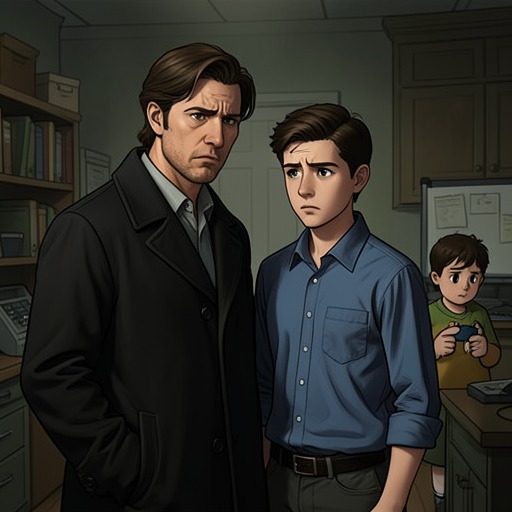
Bullet TrainThe Yuichi–Wataru father–son relationship links a father’s dangerous past to his determination that his son should not inherit its consequences. Yuichi’s concern is explicit when he turns from the danger facing himself and Akiko Kimura to Wataru’s safety. Elsewhere, he recognizes a family resemblance in his own path and hopes it will end with him rather than continue through his son and grandson. The relationship is therefore marked both by care for Wataru and by anxiety about what a son may inherit from his father.
Family Inheritance and the Wish to Stop the Pattern
Yuichi’s connection to Wataru emerges within a longer family pattern. In a conversation with Shigeru Kimura, Shigeru notes that Yuichi also entered the same line of work as his father. Yuichi reacts with rueful recognition: like father, like son. His reflection immediately turns to Wataru. Whatever the work has meant for the older generations, Yuichi thinks, it has to stop with Wataru; he hopes there will not be a similar repetition with his grandson. The thought makes the relationship more than a matter of kinship: Wataru represents the point at which Yuichi wants the family’s inherited pattern to end.
Shigeru’s account adds another dimension to that inheritance. He tells Yuichi that he had saved his skin several times, recalling the younger man’s past mistakes with some reluctance. The exchange places Yuichi in the position of a son who once needed protection from an older man, while his own attention is now fixed on protecting Wataru. It does not establish that Wataru has followed Yuichi into the same work; rather, Yuichi’s hope that the pattern will stop with him shows how strongly he fears that possibility.
Wataru as the Focus of Yuichi’s Concern
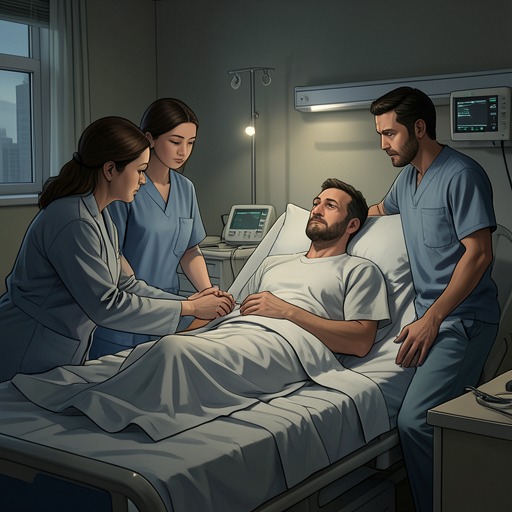
When Akiko asks whether the old gun can still be used after thirty years, Yuichi redirects the conversation to Wataru: he is more worried about his son. Wataru is in the hospital, and Akiko initially reasons that there is no obvious cause for danger there. Yuichi nevertheless raises a possibility she had not considered: someone who holds a grudge against them from the past might try to take revenge through Wataru. His concern is not presented as knowledge of a specific threat, but as an apprehension about what their own history could bring down on their child.
Akiko’s response changes the scale of the danger. Thirty years have passed, and she and Shigeru are now senior citizens; someone once frightened of them might believe the intervening years have made this an opportunity to strike. Shigeru rejects that assumption, insisting that he and Akiko remain as dangerous as before, even as he acknowledges how much they have doted on Wataru in recent years. Their exchange frames Wataru’s vulnerability against the older couple’s determination to defend him. Yuichi’s worry, voiced first, anticipates the possibility that a conflict from the parents’ past could reach the hospitalized son.
A Threat Used to Wound the Family
Later, an adversarial boy tries to break the family’s composure with a claim about Yuichi. After Akiko explains that the boy had tried to hurt their grandson and would not be allowed an easy death, he abandons his earlier stratagems and makes one last desperate attack: he says Yuichi is dead on a bathroom floor and invokes Yuichi’s alcoholism to call the family weak. The statement is a taunt intended to cause distress, not a confirmed report of Yuichi’s death.
The tactic works briefly on Yuichi’s father: Kimura feels anxiety rise, despite recognizing that the boy wants precisely that reaction. Akiko counters the threat by insisting that Yuichi is tough and that concern for Wataru would keep him from giving in. Kimura accepts her reasoning and reinforces it with an image of Yuichi surviving even a giant shoe stomping on him. The exchange shows the family’s confidence in Yuichi as a source of endurance, but it does not independently establish his condition or confirm Wataru’s safety.
Protection Across Generations
The relationship is shown chiefly through the adults’ concern for Wataru; these scenes do not provide Wataru’s own account of his father. Yuichi’s worry about a possible revenge attack, his wish to prevent a family pattern from passing to his son, and Akiko’s use of Wataru as a reason to believe Yuichi will survive all make the next generation the emotional stake in the family’s danger. Protection moves in both directions across the generations: Yuichi fears for Wataru, while the family believes Wataru’s presence gives Yuichi a reason to endure. That reciprocity is powerful, but the scenes leave the immediate outcomes unresolved.