Andrews joins Miller’s hunting expedition
Butcher's CrossingAndrews joins Miller’s hunting expedition as a paying partner, committing nearly half his savings to a journey whose apparent purpose is profit and whose deeper appeal is the wilderness itself. The decision sets the novel’s central expedition in motion: Miller offers a route to the last great bison herds, but his insistence on killing until none remain turns the prospect of adventure into a campaign of destruction. The expedition will succeed at accumulating hides and fail at making them valuable, leaving Andrews with an experience that cannot be reduced to the promised return.
A vanishing resource and a wilderness ideal
When Andrews first learns how the local trade works, J. D. McDonald describes a business that buys, processes, and wholesales bison hides in Saint Louis. He says he handled nearly one hundred thousand hides the previous year and expects two or three times as many this year. The scale of that business makes Miller’s account of the changing landscape more than a hunter’s complaint: four years earlier, he recalls, the spring plains had been black with bison for miles, and a fortnight’s hunting could yield a thousand or even fifteen hundred animals. Now a successful hunt brings only two or three hundred, and Miller expects Kansas to be hunted out within another year or two.
The opening pages set this ambition against a language of nature as spiritual consolation. Later, Andrews recognizes that the freedom he once felt outdoors had drawn him west from the confines of college life. His excitement at Miller’s proposal therefore joins a material calculation to a personal longing: the hunt offers both a share in a profitable enterprise and entry into a landscape he has imagined as a place of revelation. The tension is already present in the plan. The wilderness is sought as an experience, while the bison within it are counted as inventory.
The bargain and the expedition’s design
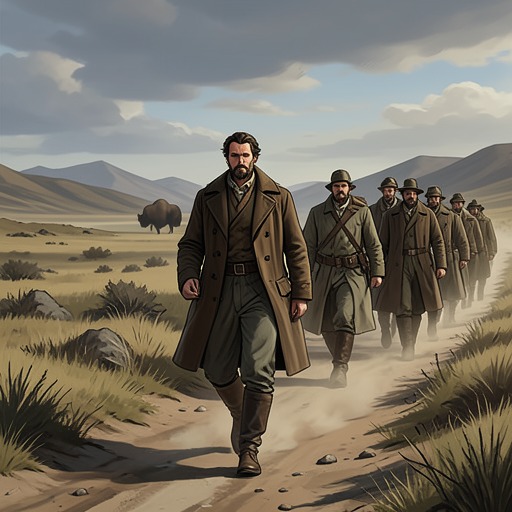
Miller does not propose an ordinary trading expedition. He wants a small party that will let him hunt as he chooses and keep other hunters from interfering. He estimates that four men can manage the work: himself as the hunter, two skinners, and one man to tend camp. Fewer participants, he explains, mean more profit for each. Andrews’s interest sharpens as he hears the plan, but Miller makes clear that the hunt remains his; Andrews’s role is to supply the money for transport and provisions.
The initial budget is five or six hundred dollars, almost half of Andrews’s savings. The supplies include a wagon and oxen, a rifle for Andrews, a ton of lead, five hundred pounds of gunpowder, food for the journey, cookware, utensils, and some hay for the horses. Miller favors oxen over mules because they can graze along the way and pull heavy loads, even if they travel slowly. He estimates that a good wagon could carry close to a thousand hides, worth about twenty-five hundred dollars. Under their agreement, Miller receives sixty percent and Andrews forty; Miller says his larger share reflects his ownership of the hunt and his responsibility for Charley Hoge, while Andrews will pay the other skinner.
Miller’s estimate depends on more than the number of animals killed. He expects that, if the hunt is large, some hides can be left behind over winter and collected in spring. He also expects Andrews to resell the wagon and team for approximately their purchase price. The forecast makes the enterprise sound recoverable at every stage: equipment can be resold, hides stored, and a remote herd converted into cash. Its optimism rests on a chain of assumptions about labor, transport, and demand that the men cannot control equally.
Recruitment, transport, and the promised market
The party’s terms take shape around a prospective buyer as well as a prospective hunt. On his return from the river, Miller tells the others that McDonald will buy their hides, sparing them the longer haul to Ellsworth. Miller says McDonald has an eastern buyer and will pay four dollars apiece for winter hides. Fred Schneider questions the delay before those hides can be sold and presses for a secure wage rather than a share of the proceeds. He agrees to join for sixty dollars a month from departure until the party’s return, fifteen dollars above his usual pay. His decision gives the venture an experienced skinner while placing his compensation outside the speculative bargain Andrews accepts.
Departure is not immediate. The wagon needs repairs and two oxen must be shod; Miller expects the party to leave in three or four days. He says the days are long, the road toward the mountains is mostly level, and water is available along the way. His assurance that the route is already arranged contrasts with the uncertainty embedded in the undertaking: Andrews finances the provisions and transport, while Miller controls the hunt and its destination. Hoge objects that the country is the devil’s land, a response Miller connects to the loss of Hoge’s hand in the Rocky Mountains. The expedition thus begins with unequal kinds of exposure: Andrews risks savings, Schneider bargains for wages, Hoge carries an earlier injury, and Miller claims authority over the enterprise.
Slaughter, market reversal, and significance
The expedition’s later scenes show what Miller’s plan means on the ground. In the valley, Schneider and Andrews struggle to skin the animals Miller kills, working into the evening and rising before dawn to cut up carcasses stiffened overnight. The rifle’s repeated report becomes part of their laboring days. As the herd dwindles, Andrews realizes that he has measured time by the number of bison remaining rather than by days passing. He has also lost the surrounding world in memory: the route across the plains and Butcher’s Crossing seem distant and dreamlike beside the valley that has come to define his experience.
That transformation is inseparable from the scale of the killing. Miller recalls that only five or six years earlier, bison bones covered the country from Pawnee Fork to the end of the Smoky Hill River. He kicks a rib from a skeleton as he describes what the Kansas hunts have done, and warns that farmers may eventually haul the bones away as fertilizer. In the valley, Andrews sees the same violence advance toward its logical end: bodies cover the ground, and the surviving animals graze among them. He understands that Miller will not leave while even one bison remains alive.
The financial promise collapses after the party returns. Miller insists that three thousand prime winter hides are waiting in the mountains and values them at more than ten thousand dollars even after transport costs. McDonald, however, tells him that demand has disappeared: buyers who wanted bison furs have already bought them, just as fashion once turned away from beaver pelts. The railroad has not rescued the hide trade. Its tracks are being laid fifty miles north, and hunters are selling bison meat to the railroad company while leaving hides to rot in the sun. The expedition’s commercial success in killing and collecting therefore coincides with the loss of the market on which its calculations depended. Andrews’s decision to join Miller leads not to the secure profit promised by the original bargain but to a reckoning with both the destruction of the herd and the fragility of the value assigned to it.