Andrews’s reunion with Francine
Butcher's CrossingWill Andrews’s reunion with Francine is both a return to a person he had left in shame and a temporary withdrawal from the world he has come back to. Their meeting begins with news that Francine is still in town but packing to leave, and it develops into an attempt to name what happened between them before his departure. The reunion does not resolve the larger uncertainty of Andrews’s life; instead, it confines him for five days and nights to a dim room where intimacy, silence, and the suspension of ordinary time become the substance of his return.
The Search and the Threshold
Soon after arriving, Andrews learns that Francine remains nearby. When the woman at the table rises to leave, he asks whether a girl named Francine is still around. She is, the woman says, though she has been packing for several days and will not stay much longer. Andrews declines an offer to have her brought down, saying that he will see her later. His decision makes the meeting his own undertaking rather than an encounter arranged for him, and the news that Francine may soon depart gives that choice an immediate urgency.
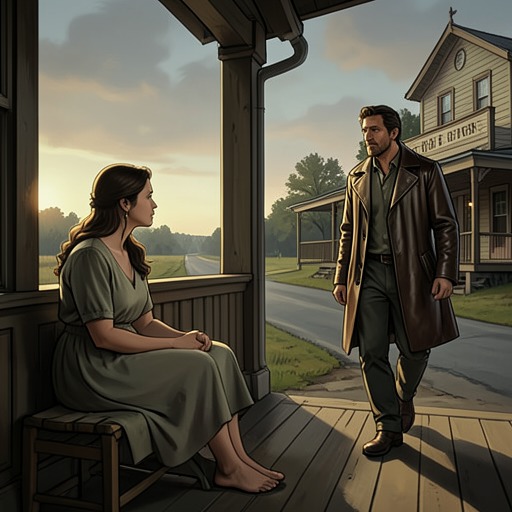
When he eventually goes to her, the approach becomes a drawn-out struggle of hesitation. He passes the stairs, reaches the sidewalk, turns, and only then understands that he has decided to climb them. His legs weaken; his arms hang at his sides. He stands still before one foot finally rises to the first step. At the top he pauses again, breathes the warm village fog, finds the latch, and enters. In the dark, he follows a wall past two doorways before reaching a third, marked by a narrow line of yellow light. He listens, waits, knocks twice, and remains rigid as the door opens and Francine appears against the lamp. The slow, physical progress to her threshold gives the reunion the quality of an ordeal: Andrews reaches her only after moving through uncertainty one small action at a time.
Recognition and the Old Shame
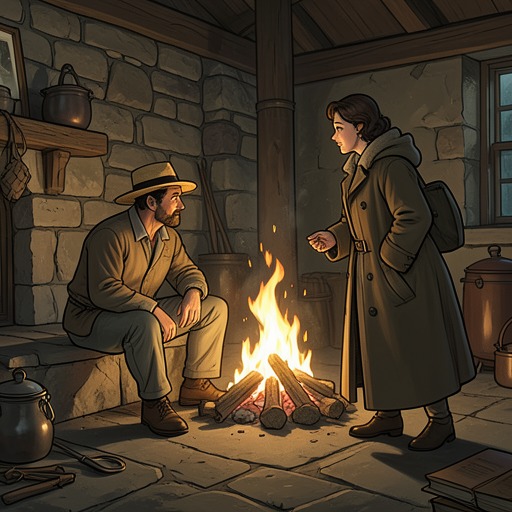
Francine recognizes him by name only after a long moment. She tells Andrews that she thought he was dead, as did everyone else. Her words reveal the cost of his absence to the people who remained behind: throughout the winter, she had believed he had not survived. Andrews, embarrassed, shifts his weight rather than meeting her with easy confidence. He explains that he has returned only hours earlier and wanted to see her, an explanation that makes the visit less a casual stop than a delayed obligation he has carried back from the expedition.
The conversation turns to the night he left her. Andrews says that, while trapped by snow through the winter, he kept thinking about the way he had gone. He wants Francine to understand that she had nothing to do with his decision: he had acted alone. Francine already understands his departure as an expression of shame, and she tries to reduce its weight by telling him that what happened was not important and could happen to a young man the first time. Andrews recalls that she had called him very young. Their exchange gives the reunion its emotional center. He does not blame her or ask her to excuse him; he tries to make clear that he had wrongly carried his humiliation away as if it were her responsibility. Her response treats the old wound gently, while his insistence that he acted alone shows how long he has continued to revisit it.
The Invitation to Stay
At first, Andrews seems ready to leave after saying what he came to say. He breaks off before finishing his thought and starts toward the door. Francine asks him not to leave again. He stops and promises that this time he will stay, apologizing for making her ask and saying that he wants to remain. Her request changes the encounter from a visit organized around his need to explain himself into a choice about what he will do now. Francine recalls that she thought he was dead, but does not complete the thought; she asks him simply to stay with her for a while and tells him that what exists between them is not like what she has with everyone else.
They pause without approaching one another. Andrews senses that something has changed, and Francine confirms it, though she says she is glad he has returned. She turns to the lamp, lowers its wick, studies his face, and blows it out. The narration follows the sounds and movements in the dark: Francine crossing toward the window, the covers shifting, her body settling on the bed, and Andrews unbuttoning his shirt as he crosses the room toward her. The scene’s intimacy is conveyed through this sequence of gestures rather than through a declaration. The extinguished lamp also marks a passage from the spoken effort to repair their past to a physical closeness neither needs to explain in the moment.
Five Days in Half-Light
After their first night together, Andrews loses track of time. For five days and five nights he remains in the small room with Francine, leaving only to eat and drink or to buy clothing from the few garments still available at Bradley’s cloth store. The room’s single window stays veiled by a curtain; morning and afternoon become difficult to distinguish, and the lamp makes night and day hard to tell apart. This enclosed routine recalls the snowbound shelter of bison hides where Andrews spent the winter in the mountains. In both places, isolation interrupts ordinary time, though the room with Francine offers bodily warmth where the mountain refuge had been defined by snow and confinement.
Andrews speaks rarely. He and Francine communicate chiefly through embraces, heavy breathing, and inarticulate cries, until he becomes convinced that his whole existence is concentrated within the room. Beyond its four walls he can imagine only a threatening void of light and noise. Even the furnishings—the red sofa, the rug, and the objects scattered across the tables—seem capable of disturbing the ease he has found in the semidarkness. Naked beside Francine’s inert body, he closes his eyes and feels weightless; sensations from deep sleep sometimes return while he is awake. The reunion thus becomes more than a conversation about an old departure: it suspends Andrews in a private, twilight world whose intensity depends on keeping the outside at bay. Its duration and enclosure offer temporary absorption, not evidence that his wider estrangement has been settled.