Bison hides
Butcher's CrossingBison hides are both the material record of the hunt and the hoped-for reward that drives it. First treated as a valuable product moving from the prairie through processors and buyers to eastern markets, they become an enormous, precarious burden: accumulated through months of killing, stranded by transport, rendered nearly worthless by a change in demand, and ultimately burned by Miller. Their changing value makes visible the distance between taking a resource and being able to profit from it.
Commodity and Market
J.D. McDonald describes the hides as the basis of his business: hunters bring them to him, he buys and resells them wholesale in Saint Louis, and he tans them himself. He says he processed nearly one hundred thousand the previous year and expects two or three times as many in the current one. The figures make the trade appear to be expanding rapidly, while his piles of paperwork and need for help reveal the work required to handle that volume.
Miller distinguishes his own hunting from J.D. McDonald’s system of organizing expeditions. J.D. McDonald pays fifty cents for a raw summer hide, which Miller describes as little thicker than a strip of leather, and has thirty or forty expeditions operating around the country. Miller says he hunts independently or not at all. The contrast is not simply between two hunters: the hides pass through an organized purchasing and resale network, while Miller insists on controlling his own work and share of its returns.
Their commercial value also varies by season. Miller proposes that J.D. McDonald buy the expedition’s hides so the hunters will not have to haul them to Ellsworth. J.D. McDonald has an eastern buyer and offers four dollars apiece for winter hides, a price that gives the expedition a concrete financial objective. At the time, the hunters expect the winter pelts to make their work and the difficult journey profitable.
That expectation fails when the market changes. On returning, Miller says that more than three thousand winter hides are waiting in the mountains and values them at over ten thousand dollars even after transport costs. J.D. McDonald explains that buyers no longer want bison fur: those who wanted one have apparently already bought it. He compares the change to the decline in demand for beaver pelts after beaver hats went out of fashion. The price collapse is not caused by a sudden change in the hides themselves, but by a shift in distant consumers’ tastes. He predicts that the hides may eventually be worth only thirty or forty cents apiece, like summer hides.
Accumulation and the Hunt
The hides’ growing quantity is inseparable from the destruction that produces them. Miller recalls that, four years earlier, the Kansas plains had been black with bison, and that hunters could take a thousand or fifteen hundred in two weeks. By the time he speaks, the animals move in small herds and a successful hunt may yield only two or three hundred; he expects Kansas to be exhausted within another year or two. The hides therefore register a short-lived abundance even as their production accelerates the disappearance of the animals.
The remains of earlier hunts extend beyond the pelts. Miller points to a bison skeleton and recalls mountains of bones stretching from Pawnee Fork to the end of Smoky Hill, a landscape he says hunters could ride through only five or six years earlier. He expects even the remaining bones to be gathered by farmers for fertilizer. His account of bones used for needles, knives, arrow points, necklaces, toys, and combs contrasts these varied uses with the prospect of reducing them to manure. The hides belong to the same history of extraction, but they are the part of the dead animal most visibly drawn into a commercial chain.
In the valley, the work of turning kills into hides gives the slaughter its exhausting daily rhythm. Fred Schneider and William Andrews struggle to skin the animals Miller leaves behind; they work into the evening and rise before dawn to cut into frozen carcasses. As the herd thins, William Andrews recognizes that Miller will not leave while any bison remain. The growing pile of hides thus measures not only the expedition’s prospective earnings but also the pursuit’s relentless objective: the removal of the entire herd.
The Mountain Stockpile and Its Loss
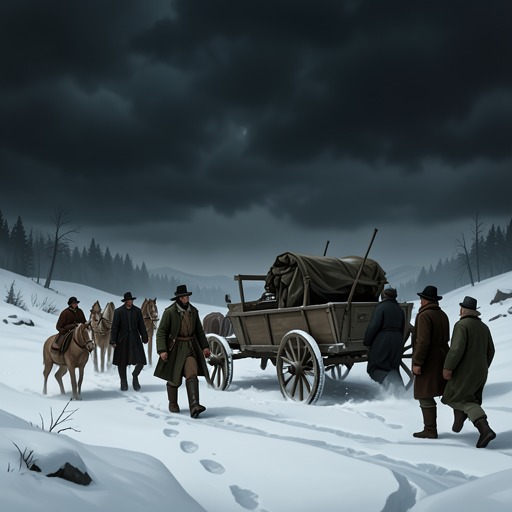
When the expedition prepares to leave the valley, its accumulated hides become a physical problem. The men load eighteen large bales onto the wagon, arranging six in the bed, six above them, and six more at Miller’s insistence. The stack rises above the seat and extends dangerously beyond the wagon’s sides. Fred Schneider warns that the overloaded vehicle may overturn or break an axle; Miller replies that they can keep it upright and says he wants to return to Butcher’s Crossing with a load that will impress everyone.
After the load is tied down, about forty bales remain on the ground. Miller estimates that the expedition is taking roughly fifteen hundred hides and leaving more than three thousand, for a total of about forty-six or forty-seven hundred. If prices hold, he calculates, the whole stock will be worth more than eighteen thousand dollars, with William Andrews’s share exceeding seven thousand. Those estimates turn the hides into a promise of future wealth, but the promise already depends on two uncertainties: the prices holding and the men being able to move the remaining stock out of the mountains.
They leave the remaining bales where they are, without hiding them among the trees, and Charley Hoge scatters their remaining strychnine over them to deter pests. The loaded wagon’s passage cuts deep parallel tracks through the soft ground. At the pass, William Andrews looks back at the valley, where fresh grass makes a pale haze over the ground, and sees the place of the hunt receding behind the precarious cargo. The hides that were supposed to convert the winter’s labor into money are now stacked high enough to endanger the journey.
The spring river crossing destroys that loaded cargo. A collision involving the wagon and a tree trunk drives the wagon against the rocks and overturns it. The harness breaks; the bison hides burst in every direction and are swept downstream with the wagon. For about a minute, the men on shore can see the wreck and the oxen struggling in the current, and then both disappear. The hides’ commercial value is lost in the same catastrophe that kills Fred Schneider and carries away the expedition’s equipment and animals. Their weight, so carefully accumulated and dangerously loaded, offers no protection against the river.
Worthless Pelts and Destruction
The return to Butcher’s Crossing brings a second collapse, this time of value rather than cargo. Miller insists that the expedition has more than three thousand first-rate winter hides stored in the mountains and reminds J.D. McDonald of their agreement at four dollars each. But the market has changed during their absence. The hides may still exist, and may still be physically sound, yet the buyers’ lack of interest makes the anticipated revenue unrealizable. J.D. McDonald’s account of the market reverses Miller’s calculations: a stock once valued at more than ten thousand dollars now has no assured buyer at the agreed price.
The railroad’s arrival does not restore that value. J.D. McDonald says the tracks are being laid fifty miles to the north, but the hunters are selling bison meat to the railroad company and leaving the hides to rot where they skinned the animals. The contrast exposes a different use for the dead bison: meat has found a nearby customer, while the hides that shaped the expedition’s economic purpose have become unwanted. The hunters’ failure to sell the pelts is not evidence that the bison were not killed or that their bodies lacked uses; it is evidence that the trade depends on demand and transport as much as on the hunt.
Miller’s final response is to burn the hides. He pushes bales toward the fire with his horse, then uses the horse to set a loaded wagon moving and steers it toward the blaze before releasing the rope, sending the wagon and its pelts into the flames. He continues loading and driving wagons into the fire for nearly an hour. J.D. McDonald protests that the hides belonged to him, even if they were worth nothing. His objection separates ownership from market value: the pelts have lost their price, but not their status as his property.
The burning reverses the hides’ earlier function. They had been gathered to turn slaughter into wealth, counted by the thousand and stacked into loads meant to impress the town. Now Miller destroys them deliberately, while the crowd watches and the fire grows higher. The bison hides end not as payment for the hunt but as fuel in a public act of refusal. Their trajectory—from living animals on the plains, to processed goods and mountain stockpiles, to freight lost in the river and pelts consumed by fire—connects ecological depletion to the instability of commerce, and leaves the expedition’s enormous labor without the promised return.