Butcher’s Crossing
Butcher's CrossingButcher’s Crossing is a prairie settlement whose brief prosperity rests on hunting and the sale of buffalo hides. Its few rough buildings, tents, and muddy stream crossing place it at the meeting point of an expanding commercial frontier and a landscape being rapidly depleted. The settlement first appears as a destination reached by a jolting coach; after the hunting expedition returns, it is already in decline, and William Andrews rides away as its buildings seem poised to disappear back into the grass.
Setting and Appearance
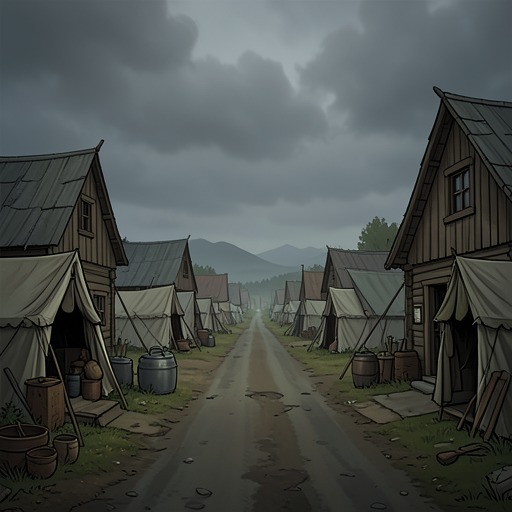
Butcher’s Crossing lies at the end of a rough road descending gently from the prairie. William Andrews arrives from Ellsworth in a passenger coach converted from a freight wagon, drawn by four mules. As the road levels near the village, the jolting eases and the wheels raise yellow dust. Around the settlement are open grassland, bare patches of earth, the blackened stumps of old campfires, and a few lame horses grazing by the roadside. The first approach presents no firm boundary between town and prairie: dust, animals, and the tracks of travel run directly into the settlement.
The village is small enough to survey almost at a glance. Six wooden shacks stand along a dirt street, with scattered tents beyond them. Among the businesses are a roughly erected gray tent advertising Joe Long-Barber and a low, nearly square cloth-doored building marked Bradley-Fabrics. The larger Jackson’s Saloon, a long, two-story structure, has a covered entrance; voices and clinking glasses carry from inside. Men seated outside watch the coach arrive. The crude signs, improvised walls, and limited number of buildings give the place the appearance of a temporary outpost rather than an established town.
The stream and its banks mark the village’s practical approaches. On his return, Andrews first sees the settlement from a rise above the water, then descends with his companions into the narrow channel. The stream is deeper than it was in autumn and runs thick with mud; the men pause in the crossing to let their horses drink. Nearby, a grove of cottonwoods is bare of its new leaves. In the late-afternoon light the buildings appear pink in places and fall into shadow in others, while a lone horse grazing outside bolts as the riders draw near.
A Settlement Built on Hides
The town’s livelihood is bound to hunting. J. D. McDonald describes the inhabitants as hunters and hard men and says that the village lives on hides. In his view, its residents use the land to survive but do not know how to make anything more of it. He contrasts them with men who plan for the future, and expects the railroad to change the settlement’s prospects. His judgment reveals both the economic basis of the place and his desire to distinguish his own commercial ambitions from the hunters around him.
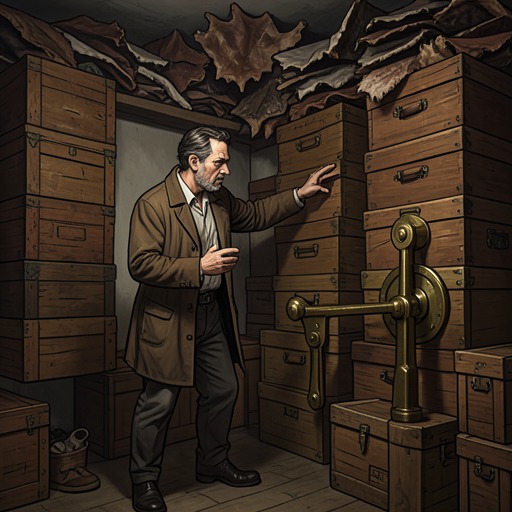
Miller’s recollection gives that economy a short, measurable history. He arrived four years earlier, the same year as McDonald, when the spring plains had been black with bison as far as he could see. A two-week hunt could then yield a thousand or fifteen hundred animals and good spring hides. By the time he speaks to Andrews, hunters are fortunate to take two or three hundred in a season, and Miller expects Kansas to have no bison left to hunt within a year or two. The settlement’s trade has generated prosperity by consuming the resource on which it depends; its success carries the conditions of its decline within it.
The prairie around the town bears the material record of that depletion. Miller points out bison bones and recalls stretches where piles of remains once extended from Pawnee Fork to the end of the Smoky Hill. He describes bones made into tools, weapons, ornaments, combs, and toys, contrasting those varied uses with the prospect that settlers will gather the remains for fertilizer. In the valley, Andrews later sees the consequences on a larger scale: the herd diminished from about five thousand animals to fewer than three hundred, with naked carcasses covering the ground. Butcher’s Crossing is therefore connected not only to the trade in hides but to a landscape transformed by the killing that supplies it.
People and Changing Routes
The settlement is also a stopping place on routes crossing the plains. During the expedition’s outward journey, the men encounter a family traveling with a failing mule and a separate group of five men bound for Colorado to claim an undeveloped mine. They also pass a riverside encampment where Native families live in makeshift shelters cut into a bluff. Children stop playing to watch the hunters pass; the adults do not return Miller’s greeting. His contemptuous dismissal of them exposes the unequal social perspective through which the hunting party reads the land and its inhabitants.
New routes and commercial uses begin to alter the region while the expedition is away. The hunters notice tracks suggesting that cattle are being driven north from Texas. Later, they see the railroad’s parallel lines crossing the plain toward the hills. Miller stops to touch the steel rails and looks toward the mountains, a gesture that registers the arrival of the change McDonald had anticipated. Yet the line does not pass through the settlement: McDonald later tells Miller that it will run fifty miles to the north. The railroad has reached the wider region without delivering the local transformation on which McDonald had staked his hopes.
Return and Decline
More than a month after leaving Butcher’s Crossing, the hunters are still in the valley. Andrews measures their return by the remaining bison and realizes that he has almost lost the outside world from memory: the mountains they crossed, the thirsty plains, and the town itself have become indistinct. When the party finally returns in late May, three men ride east along the Smoky Hill route through cold rain, mud, and then humid heat. Charley Hoge, his right wrist amputated, sits behind Miller and does not appear to recognize Andrews. The return to the settlement brings the consequences of the expedition into the same place from which it began.
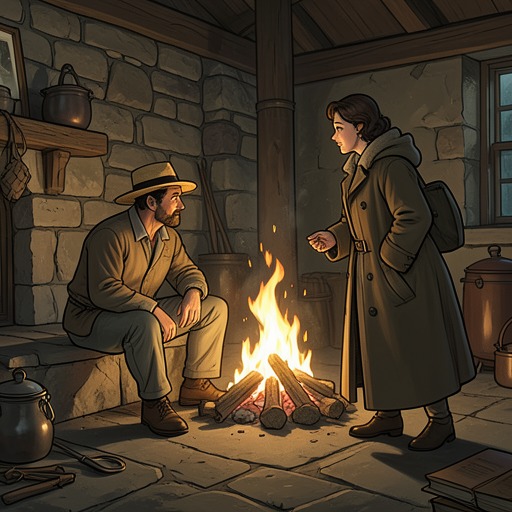
The hunters’ arrival does not restore the old economy. McDonald tells Miller that the hide market has collapsed and that the buffalo trade is finished. Their agreement cannot protect Miller’s earnings: he is seven months late, and McDonald says the money was still available at the expected time of return but is gone now. The railroad’s presence makes the reversal sharper rather than redeeming it. Hunters are selling bison meat to the railway company while leaving hides to rot where they were skinned; the commodity that once defined the town has lost its market even as another use for the slaughter emerges.
Andrews’s final departure gives the settlement a physical image of that decline. At dawn he rides past the smoldering remains of McDonald’s shack, crosses the stream, and looks back toward the town. He imagines its wooden buildings being dismantled for reusable material, its sod huts weathering away, and prairie grass gradually covering the road. In the first sunlight, the settlement already resembles a small ruin. He then turns toward the open country without knowing his destination beyond a general direction. Butcher’s Crossing begins as a cluster of buildings that can be taken in almost at one glance; it ends as a place Andrews leaves behind, with its future tending toward erasure rather than expansion.