Charley Hoge
Butcher's CrossingCharley Hoge is Miller’s one-handed teamster, a resourceful worker whose jokes and religious habits persist through the expedition’s escalating hardship. He is both a practical support to the men and a measure of what the wilderness does to them: his earlier frostbite injury shapes his fear of Colorado, while his winter disorientation and final insistence that nobody dies reveal a mind increasingly unable to distinguish memory from present reality.
Identity and Introduction
When William Andrews first meets Charley Hoge, Miller introduces him as the gray-faced man sitting across the table. Charley Hoge offers his right arm for a handshake, then abruptly thrusts forward its scarred, shriveled stump. William Andrews instinctively pulls his own hand back; Charley Hoge responds with a laugh that sounds nearly voiceless, rising like a rattle from his chest. Miller treats this as one of Charley Hoge’s habitual jokes, but the encounter establishes the bodily injury around which his history and later conduct repeatedly turn.
Charley Hoge says he lost his hand in the winter of 1862, when it froze so badly that it would have fallen away. The memory remains physically immediate: while recounting it, he shivers and trembles as though cold has returned. His injury is not merely a story he tells to unsettle a newcomer; it explains his aversion to the Colorado country and makes the expedition’s exposure to snow a personal danger as well as a general one.
The Colorado Expedition
Charley Hoge refuses to go with Miller at first, calling the country a place for the devil and insisting that it is no place for men. His account of the injury explains the refusal. He and Miller had been trapping in Colorado at the beginning of winter, on high ground before the mountains, when a blizzard separated them. Charley Hoge slipped on a rock, struck his head, and lost consciousness. When he awoke, the storm was still blowing and he could hear Miller calling for him.
Charley Hoge believes he lost a glove in the fall. His exposed hand first seemed strangely numb rather than cold; after Miller found him, they sheltered behind rocks and lit a fire with dry wood. Over the next two or three days, as the storm continued, the hand changed from a vivid blue to red, then blue-black again. The sensory sequence makes his fear concrete: Colorado is associated not with an abstract dislike of the mountains but with helplessness, prolonged exposure, and the visible transformation of his own body.
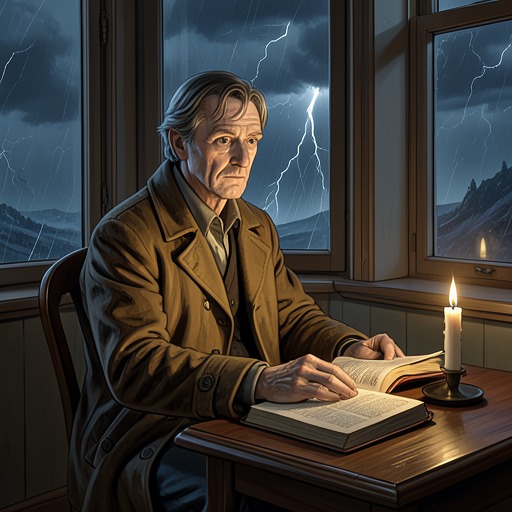
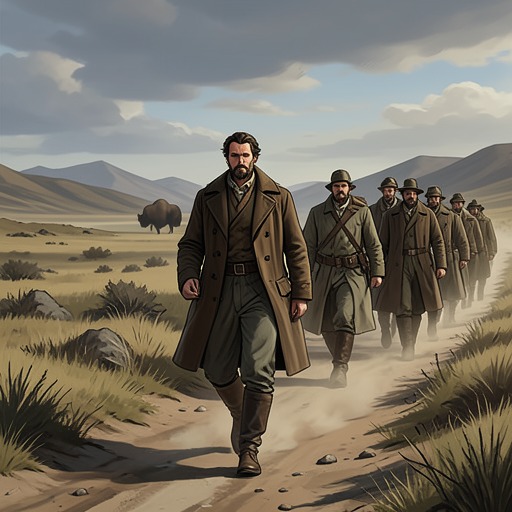
Nevertheless, Miller says Charley Hoge will come because, even with one hand, he is the best teamster Miller knows. Charley Hoge objects, but Miller assumes he will join and continues planning the party. On the journey, Charley Hoge occupies the wagon seat behind the mounted men, keeping his head raised above the animals and riders. At times he calls out in a thin, cheerful, insolent voice; at others he sings off-key, beating time with the stump of his right wrist. His sudden hymns can become so forceful that the other men turn to look at him, while he sings with his eyes narrowed and apparently withdrawn from everything around him. At night he reads his worn Bible by the dying campfire, establishing a repeated contrast between his public irreverence and private devotional routine.
Work, Injury, and the Hunt
Charley Hoge’s value to the expedition is practical as well as symbolic. When the exhausted animals reach a river, Miller orders the riders to dismount and let them go to the water. Charley Hoge is still working the wagon brake with his good hand and the elbow of his other arm; he calls for help as the locked wheels slide through the grass. William Andrews climbs onto the wagon and takes over the brake, while Charley Hoge jumps down to release the oxen before they injure themselves by continuing to pull. He moves from animal to animal, unfastening the yokes with practiced skill as the others help manage the team.
At the camp beside a small spring, Charley Hoge again takes charge of the animals and helps William Andrews pull the wagon canvas down. Together they cut pine branches, raise a frame, and secure the canvas into a small shelter. They also store the gunpowder boxes inside it. His joke that Miller would kill him if he got the powder wet lightens a task whose consequences are plainly serious: the expedition depends on keeping its supplies usable in a remote valley.
When Miller has stopped the bison and wants a new rifle, additional cartridges, and water, Charley Hoge is at camp building a cattle enclosure from small cottonwoods. He has spent the morning cutting and dragging the trees. William Andrews asks him to help with the trunks and reports Miller’s needs; Charley Hoge drops the piece of wood he has been holding against a pine with his stump and runs to the covered provisions. The moment links his labor around camp to Miller’s hunt: Charley Hoge is not the shooter, but his work sustains the expedition that makes the shooting possible.
The killing also becomes visible in the landscape Charley Hoge crosses. Miller points out the remains of a large bison and recalls when bones lay in heaps across the Kansas plains, from Pawnee Fork toward the end of the Smoky Hill. He describes those remains as evidence of what the Kansas hunts have done. Later, as Miller’s valley herd dwindles, William Andrews realizes that Miller will not leave while even one bison remains alive. Charley Hoge belongs to this machinery of hunting as driver and camp worker, even as the expedition’s increasingly brutal purpose unfolds around him.
Winter Confinement and the Bible
When snow arrives, the old injury and Charley Hoge’s earlier warning return with force. Miller finds him in the snow and urges him to move. For a moment, Charley Hoge does not seem to recognize Miller; then he accuses him of having promised that all would be well and that they would finish before the snow. Miller answers that they have plenty of time, but the reassurance cannot undo the broken promise Charley Hoge remembers. His earlier reluctance has become an explicit reproach.
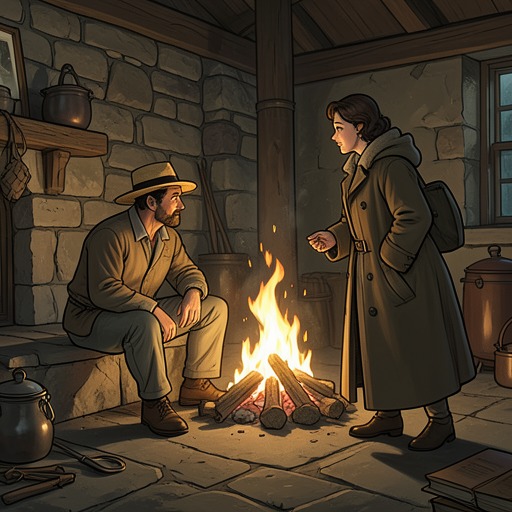
After Miller brings him toward the fire, Charley Hoge walks unsteadily along the rough path, sometimes falling to his knees and once continuing straight into untouched snow until Miller gently turns him back. At the fire he remains with his head lowered. As he warms, he looks at William Andrews, Fred Schneider, and Miller, then pushes his stump toward the flames and holds it there for a long time. The gesture recalls the hand injured by cold while showing how profoundly the snowbound camp has disoriented him: the fire offers warmth, but Charley Hoge sits staring into it as if unable to rejoin ordinary conversation or activity.
Charley Hoge gradually begins to recognize and accept the camp around him. Miller finds two gallons of whiskey among the storm-scattered remains and dispenses it to him day by day, mixed into weak coffee brewed repeatedly from used grounds. At first Charley Hoge wanders only within the broad, thawed circle between the shelter and the fire. Then he suddenly remembers his missing book and digs frantically in the snow, crying out that it is the book he needs. William Andrews eventually finds Charley Hoge’s bloodstained Bible, open and soaked, on a bed of snow and ice. Charley Hoge spends the rest of the afternoon and part of the next morning drying it page by page before returning to it during the idle days that follow.
The recovery of the Bible restores a familiar routine but does not restore easy communication. When William Andrews, frustrated by the silence and inactivity, asks him to read something, Charley Hoge looks at him angrily and says nothing. He turns back to the pages, tracing each line laboriously with his thumb. The book remains an object of concentration and solace, but Charley Hoge does not offer it as comfort to someone else. His faith is intimate and guarded, sustained through repetitive handling rather than shared explanation.
The Crossing and the Return
During the later river-crossing preparations, Miller says he will make the animals cross alone. Charley Hoge interrupts and insists that the task is his. He says he needs no horse and points to the first ox, declaring it the best way across. When Miller asks whether he is sure, Charley Hoge answers with confidence, takes his Bible from inside his shirt, and invokes the Lord’s guidance before tucking the book back beneath his belt. The decision brings together the two defining aspects of his role: the teamster’s responsibility for the animals and the faith he carries close to his body. His injured hand has not erased his sense of competence or duty.
Back in Butcher’s Crossing, the failure of the hide trade becomes clear when J.D. McDonald tells Miller that the market has collapsed. Miller protests that they had an agreement and that the men have worked themselves nearly to pieces for the hides. In this confrontation, Charley Hoge responds to McDonald’s account of hunters selling bison meat to the railroad while leaving the hides to rot in the sun: he says he killed all the gray wolves with strychnine. His remark is starkly literal amid the commercial collapse. The expedition’s labor has yielded hides without value, while even the animals that might have consumed the discarded remains have, in his account, been poisoned.
In the final encounter with William Andrews, Charley Hoge mistakes Fred Schneider for the skinner Miller found in Ellsworth. William Andrews reminds him that Fred Schneider is dead, but Charley Hoge shakes his head and answers gently that nobody dies and the Lord sees and provides. His blue, opaque eyes seem to offer William Andrews no recognition behind them. William Andrews retreats from the conversation in terror. Charley Hoge’s last appearance joins religious assurance to unmistakable cognitive loss: the faith that once accompanied work, travel, and endurance now supports a denial of death itself. Across his arc, the one-handed teamster remains capable and observant in concrete tasks, but the expedition’s injuries, winter isolation, and deaths leave him unable to hold the returning world together in memory.