Charley Hoge’s bloodstained Bible
Butcher's CrossingCharley Hoge’s bloodstained Bible is both a battered material object and a recurring point of contact between religious faith and the violence of the bison hunt. Given to Hoge by a traveling preacher, its torn pages and stain from bison blood make the consequences of that hunting life visible on the very book he turns to for spiritual guidance.
Provenance and Physical Condition
Hoge explains that a traveling preacher saved him in Kansas City and gave him the Bible. It is an inexpensive edition, worn from use, with several pages torn out. A large brown stain covers the corners of many leaves; Hoge identifies it as bison blood that fell on the book a few years earlier. The stain is accidental, but it joins the book’s religious significance to the work and violence of hunting.
A Test of Faith and Understanding
When Hoge shows the stained pages to William Andrews, he wonders whether the blood has made the book sacrilegious. Andrews reassures him that it has not. The exchange opens a channel between the men: learning that Andrews’s father was a Unitarian Church preacher, Hoge treats him as someone with whom he can discuss Scripture. He seeks him out to talk over passages, events, and doubts about interpretation.
Those conversations also expose a difference between the two men. Andrews realizes that he knows the Bible too poorly to discuss it confidently and admits that he has never read it attentively. His father had encouraged him to read Emerson, but, as Andrews recalls it, had not pressed the Bible on him. Hoge’s eyes grow clouded with suspicion, and he thereafter addresses Andrews in an evangelical rather than an equal tone. The Bible thus becomes more than a shared topic: it reveals the unequal ground beneath their attempted fellowship.
Use on the Expedition
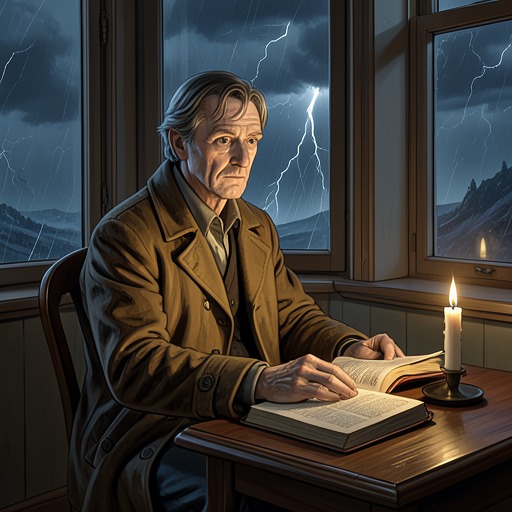
The book remains part of Hoge’s daily routine as the expedition travels. At night, after the men have been fed and the animals hobbled, he opens the dirty, worn Bible and reads silently by the dying firelight. On the wagon, when the trail runs level, he takes it out and turns its pages, squinting through his weak gray eyes in the dust. These repeated gestures place the volume within the expedition’s ordinary rhythms, alongside the physical demands of travel and the destruction of bison.
Hoge’s reading exists beside other expressions of his faith: he sometimes breaks into hymns, his voice carrying through the dust before fading for the men riding ahead. The Bible is a private object in these scenes, handled and read amid a largely indifferent landscape; the stain it bears, however, prevents it from being wholly separate from that landscape’s violence.
Material Significance
The book’s worn surface holds together what the expedition might otherwise keep apart: religious devotion and the bloody labor of killing bison. Its stain is not presented as deliberate desecration, and Andrews rejects Hoge’s fear that it has profaned the text. Yet the mark remains materially present. The Bible can offer Hoge a source of guidance and a reason to seek conversation, while its damaged pages and blood-darkened corners register the hunting world in which he carries it. Its significance lies in that unresolved coexistence, not in any simple opposition between faith and the hunt.