Charley Hoge’s psychological collapse and memory loss
Butcher's CrossingCharley Hoge’s psychological collapse and memory loss are revealed through a series of breaks between what he has lived and what he can recognize. After the blizzard, he slowly regains contact with the camp and becomes absorbed in recovering his Bible. Later, following Fred Schneider’s death, he gives the disaster a religious explanation; back in Butcher’s Crossing, he cannot remember the mountains, the hunt, or Schneider’s death. His surviving words revive the expedition’s original promise even as the people and circumstances that gave it meaning have been destroyed.
Disorientation in the snow
The collapse takes shape after the storm has buried the camp and left the men isolated in the valley. Charley Hoge first appears dazed by the trauma of finding himself amid the snow. As he begins to recognize and accept his surroundings, Miller supplies him with coffee made from repeatedly boiled grounds and small portions of whisky recovered from the scattered camp. The warmth and repeated routine help him move beyond the broad circle between the shelter and the fire, but his recovery is narrow and dependent on the camp’s fragile order.
One day Charley Hoge abruptly drops his coffee and whisky, strikes his chest, reaches inside his jacket, and runs to the large tree where he has stored his belongings. He digs frantically into the snow, repeating that he has lost his book. The search lasts nearly an hour. He repeatedly returns to the fire to warm his hand and the wrinkled, bluish stump of his right wrist, then resumes digging and whimpering in fear. William Andrews joins the search without knowing where the book is buried. When he finds it, the Bible is open and soaked, lying on snow and ice. Charley Hoge takes it with a trembling hand and spends the rest of the afternoon and part of the next morning drying its pages beside the fire. The episode gives his distress a concrete focus: amid a landscape that has erased the familiar camp, recovering one damaged object becomes an urgent means of re-establishing continuity.
The Bible and a religious explanation
In the following days, Charley Hoge fills his idle hours with weak coffee and whisky and the dirty, stained pages of the Bible. When William Andrews, strained by the silence and inactivity during Miller’s absences, asks him to read something aloud, Charley Hoge responds with anger rather than companionship. He returns to the book and laboriously follows its lines with his thumb. The Bible is therefore both a possession he has fought to recover and a private refuge that does not readily become a shared source of comfort.
That religious language becomes more forceful after Schneider dies in the river during the crossing. As William Andrews struggles to accept the loss and repeats Schneider’s name, Charley Hoge calls the dead man blasphemous. His face twitches; he blinks rapidly, closes his eyes, and clutches his stomach where he keeps the Bible. He condemns Schneider for sexual misconduct and blasphemy, then presents the death as God’s will. The account shows Charley Hoge imposing a moral pattern on a violent event that William Andrews experiences as an irreparable loss. His certainty does not repair the group’s disaster; it makes the distance between the two men’s responses unmistakable.
Return without recognition
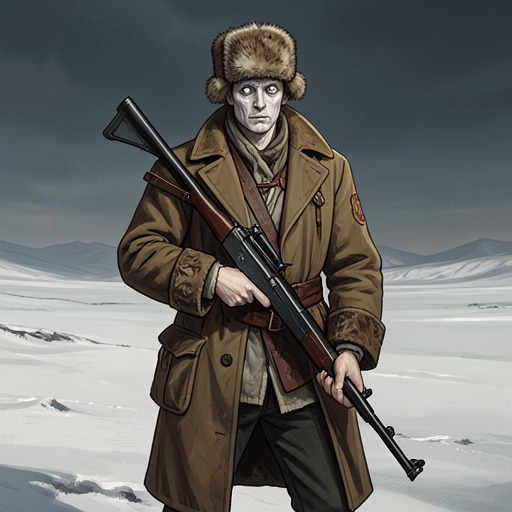
When Charley Hoge returns to Butcher’s Crossing, the damage is visible before he speaks. His cheeks are hollow, his eyes sunken and dull, his mouth slack, and his lips move soundlessly over yellow, broken teeth. The sly expression he once had is gone. His clipped grey beard and the stump of his right wrist accentuate the change, while his vacant posture beside Miller makes him seem detached from the town and from the journey that brought him back.
At a later meeting with William Andrews, Charley Hoge initially misunderstands the conversation about the hides and says that Miller is well and resting at the shack. He then identifies William Andrews only after asking his name, and begins describing a new bison hunt: Miller knows a place in Colorado and a skinner in Ellsworth, and the three of them will go together. These details reproduce the expedition’s old arrangement, but not as recollection. When William Andrews urges him to remember the mountains, the hunt, and Schneider, Charley Hoge treats Schneider as the skinner Miller found in Ellsworth. The past is not merely incomplete; its people and events have been rearranged into a prospective adventure.
William Andrews tells him plainly that Schneider is dead. Charley Hoge shakes his head and answers with gentle assurance that nobody dies and that the Lord sees and provides. Saliva gathers on his lower lip as he smiles. The confidence of the religious refrain sits beside his failure to recognize the death it is supposed to explain. William Andrews sees no sign of recognition behind Charley Hoge’s pale, opaque eyes and leaves the saloon shaken, his hands trembling and his legs weak.
Meaning of the collapse
Charley Hoge’s memory loss is conveyed less by an account of his thoughts than by the repeated mismatch between his words and the evidence before him. The lost book becomes the object of a frantic search; the recovered Bible becomes the focus of solitary, painstaking attention; after Schneider’s death, the Bible supports a judgment that cannot accommodate William Andrews’s grief. Finally, the promise of another hunt returns as if the blizzard, the crossing, and the death had never occurred. His repeated religious assurance persists, but its repetition no longer demonstrates understanding of the circumstances around him.
The contrast with William Andrews’s earlier responses to the valley’s immensity sharpens the loss. William Andrews had once looked at the horizon and the vast pine forest with awe, allowing their scale to unsettle his sense of measure and identity. In the storm, the familiar valley itself becomes unrecognizable beneath the snow. Charley Hoge’s later inability to recognize the expedition’s past is a different but related rupture: the external landscape has been transformed, and the returning man cannot restore an intelligible history within himself. His projected hunt offers the form of a future while revealing that the actual journey, with its dead and its consequences, has vanished from his conscious account.