Colorado’s hidden valley
Butcher's CrossingColorado’s hidden valley is a remote basin among the mountains of Colorado, first discovered by Miller while he was trapping beavers and searching for bears. Its hidden trail, enclosed landscape, and apparently immense bison herd make it seem beyond the reach of ordinary hunting. Yet the valley’s isolation does not protect it: Miller returns with a small expedition, and the place that first appears untouched becomes the scene of a slaughter that reshapes the hunters’ sense of time, distance, and home.
Discovery and Concealed Approach
Miller found the valley in the autumn of 1863. With beavers late in their molt, he left his traps beside a river and rode a mule north into the mountains, hoping to find bears. After nearly three days without seeing one, he reached a narrow opening in the mountains and descended, expecting a stream at its bottom. There was none. Instead, he found a flat, bare strip of packed earth, ten or twelve feet wide, worn hard as stone by generations of bison moving along the route.
Following this animal trail for the rest of the day, Miller emerged toward evening into a level valley that wound through the mountains beyond sight. Small bands of bison grazed across the basin, and he estimated that three or four thousand were visible from his vantage, with more concealed in folds of the terrain. Their autumn hides were thick and full. Miller spent two days there and saw no human tracks, either in the valley or on his return. The bison path bent along the mountain near the river and disappeared among trees, so that someone traveling beside the water could not see it.
The concealment helps explain why Miller believed the place would remain unchanged and why he thought it unlikely that anyone could find it without knowing where to look or stumbling upon it by chance. He did not return after the discovery for years. He cited practical obstacles—a sick Charley Hoge, other work, a lack of money—and, above all, his inability to assemble the right party. He wanted men who would let him work in his own way, and no competing hunters to interfere. The valley’s remoteness was therefore not just a feature of its geography; it became a condition Miller sought to preserve through control of who accompanied him.
Landscape and Arrival
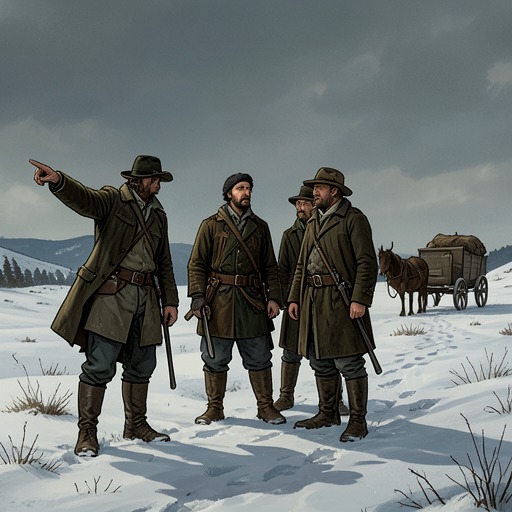
When Miller finally leads the expedition toward the basin, the approach unfolds through foothills, a river corridor, and dense pine forest. After riding late into the night, the party reaches the foot of the hills in the morning and follows a line of trees down toward a small stream. The riverbed is broad, though the water runs in a narrow, clear channel among rocks. Miller scouts northeast along it while the others rest.
From the bank, William Andrews looks across the river at a mountain mass crowded with pines. Trunk after trunk vanishes into a darkness that seems to have no opening or human measure. As he continues to look, the distinct mountain disappears into an immense field of green branches, which his perception transforms into something like a frozen sea. The forest offers both invitation and threat: Andrews imagines entering it, sinking into its depth, and becoming obscurely part of it. Before the valley is fully revealed, the surrounding wilderness has already begun to unsettle the boundaries between landscape and self.
The final approach makes the valley’s quiet an event in itself. The trail descends among the pines, then the land abruptly levels into a long, narrow basin, flat as a tabletop and filled with luxuriant grass moving in the breeze. Andrews, exhausted, catches himself holding his breath, then releases it slowly, unwilling to disturb the silence. Miller points out a dark patch moving beneath the trees on the far side. What first appears small at that distance resolves into a vast herd, nearly half a mile wide and more than a mile long. The reveal converts the valley’s stillness into the setting for the expedition’s central pursuit.
A Refuge from Depletion
The valley’s promise is sharpened by the hunters’ experience on the plains. Miller recalls that when he arrived in Kansas, the spring landscape had been black with bison for miles; a two-week hunt could yield a thousand or fifteen hundred animals. By the time he tells the story, the herds have dwindled to small groups, and a successful outing may bring only two or three hundred. He expects that within a year or two there will be no bison left to hunt in Kansas. The hidden basin appears to offer an escape from that scarcity: a place with thousands of animals and no visible sign of prior human intrusion.
That contrast is part of the valley’s attraction, but it also exposes the terms of Miller’s plan. He does not describe it as a protected refuge for the herd. He calculates that one hunter could keep the animals in the basin while two skinners and one camp worker process the kills; four men, he says, should be enough. Fewer men mean a larger share of the proceeds. The isolated geography makes possible both the expedition’s efficiency and the removal of other hunters who might challenge Miller’s method.
The valley also belongs to a wider history of waste. On the Kansas plains, William Andrews sees the bones left by earlier hunts; Miller recalls that riders once traveled among heaps of them from Pawnee Fork to the end of the Smoky Hill River. The bones could be made into tools, ornaments, and children’s toys, while farmers might collect them for fertilizer. Such uses do not undo the destruction that produced the remains. Later, after the expedition’s killing, McDonald points out that hunters are selling bison meat to the railway company while leaving hides to rot in the sun. The commercial value of the animals shifts, but the valley’s abundance has already been treated as a resource to exhaust.
Hunting, Winter, and Transformation
Inside the valley, the scale of the herd declines into a daily measure of the expedition’s work. Fred Schneider and William Andrews struggle to skin the animals Miller leaves behind, working later into the day and rising before dawn to cut apart carcasses stiffened by cold. Miller’s rifle continues its steady report while they labor. The ground becomes covered with exposed bodies, and the surviving bison move among the dead, grazing on grass marked with dried blood. The valley’s apparent timelessness gives way to a landscape being remade by the hunt.
William Andrews gradually understands that Miller will not leave while a single bison remains alive. He measures the time not by days but by the shrinking herd and the moment when the party might load the hides and descend from the mountains. The world beyond the basin grows indistinct in his memory: the plains, the ascent, and even Butcher’s Crossing seem dreamlike beside the place where he has spent what feels like the most important stretch of his life. Looking across the valley, he feels its contours give shape and location to his own existence, and cannot imagine being elsewhere. The location thus becomes more than a destination; its enclosure narrows Andrews’s imagined world even as its vastness overwhelms him.
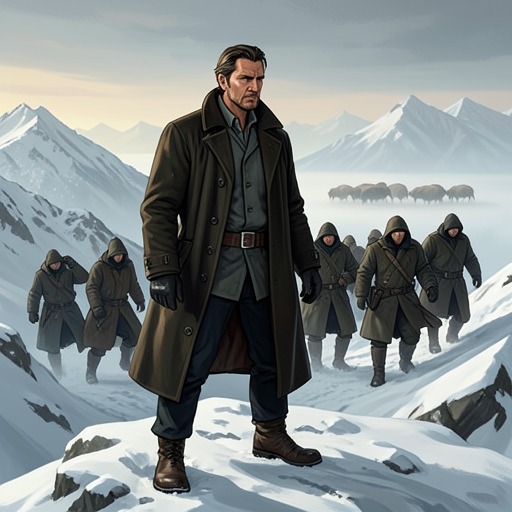
Winter alters the familiar basin again. On the third morning after a snowfall, Andrews digs himself out from under the accumulated snow and opens his eyes to a landscape transformed by white. Snow covers the valley in rounded drifts like waves arrested in motion; it buries the mountain’s green slopes and most of the pines, leaving only their tips visible. Weak from lack of food and disoriented by days and nights in darkness, he struggles through snow reaching his waist. The place he had learned to regard as familiar suddenly seems strange, and the silence rises from the valley toward the mountains and sky. Its remoteness, once an advantage for the hunters, becomes a condition of confinement.
Narrative Significance
Colorado’s hidden valley gathers the expedition’s central contradictions into one setting. Its concealed trail and immense herd make it appear untouched, but its isolation enables a concentrated assault on the animals; its silence offers Andrews a powerful encounter with wilderness, but the daily sound of Miller’s rifle and the spread of carcasses turn that encounter into labor and destruction. The basin’s enclosed geography also helps explain the hunters’ altered sense of time: as the herd dwindles and winter closes in, the outside world recedes from Andrews’s memory.
The valley is therefore neither an uncomplicated sanctuary nor a landscape that yields meaning on human terms. It seems to promise abundance beyond the depleted plains, but the expedition converts that abundance into hides, meat, and a dwindling count of living animals. Snow can erase the visible green and make the basin newly strange, yet it cannot restore what the hunt has killed. The place remains immense and indifferent to the party’s designs, even as their actions leave its ecological and human world profoundly changed.