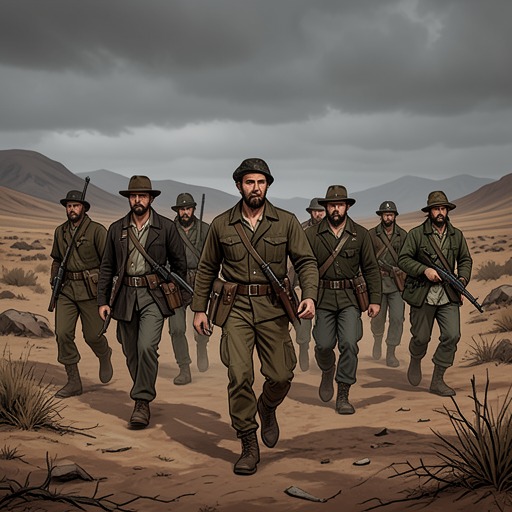
Crossing the arid plains in search of water
Butcher's CrossingThe crossing of the arid plains in search of water tests the hunting party’s survival before it reaches the mountains. For William Andrews, the journey contracts into the effort to keep breathing, remain with the wagon, and trust Miller’s direction across a landscape that offers no clear guide. Water is found only after a night of severe thirst, and even its arrival demands restraint before it can bring relief.
Causes and Setting
The crossing unfolds against the diminishing herds that have made Kansas hunting less rewarding. Miller recalls that the plains once appeared black with bison, and that a fortnight’s hunt could yield a thousand or fifteen hundred animals; now the herds have dwindled, and a successful hunt might bring only a few hundred. He expects Kansas to be exhausted as a hunting ground within a year or two, while insisting that bison remain elsewhere for those who know where to look. The search westward belongs to that changed landscape: the open country is not an abundant frontier but a difficult passage toward the remaining game.
The land itself makes orientation uncertain. The party travels west over terrain that seems continually alike, with a flat horizon and few visible landmarks. The narrative gives the crossing not as a measured route but as a succession of bodily and perceptual trials. Distance is experienced through fatigue, the failing strength of the animals, and the repeated question of whether water can be reached before either men or team give out.
A Night of Thirst
As the sun drops beyond the level horizon, darkness arrives quickly. William Andrews can barely keep his hands on the saddle horn; they slip, and he has little strength to raise them again. Breathing becomes painful and laborious. His mouth hangs open, his tongue presses between his teeth, and trying to close his jaw sends a dull, sharp pain across his palate. The memory of the oxen’s swollen, blackened tongues intrudes, an image that he tries to escape by turning his thoughts away from himself and toward the immense darkness around him.
The wagon and its team also falter. When an ox stumbles and cannot rise, the three men dismount and struggle to get it back on its feet. The oxen can no longer restart the wagon by themselves, so the men push at the wheel spokes while Charley Hoge cracks his whip. Andrews tries to wet his mouth with Charley Hoge’s whisky, but most of it spills down his lips. He rides through the night between delirium and intense pain, with the wagon’s movement the remaining evidence that he is still travelling with the others.
At one point he wakes to find himself alone in the dark. Disoriented, he cannot tell where he is or which way he is going; the sky and the ground both seem remote. Hearing the wagon creak in the distance, he urges his horse toward the sound and rejoins the party. The others have not noticed that he has fallen behind, but the panic of being left alone stays with him. He watches Miller’s movements closely—not because Miller can take him to a chosen destination, but because following him is Andrews’s only safeguard against losing himself in the apparent emptiness.
Finding the River
Shortly before dawn, Miller senses water. In the first eastern light he straightens in the saddle, raises his head, and gradually turns north. His horse grows tense, as does Miller’s, and the animals’ reactions confirm the direction before the water is visible. Miller smiles through lips split and bleeding from thirst, then signals the others to hold their horses: the team may smell the water and bolt. The moment reverses the night’s helplessness. Miller’s alertness, and the animals’ response to a trace the men cannot yet perceive, bring the party to a narrow, muddy river.
The men release the oxen from the yokes as the animals strain toward the water. Then they run down to the bank and throw themselves on their stomachs. Miller warns them to wet their mouths first rather than drink too much at once. They let only a few drops run down their throats, lie on their backs as cool water spills over them, and only then drink more deeply. Relief comes in stages, governed by the same physical limits that made the crossing dangerous.
They remain by the river through the day. The animals drink freely and graze on short, dry grass, but Miller judges that they will need a full day to recover even part of their strength. Charley Hoge gathers drifting branches and cooks dried beans and bacon; the men eat with their last hardtack and coffee, sleep through the afternoon, and eat the undercooked beans again after dark. They settle in their sleeping bags near the embers, listening as the animals move around them and the river murmurs nearby. The camp is not a return to comfort so much as a pause in which the party can replenish itself.
Westward and the Mountains
The next morning, before dawn, they resume the journey, still weakened by the ordeal. With water found, Miller leads more confidently. He speaks of it as if it were a living quarry that had tried to evade him, and treats its rediscovery as a success that will not be undone. In the days that follow, the party keeps changing its course across the monotonous country, yet reaches water each evening. Often it appears only after dark, when William Andrews and Fred Schneider have begun to believe they will not find it. The daily recurrence turns the first discovery into a pattern of continued dependence: water is not carried as certainty across the plains but encountered again and again at the end of each day.
On the fourteenth day of travel, the mountains come into view. The previous afternoon the party had ridden toward low clouds on the western horizon, continued through the night, and found water before resting late the following morning. When Andrews wakes, the sky is steel-blue and the sun burns in the east. He notices a low, irregular dark-blue rise far to the west, stands to see it more clearly, and hurries to wake Miller. The distant mountains mark a change in the journey’s horizon, but their appearance follows rather than erases the crossing’s cost: the party has reached them only after prolonged thirst, near-exhaustion, and dependence on Miller’s ability to locate water.
The crossing also places human extraction in a landscape already marked by depletion. Elsewhere on the route, Miller points out enormous piles of bison bones left from the great Kansas hunts, stretching for miles between Pawnee Fork and the end of the Smoky Hill. He notes that farmers may collect the bones for fertilizer, while recalling their many other uses. Later, the scale of the hunt becomes unmistakable in the valley: William Andrews realizes that Miller will not leave while a single bison remains. Against those scenes, the search for water is more than a difficult transit. It shows the expedition relying on close attention to a land it does not control, even as its purpose is to take the animals still living there.