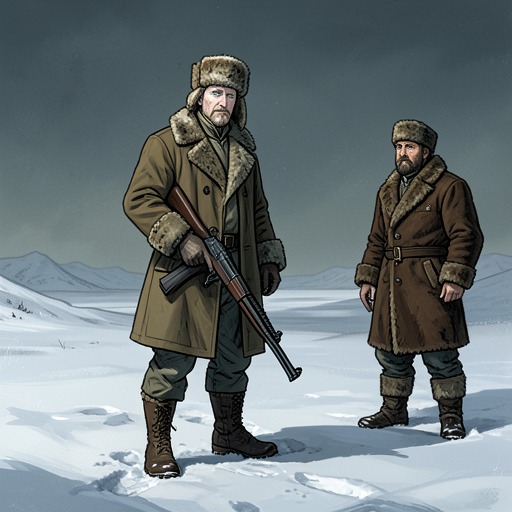
Miller and Fred Schneider
Butcher's CrossingMiller and Fred Schneider’s relationship is forged in a hunting venture whose commercial promise depends on shared labor and whose dangers Miller ultimately controls. Their partnership moves from an arrangement over the price of hides to a winter-long struggle over whether the party can leave the valley, then ends in a sudden river death. Schneider’s anger at Miller’s decision cannot alter the conditions trapping them; after Schneider dies, Miller continues to invoke the bargain that had bound them, even as the hides lose their market value.
A partnership built on the hide trade
Before the expedition’s terms are settled, Miller approaches J.D. McDonald about buying the hides, so the hunters will not have to transport them as far as Ellsworth. McDonald’s business depends on the volume and resale of bison pelts: he tells William Andrews that he processed nearly one hundred thousand the previous year and expects two or three times that amount in the current one. The scale of the trade gives the expedition’s proposed price a concrete commercial context.
Miller reports that McDonald will pay four dollars apiece for winter hides and already has a buyer in the East. Fred Schneider immediately asks what the summer hides will bring, pointing out that the winter pelts will require at least three months of waiting. Miller has not yet made an agreement with Schneider or even disclosed where they are going; he says he chose to discuss the arrangement with everyone together. Their partnership thus begins with a negotiation in which Miller controls the plan and the information, while Schneider presses on the practical return and timing.
The winter decision
That division of control becomes consequential when the men are trapped by snow. Fred Schneider asks Miller to let him leave, but Miller refuses, arguing that Schneider could not navigate the route even with directions and landmarks and that remaining with the group is his only chance of survival. Schneider finally accepts that he must stay, bitterly describing himself as stuck through the winter while earning sixty dollars a month. His consent is not reconciliation: he turns his back on Miller and William Andrews and angrily holds his hands toward the fire.
Miller makes the terms of their confinement explicit. The party will remain until the pass by which it entered the valley is clear; even three or four weeks of good weather would be needed, and such weather will not arrive before winter ends. Fred Schneider’s frustration therefore meets a boundary Miller presents as dictated by the terrain and the danger of going alone. The decision protects the group from an attempted escape, but it also leaves Schneider dependent on the man whose judgment he resents.
Repeated confrontations at the pass
During the remaining winter, Schneider’s resentment becomes a quiet, persistent ferocity directed at Miller. Nearly every day, he asks Miller to accompany him to inspect the snow at the pass. Miller agrees each time, neither enthusiastically nor in open refusal, and the two return with contrasting expressions: Miller calm, Fred Schneider red with anger. When Schneider presses the matter again, Miller’s answer remains that the pass is not yet clear.
The routine gives their conflict a measured, repetitive shape. Schneider cannot make the snow recede by insisting, and Miller does not answer the pressure with argument or retaliation. Their shared inspections are the only regular movement toward the exit, but each return confirms that departure remains impossible. Schneider’s anger grows in the same landscape that confines him, while Miller appears, at least outwardly, unaffected by it.
Death at the river
Once the party attempts to cross the river, the physical danger that had governed Miller’s winter decision becomes immediate. As the wagon moves toward a depression in the riverbed, William Andrews sees a large broken trunk being swept downstream. He runs along the bank and warns Fred Schneider, whose attention is on the water ahead of his horse. The current and its noise interfere with the warning; the trunk strikes the horse before Schneider can get clear.
The wounded horse falls toward the wagon and rolls onto its back, pinning Schneider. He surfaces briefly among its legs, reaching with his left hand as if to push the animal away. When the horse rolls again, a hind hoof strikes him in the head. He stiffens and sinks beside the horse. Almost simultaneously, the trunk and animal hit the wagon, forcing it against the rocks; the load shifts, the rear of the convoy floods, and the wagon overturns.
Miller responds to Andrews’s distress with a hand on his shoulder and tells him there is nothing they can do. He says Fred Schneider was already dead when he fell into the water and that searching for him would be senseless, given how quickly the oxen have disappeared. The contrast is stark: Andrews tries to turn shock into action, while Miller treats the loss as irreversible and directs attention to survival. The judgment also closes the possibility of recovering Schneider from the river.
The bargain after Schneider
Back in Butcher’s Crossing, Miller still measures the expedition’s prospects through the agreement made with J.D. McDonald. He insists that three thousand winter hides remain hidden in the mountains and says they would be worth more than ten thousand dollars even after the hunters paid to transport them. He recalls the promised price of four dollars per winter hide, presenting the partnership’s commercial terms as still binding despite the intervening disasters.
McDonald counters that the market has collapsed: the demand for bison fur has run its course, just as demand for beaver pelts faded when beaver hats went out of fashion. Miller protests that only a year has passed, but the old agreement cannot restore the vanished buyers. Schneider’s death and the lost wagon have already made the expedition’s return costly; the changed market further separates the hides from the value the partners expected them to realize. Their relationship ends, in effect, as both a human loss and a stranded bargain: Miller survives to claim the price they agreed upon, but Fred Schneider is absent from the return, and the goods can no longer secure the future their venture promised.