Saint Louis
Butcher's CrossingSaint Louis functions as a recurring point of reference between the established cities of the East and the exposed, changing frontier of Butcher’s Crossing. It is a place William Andrews passes through on his way west and a former home for Francine; elsewhere, its name evokes both the trade that links distant settlements and the standards by which frontier life is judged.
A stop on the journey west
After nearly two weeks traveling by stagecoach and train, William Andrews recalls a route whose cities have begun to blur together. Boston, Albany, New York, Baltimore, Philadelphia, Cincinnati, and Saint Louis remain as names, but no longer form a clear sequence of roads in his memory. The rigid coach seats, dirty stations, and long waits on wooden benches return to him physically as he rests at his destination. Saint Louis belongs to this chain of travel: a remembered waypoint within a journey whose discomforts become vivid only after it is over.
Francine’s former home
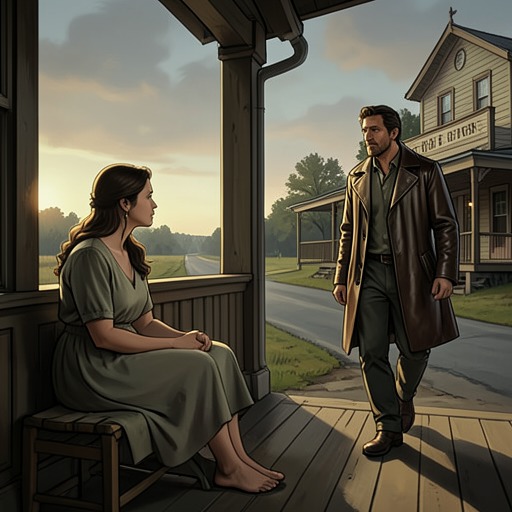
Francine says she lived in Saint Louis before moving to Butcher’s Crossing two years earlier. She left because there were too many girls there and she did not feel at ease; in the village, she says, she likes the quieter summers. Her account makes the city part of her personal history, but William Andrews overlays it with his own assumptions. Moved by pity, he imagines her as a victim of artificial social customs and a world of machines, stranded on a lonely plateau before the wilderness. His response reveals less about what Francine says she wants than about his impulse to cast her life as a contrast between civilization and nature.
That contrast sharpens when William Andrews remembers Fred Schneider’s crude remark that he had not seen a prostitute as beautiful as Francine since leaving Saint Louis. The city enters the scene through Schneider’s association of it with her past and through William Andrews’s sudden awareness that other men have looked at and touched her before him. The remembered reference transforms an intimate encounter: he imagines a succession of paying customers and withdraws, unable to separate Francine’s present closeness from the history he has assigned to her.
A measure of commerce and abundance
Saint Louis also supplies a standard for evaluating goods made far from the city. While examining a bison skeleton, Miller describes objects made from bone and horn: needles, folding knives, arrow points, necklaces, toys, and combs. He recalls necklaces so finely made that they looked as if they had come from a Saint Louis jewelry shop. The comparison sets skilled craft against the fate of the remaining bones, which a farmer might eventually gather for fertilizer. The city’s name thus evokes both a distant market and a benchmark of finished workmanship, while the bones make visible how the bison’s body can be transformed into useful or ornamental material.
The city and the changing frontier
Miller remembers a time when the Kansas plains were dark with bison in spring, and a short hunt could yield a thousand or fifteen hundred good spring hides. By the time he speaks, the herds have dwindled to small groups and a successful hunt may bring only two or three hundred animals. He expects that Kansas will soon have no bison left to hunt. Against this history of abundance and depletion, Saint Louis stands among the distant settlements that give the frontier its commercial and cultural points of reference, but it does not halt the change Miller describes.
Later, J.D. McDonald says the railroad is being built fifty miles north of his land. He also notes that hunters now sell bison meat to the railroad company while leaving the hides to rot where the animals were skinned, observing that the discarded meat could have earned nearly five cents a pound. The railroad’s arrival marks a new channel for commerce, but the waste it carries forward is inseparable from the mass killing that has emptied the plains. Saint Louis, invoked elsewhere as a destination, a former home, and a measure of crafted goods, belongs to the wider network of settlement and exchange surrounding that transformation.