Sharps rifle
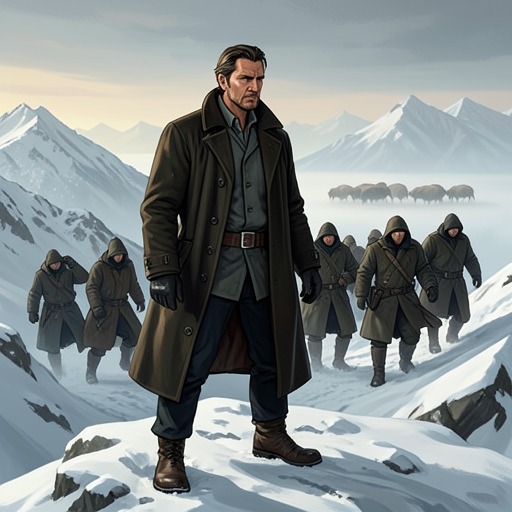
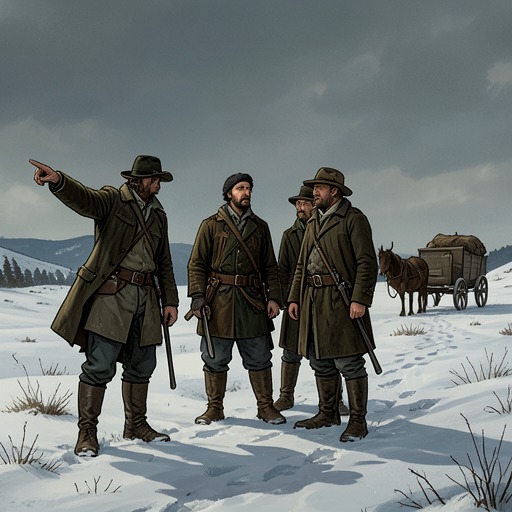
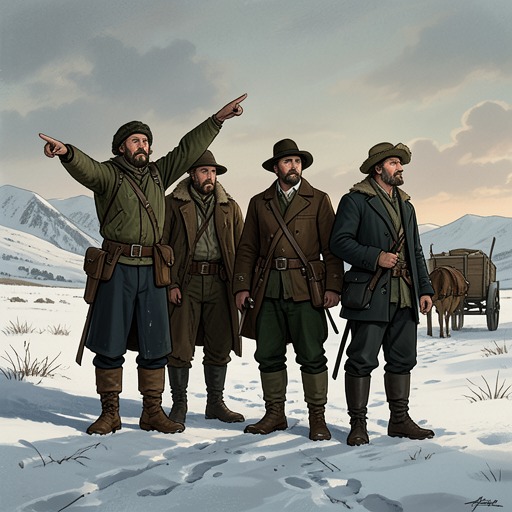
Butcher's CrossingThe Sharps rifle is both a practical tool of Miller’s hunt and the means by which William Andrews enters the killing he first observes. Its crack sets the pace of the valley’s slaughter; its recoil, smoke, and heat register that pace in the hunters’ bodies. As Andrews learns to fire it, the rifle marks a change in his role, even as the diminishing herds and discarded remains expose the consequences of the commerce built around such weapons.
Form and Handling
The rifle is identified as Miller’s Sharps. In the field he fires from a prone position, with the stock pressed to his shoulder and both eyes open as he sights along the barrel. During his first lesson, Miller explains where to aim at a bison and why wind makes an approach from the front too risky. The weapon’s use depends not only on marksmanship but on position, distance, and the animals’ movement.
The Sharps also demands immediate maintenance under the strain of sustained firing. After Miller has brought down six bison, he opens the breech and uses a wire-equipped cleaning rag to clear powder from the barrel. He gives the rifle to Andrews, whose first attempt to take hold of it ends when the hot barrel burns his hand. Miller directs him to wet the rag and insert it from the breech rather than the muzzle, warning that the other method could damage the firing pin. Water hisses against the hot metal; droplets briefly dance on the blue barrel before evaporating. Andrews cleans the weapon, then cools its exterior with a handkerchief dipped in spring water before returning it.
This pause in the firing is not a release from the hunt but part of its labor. The hot barrel, the smoke, and the careful cleaning show the rifle as a material object that must be continually managed if the shooting is to continue. Its heat interrupts Andrews’s handling of it, while Miller’s instructions turn that interruption into another task within the day’s work.
Miller’s Method and the Hunt’s Rhythm
Miller treats the rifle as the center of a method for keeping a herd within reach. He first attempts a shot at an old, scarred bull, which bounds away and continues moving. In the later shooting, Miller fires repeatedly as the animals rise and circle in confusion. He empties his ammunition pouch beside him so cartridges are within reach, and Andrews gathers the spent cases when he can. Once Miller has fired six times, the weapon must be cleaned before the shooting resumes.
The rifle’s rhythm becomes oppressive through repetition. Miller fires and reloads while powder smoke thickens around him and Andrews; the smoke makes the younger man cough and struggle to breathe. The herd continues circling almost mechanically, while the regular reports leave Andrews nearly deaf. He waits between shots for each next explosion to break through the pulsing silence in his ears. As the animals move away, the two men crawl after them, keeping their distance and following the hunt rather than stopping it.
The rifle’s effectiveness is inseparable from the labor that follows its shots. William Andrews and Fred Schneider must skin the animals Miller leaves across the valley, often working into the evening and rising before dawn to cut into carcasses stiffened overnight. At first Andrews is troubled by the killing; with time, the stench, warm flesh, and blood become familiar, and he increasingly attends to Miller’s strategy for concentrating the animals so they can be skinned more efficiently. The gunfire continues while that work accumulates, connecting the act of killing to the exhausting processing of its results.
Andrews Takes the Rifle
Miller eventually lets Andrews try the Sharps. Lying on his stomach as he has watched Miller do, Andrews aims at a bison and hits it in the lungs. He kills three more before missing and scattering the small herd. The rifle’s recoil leaves his shoulder tingling; after handing it back, he remains on the ground, fingering the used cartridges and trying to fix in his mind what he has felt. The four animals lie about two hundred yards away.
The episode changes Andrews from an observer of Miller’s technique into a participant in the hunt. His response is not presented as a simple triumph: he studies the bodily sensation of the recoil and the spent cartridges, then rises and walks away from Miller toward Fred Schneider. They sit silently near the horses until the sound of Miller’s rifle grows fainter, after which they follow the dead animals’ trail and skin them. The sequence places Andrews’s new skill beside the work and silence that surround it, rather than treating marksmanship as a self-contained achievement.
As the hunt continues, the rifle’s significance expands beyond individual shots. Andrews comes to understand that Miller will not leave the valley while any bison remain alive. He measures the prospect of departure by the dwindling number of animals, not by the passing days. The gun therefore belongs to a campaign whose endpoint is not a limited haul but the destruction of the herd; its repeated use sustains both Miller’s pursuit and the routine that has absorbed Andrews.
The Rifle in a Depleted Landscape
Miller’s recollection of Kansas supplies a measure of what hunting has already changed. Four years earlier, when he and J.D. McDonald arrived, the spring plains had seemed black with bison. A two-week hunt could bring in a thousand or fifteen hundred animals, including valuable spring hides. By the time he speaks, the herds have broken into smaller groups, and a successful hunt may yield only two or three hundred. Miller expects that within a year or two there will be nothing left to hunt in Kansas.
The rifle’s work is visible in what remains after the animals are gone. Miller points across a landscape once covered with bones from the years of major Kansas hunts, recalls riding among them, and kicks a large rib loose from a carcass. He expects that farmers will eventually collect the bones for fertilizer, although he doubts they will be of much use. The bones, like the spent cartridges beside the rifle, are physical traces of killing; unlike the weapon, they persist after the immediate act and testify to its scale.
The trade’s later turn sharpens that contrast. When Miller confronts J.D. McDonald about the railroad, McDonald says the tracks will pass fifty miles north and that hunters are selling bison meat to the railway company while leaving the hides to rot where they were skinned. He points out the value of the meat Miller had left to flies and gray wolves. The rifle belongs to the hunt that makes this waste possible, but the market has shifted: what once justified taking hides no longer determines what hunters preserve. Its recurring report thus accompanies not only a commercial enterprise but a changing and depleted landscape, where the animal is pursued, killed, and increasingly abandoned.