Smoky Hill Trail
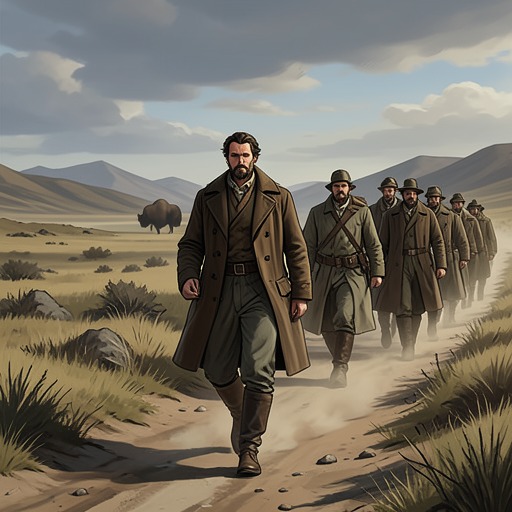
Butcher's CrossingThe Smoky Hill Trail is the expedition’s first dependable westward route out of Butcher’s Crossing, a track that keeps travelers close to the river and its water before giving way to open country. It is both a practical corridor and a record of change: its ruts bear the passage of wagons and hooves, while nearby bison paths and scattered bones show how earlier traffic and commercial hunting have altered the plains.
Route and practical function
Miller tells William Andrews that the trail runs close to the Smoky Hill River toward Colorado territory. Early in the journey, after the party has made fewer than eight miles in a morning, he estimates that the easier stretch should take less than a week. The pace depends in part on the animals learning to work together. The trail is not a smooth, continuous road: it is a narrow strip of bare earth cut by hooves and wagon wheels, and deeper ruts sometimes force the party to leave it for the taller grass, where the ground may be flatter.
Miller explains that the detours are practical rather than arbitrary. Sharp grass can strike the oxen’s hooves and legs throughout the day, while horses lift their feet higher even at a walk and are less exposed to injury. The trail’s usefulness therefore rests on an ongoing negotiation between a route worn by earlier traffic and the condition of the animals that must travel it. Its ruts help direct the wagon, but they do not make every part of the way safe or easy.
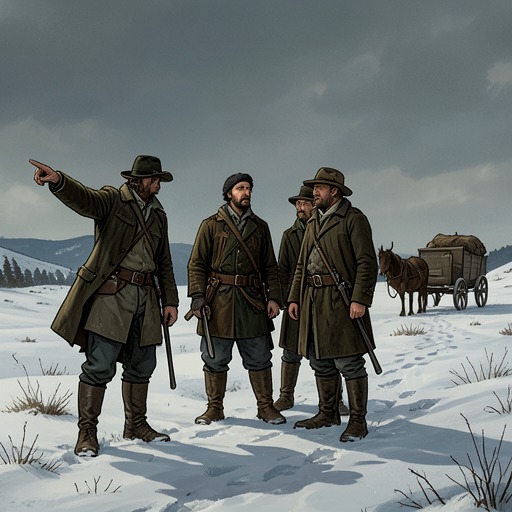
The river is the trail’s essential companion. At the end of the route, Miller points out that the trail bends with the river and follows it toward Arkansas. The party could stay with it, he explains, and have water in abundance, but doing so would add at least a week to the journey to their destination. The trail thus offers a clear exchange: a longer, water-secure passage in place of a more direct route through country without established paths.
A corridor marked by earlier passage
The trail also brings the party into contact with signs of animal movement that predate their own journey. In one place, the men find a broad, barren crossing where the ground is pressed down and marked with regular notches. The track leads away from the river across the prairie and returns to the water at a point where the bank is open. Miller identifies it as a bison route: animals had crossed in single file to drink, then spread out near the river. He recalls having seen thousands follow this pattern.
The old crossing and the wagon trail are distinct traces, but their proximity joins the human journey to the larger movements of the plains. The river draws both travelers and herds; the ground preserves their passage differently. The expedition follows a trail shaped by repeated wheels and hooves, while the broader, pressed-down crossing records the bison’s habitual approach to water. The landscape is not empty simply because it lacks buildings or a formal road. It is legible through paths made by use.
The trail’s end and the turn toward the mountains
On the sixth day, the expedition reaches the end of the Smoky Hill Trail. The river bends away, and the men pause to look back along the course they have followed since leaving Butcher’s Crossing. From their position, water glints silver through the bank-side trees; the oxen turn their heads toward it. Miller explains that continuing along the river would preserve access to water but delay their arrival. The conversation makes the trail’s limit consequential: beyond this point, the party must choose between the known route and a faster passage without one.
The transition is not merely a change in direction. The trail has supplied a recognizable line through the plains, and the river has made that line safer to follow. Beyond it, Miller leads the wagon toward the hills by way of a line of trees descending from a rise. The country opens into a valley with a stream, and then toward the mountains. The party’s movement from the trail into less-defined terrain marks a shift from following a route made visible by repeated passage to depending on Miller’s judgment of the country ahead.
Ecological history and narrative significance
The trail passes through a region already transformed by hunting. Miller recalls that only a few years earlier the Kansas plains had been black with bison, and that hunters could take a thousand or fifteen hundred animals in a fortnight. Now the herds have dwindled to smaller groups, and a successful hunt yields only a fraction of those earlier numbers. He predicts that within a year or two there will be no bison left to hunt in Kansas. Along the way, the party encounters a large skeleton, a material remnant of that decline. Miller remembers that, five or six years earlier, heaps of bones could be seen for miles between Pawnee Fork and the end of the Smoky Hill Trail.
Those bones have not simply vanished from economic life: Miller expects a farmer may collect them for fertilizer, though he doubts they will be worth much. His recollection of Indigenous uses for bison bone—tools, arrow points, jewelry, toys, and combs—contrasts with the possibility of reducing the remains to a low-value agricultural material. The trail therefore runs through a landscape where the consequences of mass killing are visible and where the animal’s remains continue to be assigned new uses.
The expedition’s passage also belongs to a commercial system that eventually changes around it. Later, Miller arranges for McDonald to buy the party’s winter hides at four dollars each, with an eastern buyer already secured. By the time Miller returns, however, McDonald reports that hunters are selling bison meat to the railroad company and leaving hides to rot where they were stripped. The railroad is being built fifty miles north, and the hunters’ choice of what to salvage has shifted with the market. The Smoky Hill Trail is not itself the cause of these changes, but its route through the hunting grounds places the expedition within a history in which access, animal abundance, and commercial value continually change. What begins as a path toward a remote destination leads through the physical evidence of a disappearing herd and into a world where even the value of its carcasses is temporary.