The collapse of the bison-hide market
Butcher's CrossingThe collapse of the bison-hide market makes the hunting expedition’s apparent success economically worthless. Miller returns to Butcher’s Crossing with 3,000 winter hides and expects the four dollars per hide promised by J.D. McDonald; instead, he learns that demand has vanished, McDonald has no money, and the hides he has brought back belong to a trade that may be finished. The reversal connects the depletion of American bison to the fragility of the business built on their remains: the animals are gone, but even the commodity that justified killing them has lost its buyers.
The trade before the collapse
When William Andrews first learns how McDonald’s business works, McDonald describes a local industry built around buying hides from hunters, tanning them himself, and selling them wholesale in Saint Louis. He says that he processed nearly 100,000 hides the previous year and expects two or three times that number this year. He has so much paperwork that he is two months behind, and he presents the trade as a growing opportunity. His confidence depends on a steady flow of hunters and hides, and on distant buyers continuing to want them.
Miller’s account gives that expansion a shorter and more troubling history. He and McDonald arrived in the area four years earlier, when the plains could appear black with American bison. A two-week hunt could yield 1,000 or 1,500 animals, including valuable spring hides. By the time Miller speaks to Andrews, hunters are fortunate to take 200 or 300 in a trip; the herds have dwindled to small groups, and Miller predicts that Kansas may have nothing left to hunt in another year or two. McDonald, meanwhile, organizes dozens of expeditions and pays 50 cents per raw summer hide. Miller refuses to hunt on those terms, objecting to the way McDonald divides the proceeds.
The decline is visible beyond the shrinking herds. Miller recalls traveling among mountains of bones from Pawnee Fork to the end of Smoky Hill, a landscape made by years of Kansas hunts. Bones that once had many uses—including tools, ornaments, and children’s toys—may now be collected by farmers for fertilizer. The image measures a change in value: the remains of the animals are abundant, but their uses and worth are shifting even as the living herds disappear.
The agreement and the delayed return
Before the expedition sets out, Miller tells the other hunters that McDonald will buy their hides, sparing them the journey to Ellsworth. He has an eastern buyer and agrees to pay four dollars each for winter hides. That price gives the expedition a concrete financial purpose, but it also makes its success dependent on a chain of transactions beyond the hunters’ control: the hides must be brought back, bought by McDonald, and resold into a market that will still accept them.
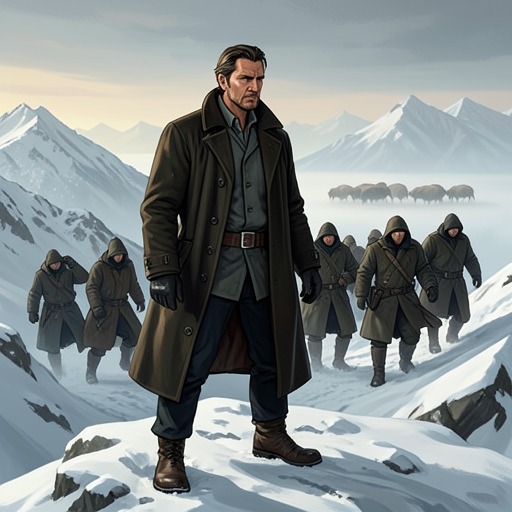
When the party returns after being trapped in the mountains through the winter, McDonald greets Miller’s claim of having come back empty-handed with bitter irony. Miller says the party has 3,000 winter hides hidden in the mountains, worth more than $10,000 even after transport costs. He insists that the original agreement still stands. McDonald confirms that the four-dollar price was real, but the promise cannot create money that is no longer there. He says he has nothing with which to pay.
The timing turns the agreement into a cruel measure of the expedition’s delay. McDonald says that seven months earlier he still had the money and that Miller would have been paid if he had returned when expected. Instead, the party’s prolonged absence has carried it past the moment when the bargain could be honored. The hides exist, and the agreed price is not disputed; what has disappeared is the market and the cash that would have connected one to the other.
The market breaks
McDonald explains that the money he had was invested in 30,000 or 40,000 hides, already bought and paid for the previous autumn and stored in salt vats. He offers Miller those hides for ten cents each, suggesting that they might become profitable in a year or several years. The offer is not payment for the expedition’s work. It is a transfer of inventory that McDonald cannot sell at its former value, and it pushes the risk of waiting for a market revival onto Miller.
The collapse, McDonald says, is not simply a temporary interruption in transport or a dispute between two men. Demand itself has failed: people who wanted bison furs have apparently already bought them, and now no one wants more. He compares the change with the beaver trade after beaver hats went out of fashion. As with that earlier trade, the reason a product becomes desirable—and the moment buyers stop wanting it—cannot be reliably predicted by the people who hunt or process it. He allows that bison hides might find a new use in four or five years, but warns that winter hides could then be worth only as much as summer ones, perhaps 30 or 40 cents each.
McDonald also offers Miller the land, taking out a paper and beginning to write. The offer sharpens the reversal rather than repairing it: the man who once spoke of the coming railroad as a source of prosperity now tells Miller that he would have to learn to farm the desert and might lose the land if he could not sustain it. The expected rise in value has not arrived where McDonald needs it.
The railroad and the failed promise of value
The railroad does reach the region during the expedition’s westward journey. Miller pauses at the rails, touches the steel, and looks toward the mountains. Its arrival seems to confirm the future McDonald had repeatedly anticipated, but the eventual route passes fifty miles north. Infrastructure is present, yet it does not deliver the benefit the partners imagined for this land or their trade.
The railroad’s actual business makes the irony harsher. Hunters are selling bison meat to the railway company while leaving the hides to rot in the sun where the animals were skinned. McDonald calculates that the abandoned meat might have earned nearly five cents per pound. Miller had organized his expedition around the value of winter hides, while another part of each carcass was already finding a buyer through a different channel. The market has not merely vanished in the abstract; it has redirected value toward meat and away from the product for which the hunters made their agreement.
The confrontation ends without Miller recovering the promised payment. McDonald’s collapse exposes the distance between a successful hunt and a successful business: 3,000 hides and an agreed price cannot secure an income when demand has disappeared, capital is tied up in unsold stock, and the anticipated route of development lies elsewhere. Against the vast earlier herds and the now scattered carcasses, the failed bargain marks both ecological depletion and commercial exhaustion. The trade has consumed the animals faster than it can preserve the value of what it takes from them.