The expedition trapped in the valley by a blizzard
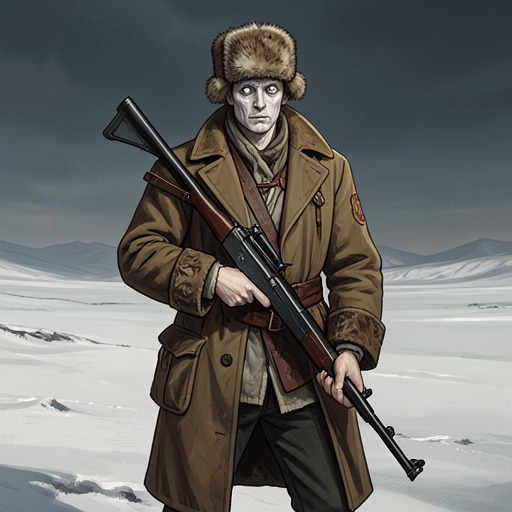
Butcher's CrossingThe expedition trapped in the valley by a blizzard is the moment when the hunting party’s passage into a seemingly open wilderness becomes confinement. The snow does not simply interrupt the journey: it closes the mountain pass, buries the camp, and forces the men to survive within the landscape whose vastness had first drawn them in. For William Andrews, the transformation is especially stark. The valley and forest had seemed to promise a freedom beyond settled life; under the storm, that ideal is tested by cold, darkness, and the body’s narrow need for shelter and heat.
Approach to the valley
The party reaches the foothills after travelling through difficult country. At the foot of the mountains, Miller leads the supply wagon along a rising route and down into a valley, then onward to a broad river. While Miller rides away to scout, Andrews sits beside the water and studies the immense stand of pines across it. Their trunks and shadows merge in his sight into a single green expanse, like a frozen sea without discernible scale. The forest’s beauty is inseparable from its threat: Andrews imagines that he could enter it only briefly before sinking into its depth and becoming obscurely alone.
The route finally opens onto the valley itself. From the trail, Andrews sees a long, narrow plain lying between the mountains, its grass moving in the breeze and its stillness suggesting a place untouched by human footsteps. The quiet is so complete that he deliberately releases his breath slowly, as though even that small sound might disturb it. Miller then points out a dark, shifting mass beneath the opposite pines: the bison herd the expedition has come to hunt. The scene joins the party’s purpose to Andrews’s sense of awe. The valley seems to exceed human presence, yet the hunters have entered it to take its animals.
First snowfall
The change begins with a single snowflake, descending slowly through air that has grown still. Schneider notices it first, and Andrews initially responds with laughter, treating the snow as an unexpected novelty. His companions do not share his lightness. Miller and Schneider keep their faces turned toward the darkening sky; Charley Hoge sits rigidly on the wagon seat, his arms held tight against his chest and his eyes moving restlessly. As the flakes multiply and fall faster, the men’s attention makes the danger legible before Andrews has fully grasped it.
Miller calls for the party to return to camp before conditions worsen. He rides over to Charley Hoge and shakes his shoulder to rouse him into motion. The shift from Andrews’s casual amusement to the others’ fixed alarm compresses the change in the weather into a change of circumstance: the snowfall is no longer scenery but a threat requiring an immediate response. The mountain setting, which had seemed immense and calm, becomes a place in which the men must move quickly without knowing how much time remains.
Two days and three nights under snow
The storm traps the party on the plateau for two days and three nights. The men lie beneath the snow in shelters made from hides, emerging only occasionally for relief or to dig openings through the drifts so that air can reach them. Their protection is precarious but functional: the hides that once covered bison flesh now enclose each man’s body and hold a little of its warmth. Andrews sleeps for much of the storm and otherwise remains curled on his side with his knees drawn toward his chest, conserving heat in the dark.
The confinement reduces his world to the immediate conditions of his body. Once, after holding his urine until the pain in his groin and upper thighs becomes intense, he forces his way out of the hide shelter. He cannot see through the darkness and snow, and, unwilling to venture away from the opening, relieves himself where he has emerged before crawling back inside. When awake, his thoughts move slowly and uncertainly. Memories of his comfortable home in Boston survive only as dim bodily impressions: the softness of a feather bed, the shelter of a sitting room, and the muted sound of conversation downstairs. The storm does not merely separate him from that earlier life; exhaustion and darkness make it feel remote and unreal.
On the third morning, Andrews digs upward through the snow. Emerging with his eyes closed, he is struck by the brightness of daylight and has to rub melting snow across his eyes before he can look around. The valley has become a white landscape of drifts and rounded forms, the scattered pines nearly swallowed by snow. He stands still, takes a handful of the crusted surface, and then struggles through snow reaching his waist. The place he had known well enough to stop noticing now seems unfamiliar. His breath sounds loud against the deep quiet, a sharp contrast with the earlier, almost reverential stillness of the grassy valley.
The blocked pass and enforced waiting
Miller rides out to find a way through the mountains. He is gone for nearly two hours, and returns on a horse trembling with exertion. His hands are blue-black from cold and gunpowder as he warms them at the fire before reporting what he has found: the party is blocked by snow. He had to turn back half a mile from the pass, where the snow was about twelve feet deep, with conditions apparently worse farther on.
Schneider’s anger gives voice to the practical consequence of the storm. He says he had urged the men to leave and blames Miller for not listening; now, he asks, they are trapped. Miller offers no route out or promise of a quick thaw. His answer is to wait, prepare for another storm, and endure their confinement. Schneider insists that he will go home, but Miller does not stop him, saying only that he may try if he can find a way. The exchange establishes the party’s altered condition: departure is no longer a matter of choosing a direction, but of finding a passage through snow too deep for the available route.
The episode reverses the meaning Andrews had given to wilderness. Before setting out, he had imagined the country beyond the river as freedom and believed that turning back toward town could itself be another form of leaving it behind. At the valley, the scale of the forest and the quiet of the grassland seemed to offer a glimpse of something beyond ordinary life. The blizzard does not make that landscape less powerful; it reveals that its power is indifferent to the hunters’ intentions. The men who entered the valley to pursue a herd must now wait for conditions they cannot command, enclosed in hides beneath snow and cut off by a pass whose depth Miller can only report.