The expedition’s departure from Butcher’s Crossing
Butcher's CrossingThe expedition’s departure from Butcher’s Crossing begins not with fanfare but with the measured creak of a loaded wagon moving into the dark. On August 25, Miller, Will Andrews, Fred Schneider, and Charley Hoge leave town with provisions for six weeks, bound west across the plains. The journey is a commercial hunt, but its significance is larger: it sets Andrews on the wildernessward course he has come to regard as a way out of town and toward a freer life, even as the damage already done to the bison country shadows the expedition from its first miles.
Background and Stakes
The departure follows a conversation in which Miller describes how quickly Kansas’s bison have dwindled. Four years earlier, when he and J. D. McDonald arrived, spring herds had covered the plains for miles; a two-week hunt could yield a thousand or fifteen hundred animals. Now the bison travel in small herds, and a successful outing brings only two or three hundred. Miller expects that in another year or two there will be none left to hunt in Kansas. His account makes the expedition’s westward direction a response to depletion: the hunters are seeking animals beyond a landscape their trade has already stripped.
That trade also exposes a clash in how the country is valued. McDonald regards the settlement as a place that can be transformed by business and the coming railroad; he dismisses hunters even while acknowledging that the village lives on hides. Miller, by contrast, refuses to hunt on McDonald’s terms, describing a system in which hunters are paid fifty cents for each raw summer hide and the organizer keeps most of the proceeds. Their disagreement establishes the expedition as Miller’s own venture, not one of McDonald’s many hired hunts. It is both a bid to find bison farther west and a break from the local trade’s arrangements.
For Andrews, the journey carries another purpose. Before the party leaves, he understands that the hunt he has agreed to join is a pretext as well as a practical undertaking: he is not going west for business alone. He imagines himself moving away from towns and toward wilderness, and sees his past as having led, almost without his knowing it, to this decision. The expedition therefore begins with two different stakes: Miller’s search for game in a dwindling hunting economy and Andrews’s attempt to give his life a direction beyond the settled world.
The Departure
At daybreak, the four men meet behind the stables, where Miller’s expedition wagon stands loaded with enough provisions for six weeks. A sleepy stable hand hitches the Oxen beneath a weak lantern. Once he has finished, he extinguishes the flame and lies down again on a heap of dirty blankets. In the darkness, three men mount their Horses while Charley Hoge climbs onto the wagon. They pause without speaking; the stable hand’s deep breathing and the Oxen’s small movements against the yoke are the last sounds of the yard before the journey starts.
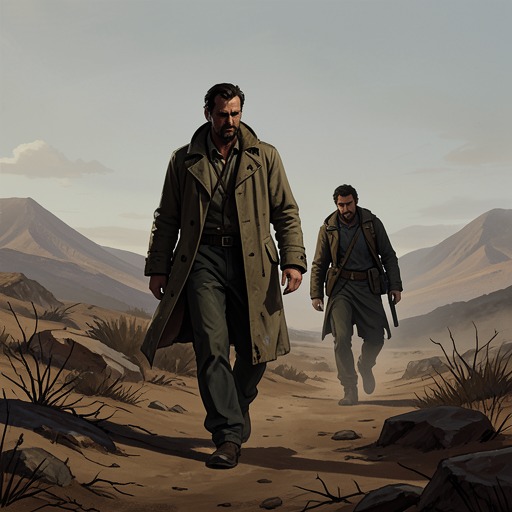
Charley Hoge breaks the stillness with the whip. The Oxen pull against the wagon’s weight, and its wooden wheels, leather, and metal fittings groan and rattle as it lurches into motion. Miller rides first, with Fred Schneider and Will Andrews following behind in a broad triangle. Miller faces forward; Schneider droops over his saddle, apparently asleep; Andrews turns repeatedly to look at the village they are leaving. In the dim light, its houses appear as grey shapes, while the earth huts seem like scattered heaps of debris. The party passes Jackson’s Saloon and rides out into the fields.
At the edge of town they leave McDonald’s small shack and the fenced salt vats behind. Miller looks back, grunts, and chuckles to himself. Beyond a grove of cottonwoods, the road rises over the riverbank. The riders stop, and the wagon halts behind them. They look back at the uncertain outline of Butcher’s Crossing as a faint yellow light appears in the darkness. Then they turn their mounts and descend toward the crossing.
Across the River and onto the Plains
The river is low where the party crosses, flowing around flat rocks set in soft mud. Moonlight breaks unevenly across its surface; the water reaches only a little above the Horses’ hooves and strikes the wagon’s wheel rims. Once across, Miller rises in his saddle and points west. He directs the party across the open country, expecting to reach the Smoky Hill River around midday.
Pink streaks appear in the eastern sky as the men leave the road. Within minutes it disappears from sight. Will Andrews turns in the saddle but can no longer identify where they left it, or see a landmark that might guide them west. The wagon rolls easily through dense yellow-green grass, leaving two narrow parallel tracks that are soon swallowed by the horizon. As the sun rises behind them, they ride faster under the growing heat, their heavy clothes damp with sweat. The departure thus becomes a literal loss of the road back: the tracks remain briefly visible, then the open plain erases them.
Significance and Early Signs
The expedition’s first view of the abandoned homestead along the way gives the outward journey an unsettled counterpoint. A once-cleared plot is filling again with grass; an old wagon lies before the door, and a wooden plow rots beside it. Miller observes that its occupants have given up with evident satisfaction. The scene offers no assurance that settlement can hold against the country, even as the expedition itself carries the tools and intentions of commercial extraction into it.
The journey also passes through a landscape already marked by the earlier hunt. Miller recalls riding among heaps of bison bones from Pawnee Fork to the end of Smoky Hill only five or six years before. He kicks a rib from a carcass and describes how farmers may gather the remains for fertilizer, while also recalling the many uses Indigenous people made of bison bone. His account ties the new expedition to a recent history of abundance, slaughter, and practical reuse; the bones are not an abstract warning but evidence of what the Kansas hunts have done.
The departure’s quiet form sharpens this irony. The men leave in search of a herd, yet the land they cross is not an untouched frontier: its bison have been reduced, its homesteads abandoned, and its paths increasingly crossed by other claims. Later, the sight of railroad tracks cutting across the plains will make the expansion of settlement and transport visible in steel. At the moment the wagon rolls west, however, Andrews’s attention is fixed on the receding village and the widening country ahead. The expedition begins as a route away from town, but the traces it encounters show that the wilderness he seeks is already entangled with hunting, commerce, and change.