The expedition’s supply wagon
Butcher's CrossingThe expedition’s supply wagon is the expedition’s indispensable but vulnerable piece of infrastructure: it carries water across the dry plains, follows the killing ground to collect Bison hides, and bears the accumulated weight of the hunt. Its uses change with the expedition’s fortunes. In the valley it becomes a mobile depot for the proceeds of slaughter; in the blizzard it slows the party and must be abandoned; during the spring crossing it is overturned and destroyed, with the hides and Oxen swept away. Through that sequence, the wagon links survival, commerce, and loss.
Purpose and Commercial Context
Before the expedition sets out, J.D. McDonald describes a business built around buying Bison hides from hunters, processing them, and selling them wholesale in Saint Louis. He says he handled almost one hundred thousand hides the previous year and expects two or three times as many this year. His operation depends on hunters bringing in their catch and on someone managing the paperwork and trade that turn pelts into money. The wagon belongs to the practical side of that system: a hunt produces no commercial return unless its heavy, awkward cargo can be gathered and transported.
Miller arranges for J.D. McDonald to buy the expedition’s hides, so the hunters will not have to carry them all the way to Ellsworth. The proposed price is four dollars per winter hide, and J.D. McDonald already has a buyer in the East. This agreement gives the wagon’s hauling work a definite destination and price. The expedition’s venture is not only a journey into the mountains; it is also an attempt to move a large quantity of animal skins through a chain of buyers and transport links.
Water, Draft, and Dependence
On the plains, the wagon carries a small reserve of water in a canvas container protected at its rear. The Oxen, grouped behind it at night, bump and push against the rear board, their restless movement audible to William Andrews as he tries to sleep. Their need for water makes the wagon more than a vehicle: it is also the party’s vulnerable water store, and the draft animals that pull it are themselves dependent on what it carries.
When the party consolidates its remaining water, Charley Hoge empties the canteens into a small wooden keg. After the last drops have been shaken out, only about four inches of water remain. Fred Schneider throws his empty canteen against the wagon in anger, objecting to the small quantity. The scene makes scarcity tangible through the containers themselves: a keg, emptied canteens, and a little water that must be measured against the needs of men and animals.
At the river, the wagon’s braking gear becomes crucial. As the exhausted animals reach the water, Charley Hoge calls for help with the brake. He hauls on it with his good hand and the elbow of his other arm while the locked wheels slide over the grass. William Andrews climbs onto the wagon and takes over the brake. Charley then releases the Oxen one pair at a time so that they can reach the river without being killed by the strain of pulling. The wagon’s mechanism briefly holds back the load and draft team, but the animals’ immediate need to drink dictates what must happen next.
Gathering the Hides
In the valley, the wagon serves as a slow-moving collection vehicle. Every two or three days Charley Hoge hitches up the Oxen and follows the irregular trail of hides left across the killing ground. Will Andrews and Fred Schneider, and sometimes Miller, help load the sun-dried skins as the wagon advances. It carries them back to camp, where the men unload them and build stacks beneath the trees.
The stacks make the scale of the enterprise measurable. Each rises seven or eight feet and contains roughly seventy-five to ninety hides. Fresh strips cut from a newly killed animal are threaded through cuts in the top and bottom skins and pulled tight to bind the pile. The burden is so heavy that all four men must push together to move a stack under the trees. The wagon thus participates in a repeated cycle: collection at the site of the kills, transport to camp, unloading, and laborious consolidation. The hides may be valuable, but before they can be sold they remain a physical mass that men and animals must move.
That work proceeds against a widening landscape of depletion. Miller recalls the former abundance of American bison on the Kansas plains and contrasts it with the small herds and reduced returns that remain. Later, as the valley herd dwindles, Will Andrews realizes that Miller will not leave while any bison survive. The wagon’s growing cargo is therefore not a neutral measure of prosperity: each load is the result of the same killing that leaves carcasses across the valley and strips the herd toward extinction.
Obstruction and Abandonment
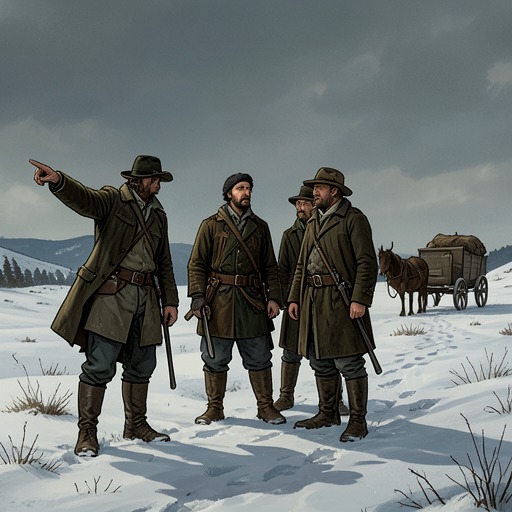
The wagon’s strength becomes a limitation when the weather turns. After snowfall begins in the valley, the party sets out through the increasingly heavy storm. The wagon moves through the dead animals, its wheels rocking over the bodies; rigid hides slide to the ground, and no one stops to retrieve them. Snow soon obscures the camp, while the men struggle to keep the animals moving and to see the route ahead.
As the wind intensifies, Miller decides that the wagon is slowing them too much. He orders William Andrews to hold the horses while he and Fred Schneider free the Oxen. The wagon, once necessary for water and cargo, has become an impediment to getting the party through the storm. Miller later reports that snow blocks the pass: he turned back about half a mile short, where the snow was around twelve feet deep and appeared worse farther on. The party cannot continue over the pass with the wagon, and its abandonment marks the failure of the expedition’s plan to carry its equipment and accumulated goods home by the intended route.
Destruction in the Spring Crossing
The wagon returns to the center of the narrative during the spring river crossing, when the expedition attempts to take its cargo across the swollen water. A large, broken-ended trunk races downstream and strikes Fred Schneider’s horse. The horse falls, crushing him; the collision and current then drive the wagon against rocks. The Bison hides sway against their restraints as water floods the rear of the load, and the wagon overturns with a sharp creak.
Charley Hoge moves clear of the Oxen as the overturned wagon drags them back into the river. For a short time the wagon drifts, partly steadied by the nearest animals, but the current pulls it across the rocky bed and turns it around. When the Oxen lose their footing, the wagon accelerates downstream and begins striking larger rocks. Its load harness breaks. The Bison hides burst outward and are swept away at once; the wagon and animals disappear downstream shortly after. The party watches the place where they vanished, but nothing can be recovered.
The wreck reverses the wagon’s earlier meaning. It had gathered the physical yield of the hunt into great, carefully bound piles; now its cargo is scattered and lost in minutes. On the return to Butcher’s Crossing, J.D. McDonald explains that the railway is being built fifty miles to the north and that hunters are selling bison meat to the railroad company while leaving the hides to rot. The expedition’s wagon cannot protect the value of its cargo from either a violent river or a changed market. Its destruction completes the material collapse of the enterprise: the labor of killing, skinning, stacking, and hauling does not become lasting wealth.