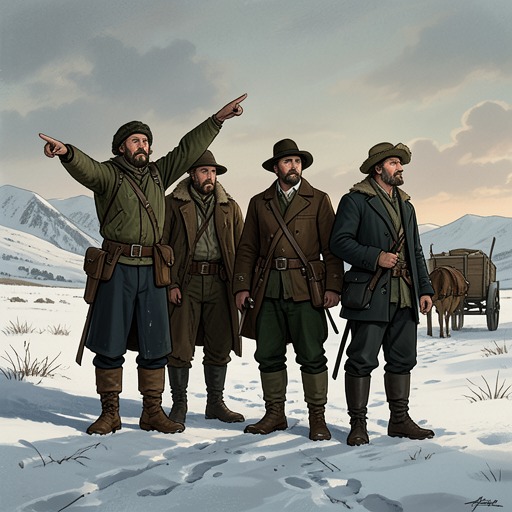
The mass buffalo hunt
Butcher's CrossingThe mass buffalo hunt is the destructive enterprise at the center of Miller’s expedition: a commercial slaughter that strips the Kansas plains of bison, continues on a larger scale in a secluded Colorado valley, and ends with the hunters unable to sell the hides they have accumulated. Its decisive irony is that the expedition succeeds at killing and preserving thousands of animals, yet neither the animals nor their hides yield the future its participants expected.
Causes and Commercial Scale
Four years before Miller recounts the decline, he and J.D. McDonald arrived in Butcher’s Crossing. Miller remembers a spring landscape in which the plains appeared black with bison, dense as grass and extending for miles. A two-week hunt could bring in a thousand to fifteen hundred animals, whose spring hides were especially valuable. By the time he tells the story, hunters are finding only small herds and may take just two or three hundred animals in a hunt. He expects Kansas to have no bison left to hunt within another year or two.
The trade depends on a chain of hunters, hide processing, buyers, and distant markets. McDonald says he buys hides brought in by hunters, processes them himself, and sells them wholesale in Saint Louis. He reports handling nearly one hundred thousand hides the previous year and expects the current year’s volume to be two or three times greater. His business organizes dozens of expeditions, paying fifty cents per head for raw summer hides; Miller rejects that arrangement, saying that he hunts independently or not at all. The scale of the trade is thus visible both in McDonald’s paperwork and in the increasingly depleted herds that supply it.
The hunt also belongs to a changing frontier economy. McDonald regards the settlement as dependent on hunters and hides, while expecting a railroad to make the land more valuable. On the expedition’s journey west, William Andrews sees the railway tracks cutting across the plain toward the first hills. The railroad’s arrival makes the region look newly connected, but its presence does not guarantee that every product of the hunt will find a buyer.
The Slaughter and Its Landscape
Miller’s account of the Kansas hunts makes their aftermath as tangible as their former abundance. He recalls riding through mountains of bones from Pawnee Fork to the end of Smoky Hill, a route where the remains had once stretched as far as the eye could see. A carcass weighing perhaps two thousand pounds lies among the prairie grass. Miller kicks a rib loose from its spine and later lifts a leg bone, describing how Indigenous people had fashioned bones into sewing needles, knives, arrow points, ornaments, toys, and combs. He contrasts those uses with the prospect that settlers will collect the remains for fertilizer, although he doubts they can make much of them.
The expedition’s journey also passes through a landscape already being used and crossed by others. Miller finds cattle tracks on a north-south trail and supposes that herds are being driven up from Texas. At a river bend, the hunters pass improvised shelters where children play and older Indigenous people sit near the entrances. The children stop to watch; the adults do not return Miller’s greeting. His contemptuous description of them, and his dismissal of them as people no longer worth shooting, registers the violence and hierarchy embedded in the hunters’ passage through the region.
In the Colorado valley, the killing becomes systematic and seemingly without a stopping point. Miller shoots while Andrews and Fred Schneider work faster and faster to skin the animals he leaves on the ground. They often cannot finish before nightfall and rise before dawn to cut into carcasses stiffened by the cold. The rifle’s repeated report presses on their nerves as the labor accumulates. At camp, Miller sits by the fire with black hunting dust left on his face, his stillness broken chiefly by his eyes.
The herd dwindles among the dead. Andrews becomes accustomed to the rancid smell of exposed carcasses and watches the surviving bison graze among their fallen companions on grass marked by dried blood. He understands that Miller will not leave while even one animal remains alive. Where Fred Schneider counts the passing days, Andrews measures time by the number of bison left and by the prospect of loading the hides for the journey back to Butcher’s Crossing. The slaughter has altered his sense of place as well: the world beyond the encircling mountains fades from memory, and the valley seems to give his own existence its shape.
Hides, Transport, and Failed Expectations
Before the expedition sets out, Miller tells the others that J.D. McDonald will buy their hides, sparing them the trouble of carrying them to Ellsworth. He names a price of four dollars apiece for winter hides and says McDonald already has an eastern buyer. The price and the promise of a buyer turn the hunt into a calculation: the animals’ deaths are expected to become a substantial commercial return.
When the party finally leaves the valley, it has three thousand first-rate winter hides, which Miller values at more than ten thousand dollars even after transport costs. The load is so heavy that the wagon’s wheels sink into soft ground and leave deep parallel ruts. At the mountain pass, the men use ropes to steady the wagon on the descent, walking beside and behind the bundles as the load shifts on the sloping trail. The carefully packed hides are a physical record of the hunt’s scale—and a burden whose value still depends on a market beyond the mountains.
That market has vanished by the time Miller returns. McDonald says that people who wanted a bison fur have already bought one, and that nobody wants more. He compares the change to the decline in demand for beaver pelts when beaver hats went out of fashion: a commodity can lose its buyers even while its producers continue to expect a price. He also tells Miller that hunters are now selling bison meat to the railroad company and leaving the hides to rot where the animals were skinned. The expedition has pursued the hides while overlooking another potential commodity, but that possibility arrives as an accusation after the killing is done, not as a remedy for it.
Consequences and Significance
The collapse is both ecological and economic. The Kansas herds that once made thousand-animal hunts possible have dwindled to small bands; the valley herd is reduced until Miller’s own persistence threatens to kill its last member. Bones accumulate across the plains, carcasses remain where they fall, and hides that once promised a fortune become unwanted stock. The trade’s dependence on distant taste is exposed: a successful hunt cannot secure a livelihood when buyers cease to value what it produces.
In his confrontation with Miller, McDonald counts the expedition’s cost as well as its missing profit: three or four thousand bison killed, hides packed only to become nesting places for mice, a wasted year, a destroyed wagon, calluses, and the memory of a dead man. His reckoning makes the slaughter’s consequences personal without reducing them to personal loss. The hunt has consumed animals, labor, time, and equipment, while the expected return dissolves with the market.
The expedition’s later recollections sharpen the contrast between living animals and what remains. Looking back across the valley as the men begin their descent, Andrews sees new grass and, even at a distance, the dark carcasses still scattered across the valley floor. The same place has held a charging herd, a blizzard, a season of killing, and the remains left behind. The mass hunt therefore culminates not in mastery of the wilderness or secure wealth, but in a landscape marked by slaughter and a commercial promise that cannot be redeemed.