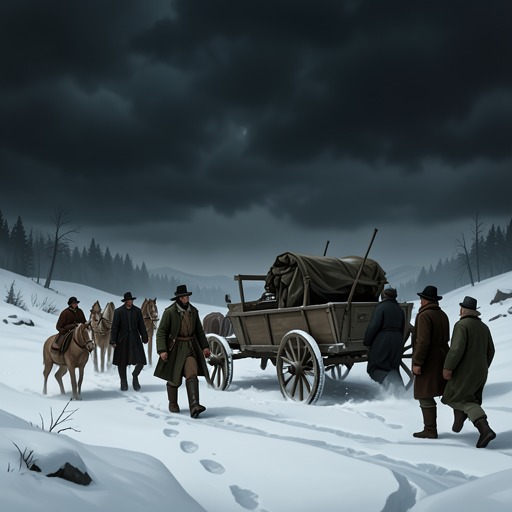
The return to Butcher’s Crossing and McDonald’s bankruptcy
Butcher's CrossingThe return to Butcher’s Crossing and J.D. McDonald’s bankruptcy expose the gap between the hunting expedition’s apparent success and the economic world it comes back to. Miller expects to turn thousands of winter hides into money under a four-dollar-per-hide agreement; instead, the party finds McDonald’s business deserted and learns that demand for bison hides has collapsed. The failure is more than a broken deal: it brings the expedition’s delayed return, the destruction of its haul, and the rapid depletion of the bison into one stark reckoning.
The trade behind the expedition
The encounter is grounded in a trade that had once seemed abundant. When William Andrews first arrived in town, J.D. McDonald described buying hides from hunters, tanning them himself, and selling them wholesale in Saint Louis. He had processed nearly one hundred thousand the previous year and expected two or three times that number in the current season. His business depended on the steady flow of hunters and hides—and on the distant buyers who made that flow profitable.
Miller’s account of the changing plains already supplied a warning. Four years earlier, he and J.D. McDonald had arrived in the area when, in spring, bison filled the prairie for miles. A two-week hunt could then yield a thousand or fifteen hundred animals, including valuable spring hides. By the time of their conversation, hunters might count themselves fortunate to kill two or three hundred in a hunt, and Miller expected Kansas to be exhausted within another year or two. The market’s later collapse therefore falls against an already shrinking resource: fewer animals meant a more precarious trade, even before buyers stopped wanting the product.
Miller had arranged to sell the expedition’s winter hides to J.D. McDonald for four dollars apiece, avoiding the need to haul them all the way to Ellsworth. The agreement had a concrete promise behind it: McDonald said he already had an eastern buyer. In the meantime, Miller’s comparison between his independent hunting and J.D. McDonald’s many small expeditions also exposed the trade’s unequal structure. McDonald organized thirty or forty crews and paid fifty cents per head for raw summer hides; Miller preferred to hunt on his own terms. The return tests whether even a high-value shipment, secured by a specific bargain, can escape the risks of the larger commercial system.
The abandoned office
As the party approached Butcher’s Crossing after the winter in the valley, Miller turned them toward J.D. McDonald’s premises to discuss the hides. He reminded William Andrews that more than three thousand remained where they had left them in the mountains. The expectation of payment shaped the stop: the hides were not incidental freight but the expedition’s intended return on months of hunting and labor.
The scene outside the office first seems to confirm that J.D. McDonald has prospered. Bales of hides crowd the small building and lie disorderly along the fence around the salt vats. A dozen or more wagons stand nearby, some upright but warped and weather-stripped, their wheels sunk into the earth and grass growing through the rims; others have been overturned, their iron-rimmed spokes rusting in the sun. Miller stares at the accumulation and recognizes that something is wrong. Inside, the evidence reverses the apparent picture of prosperity: papers and open ledgers are scattered across the floor, the desk chair is overturned, and the office is neglected. The ink on the papers William Andrews picks up has faded, while their stamps remain visible. He concludes that J.D. McDonald has not been there for a long time. Miller says nothing further; he turns away, and the men ride toward town.
The meeting in the bunkhouse
The search leads the men to the dormitory behind Jackson’s Saloon. A faint light shows through its partly open door. Inside, more than twenty beds stand scattered through a single large room; none has a mattress, and all are empty. In a far corner, beneath a weak lantern, J.D. McDonald sits bent over a small table. The abandoned office and the bare sleeping room together make the scale of his changed circumstances visible before he explains them.
He recognizes Miller and Will Andrews with astonishment, saying he had thought them dead. His hands tremble as he grips Andrews’s arms, and his whole body begins to shake. Once he has recovered enough to talk, the old commercial expectation collides with what has happened on the journey. Miller says that Fred Schneider was killed and that the hides they had brought back were lost in the river. J.D. McDonald assumes the wagon was lost too. Miller counters that the expedition is not wholly empty-handed: three thousand first-quality winter hides remain in the mountains, worth, by his estimate, more than ten thousand dollars even after paying for transport.
Miller invokes their agreement and insists that J.D. McDonald pay the four dollars per winter hide. McDonald confirms that the bargain was real, but says that there is no money with which to honor it. He had spent everything he possessed the previous autumn on thirty or forty thousand hides at the salt vats. He offers those hides for ten cents apiece and even offers Miller his land, but neither gesture supplies the cash Miller expects. The accumulated stock that looked like proof of prosperity outside the office is instead the remnant of a failed investment.
Collapse of the market and the meaning of the return
J.D. McDonald attributes the collapse to a change in demand, not to a dispute over the bargain. He compares bison hides to beaver pelts: when beaver hats went out of fashion, the trade in beaver skins ended. In his account, anyone who wanted a bison fur coat has already bought one, and buyers no longer want the hides. Miller protests that only a year has passed, but McDonald explains that he would have understood the change sooner had he stayed back east. He allows that demand might return in four or five years, but guesses that by then winter hides could be worth no more than summer ones—thirty or forty cents each. The expedition’s four-dollar price belongs to a market that has disappeared during its absence.
The railroad sharpens the reversal. Miller recalls J.D. McDonald’s former claim that land would become as valuable as gold once the railroad arrived. McDonald replies that the tracks are being laid fifty miles to the north, passing the town by. Meanwhile, hunters are selling bison meat to the railroad company and leaving the hides to rot where they skinned the animals. His calculation—that Miller might have earned nearly five cents per pound from the meat left to flies and gray wolves—makes the expedition’s waste newly legible. The animals had been killed for hides, but a changed transport and buying system has made the meat saleable while the intended commodity has lost its buyers.
The return therefore closes no triumphant circuit. The hunters come back to a town whose trade has failed while they were isolated in the mountains; their agreement is valid in memory but powerless against insolvency and vanished demand. The environmental and commercial histories converge: the herds that once darkened the Kansas plains have been reduced, the valley herd has been slaughtered with the expectation of profit, and even the value assigned to each animal changes with distant fashions and rail access. J.D. McDonald’s offer of hides and land cannot restore the bargain, while Miller’s insistence cannot restore the market. The return reveals that the expedition’s labor and killing have not secured the future its hunters imagined.