The spring river-crossing disaster
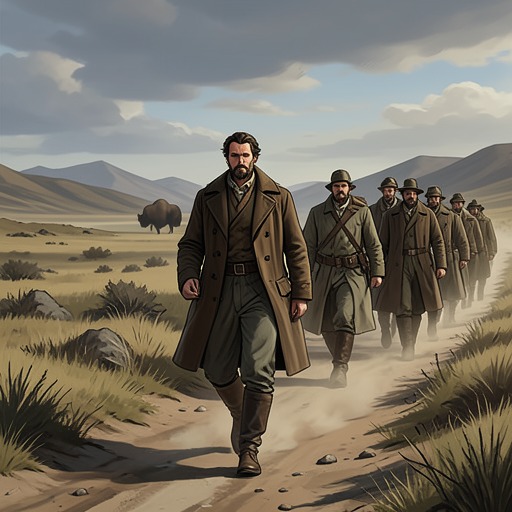
Butcher's CrossingThe spring river-crossing disaster is the expedition’s decisive return-route catastrophe: a ford that first appears manageable becomes the scene of Fred Schneider’s death and the loss of the wagon, oxen, and bison hides gathered during a winter’s work. The disaster makes the river’s force brutally concrete. Careful scouting and an apparently workable crossing cannot protect the party from a single tree borne downstream by the flood.
Background and exposure
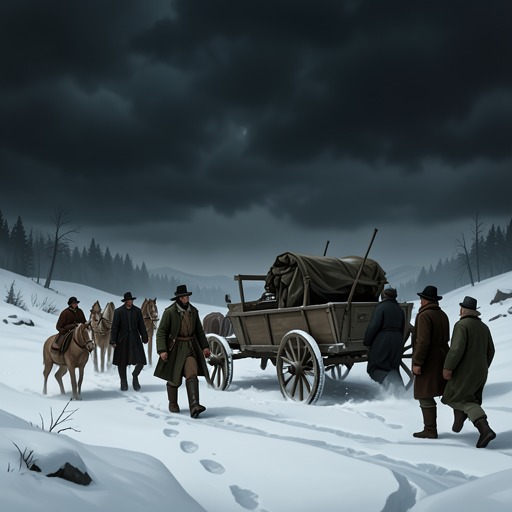
By the time the hunters reached the river, their return had already been shaped by difficult conditions. They had spent the winter trapped in the mountain valley after snow blocked the pass; when Miller tested the route, he found snow twelve feet deep at the point where he turned back. The thaw eventually released the party, but the spring river was in flood, and the wagon carried the bison hides on which the return’s material value depended.
The hunters had also spent months killing and processing the valley herd. As the herd dwindled, Andrews recognized that Miller would not leave while a single bison remained. Schneider and Andrews struggled to keep pace with the slaughter, working on carcasses left by Miller’s shooting. The crossing therefore placed an exhausted party, its draft animals, and a heavily loaded wagon in a powerful current after a winter in which the hunters’ attention had narrowed to the valley and its herd.
The crossing begins
Andrews first crossed on horseback to find a route through the river. He reached a shallower patch without encountering holes or stones that would obstruct the wagon, then signaled the others from the opposite bank. Miller entered the water and signaled Charley Hoge, who rode one of the lead oxen and used his good hand to urge the animals forward. The wagon followed, its load of hides swaying as the wheels entered the current.
The party’s arrangement seemed to offer a measure of protection. The lead oxen reached deeper water first, while those nearer the wagon remained in shallower water and could pull as the forward animals began to lose their footing. Andrews understood how the spacing might help the team draw the heavy wagon toward the far bank. His relief at seeing the plan work was brief. Schneider, who had stayed upstream of the wagon, followed the crossing at a short distance, watching the water ahead of his horse.
The accident and immediate losses
A large tree trunk, split at its downstream end, appeared in the current. Andrews saw it coming and ran along the bank to warn Schneider. The river’s roar drowned out his first call; Schneider raised his eyes and leaned forward to hear, but the trunk struck the flank of his horse. The animal struggled, then fell toward the wagon and rolled onto its back, crushing Schneider beneath it. When Schneider surfaced among the horse’s legs, the animal rolled again and struck him on the head with a hind hoof. He stiffened and sank beside it.
The horse and trunk hit the wagon’s side almost together. The impact drove the wagon against rocks, while the hide bales shifted and pulled at it. Water overwhelmed the horse still struggling in the current and flooded the rear of the convoy; the wagon overturned with a sharp creak. Hoge moved clear of the oxen as the capsized wagon’s weight dragged them back into the river. For a moment, the wagon drifted while the nearer oxen’s weight gave it some stability. Then the current pulled the wreck over the rocky bottom and turned it around, carrying the oxen with it.
The harness holding the load broke. The bison hides burst outward and were swept away. The men on shore watched the oxen struggle upside down in the current and the wrecked wagon spin downstream; then both vanished from sight. The party remained looking toward the place where they had disappeared, but the scene offered no recovery or rescue. The river had taken the transport, the draft animals, and the expedition’s accumulated hides in a matter of moments.
Consequences and significance
Andrews dropped to his hands and knees, turning his head from side to side in anguish. His first response was not to calculate the financial loss but to cry out and try to return attention to Schneider, whose fate remained the immediate human catastrophe. Miller, by contrast, stated the loss in the flat language of labor: a winter’s work had disappeared in two minutes. The contrast captures the event’s double consequence: a companion was dead, and the expedition’s hard-won cargo was gone.
The crossing reverses the apparent promise of the return journey. The hunters had survived the blizzard and reached the spring thaw with a load that represented months of killing and skinning; at the river, that labor proved vulnerable to a hazard the party could neither foresee nor control. The wreck also gives physical form to a wider pattern in the novel: the bison are reduced to carcasses and hides, while the commercial value attached to their slaughter remains subject to changing conditions. Later, J.D. McDonald observes that hunters are selling bison meat to the railroad while leaving hides to rot, underscoring how unstable the trade has become. The flood does not simply interrupt the expedition; it erases the return’s material reward and leaves its survivors to reckon with death and loss.