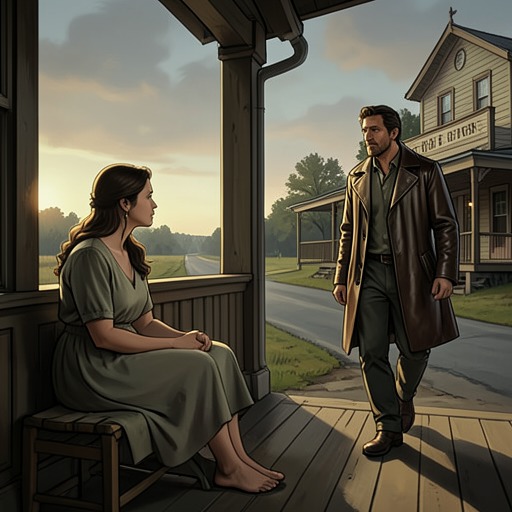
Will Andrews's final departure from Butcher's Crossing
Butcher's CrossingWill Andrews's final departure from Butcher’s Crossing is a quiet severance rather than a triumphant return: after the hunting expedition, the valley, and the settlement have all been stripped of their promises, he leaves at dawn without a destination. His last night with Francine briefly restores intimacy, but the morning ends not in a settled new life together but in a careful, solitary departure toward open country.
Background: A Settlement Built on Exhaustion
Butcher’s Crossing had presented itself to Will Andrews as a place of opportunity, but its prosperity depended on hunting and the trade in hides. J.D. McDonald had described the settlement as a hunters’ town and predicted that the railroad would change it. Miller’s account revealed the cost behind that confidence: in the four years since he and J.D. McDonald had arrived, Kansas’s immense bison herds had dwindled to scattered groups, and a hunt that once yielded a thousand or fifteen hundred animals in two weeks might now produce only a few hundred. Miller believed that within another year or two there would be no bison left to hunt in Kansas.
The landscape itself carried that history. Miller kicked a rib from the remains of a bison he estimated had weighed at least two thousand pounds, recalling that only five or six years earlier hunters rode through mountains of bones from Pawnee Fork to the end of Smoky Hill. The bones, once used by Indigenous people to make tools, ornaments, and toys, might now be collected by farmers for fertilizer. The old hunting grounds were not simply empty; their remains were being assigned new uses as the region was remade.
The railroad, long invoked by J.D. McDonald as a promise of future value, arrives in the story as another sign of change. Will Andrews and the others see its tracks crossing the plains toward the foothills. Later, J.D. McDonald tells Miller that the line is being laid fifty miles north, while hunters sell bison meat to the railroad company and leave the hides to rot. The commercial world has shifted, but the wastage that sustained the hunt remains. By the time Will Andrews leaves, the settlement and the hunting enterprise have both lost the future they once seemed to promise.
The Return to Francine
After the night of the hide-burning, Will Andrews leaves the fire and goes toward Jackson’s Saloon. His movement is hesitant: he passes the stairs, turns back, and only gradually acts on the impulse to climb them. Inside the dark building, he follows a wall past two doors before finding the one with a narrow line of yellow light beneath it. Francine opens the door and recognizes him. She tells him that she thought he was dead, as everyone had, and lets him in.
Their meeting makes his departure a relational choice, not merely a ride out of town. When Will Andrews turns toward the door after failing to finish what he meant to say, Francine asks him not to leave again. He stops and says he will stay this time, apologizing for making her ask. She wants him to remain with her, and distinguishes what she feels for him from her relations with the other men who come to her. The encounter offers the possibility of remaining, but the novel does not make it a simple reconciliation: the next morning, he watches her sleeping and understands her with a tenderness he had not allowed himself before.
Dawn: What He Takes and Leaves
After returning to Butcher’s Crossing from the fire, Will Andrews stays awake through the night. At dawn, he looks back on the people caught in the destruction: Miller riding away from the fire he had set, Charley Hoge staring into its glow and following Miller, and J.D. McDonald pursuing the animal that eludes him before collapsing in exhaustion. These remembered images gather the wreckage of the expedition and the settlement around Will Andrews, but they do not give him a new purpose or a plan.
Francine is still asleep when he quietly takes his bedroll. From the purse resting on it, he takes two banknotes and leaves the rest neatly on the table. He thinks that she will need money wherever she goes, while he will need money for a new rug and curtains for the windows. The division is practical as well as intimate: he does not take everything, and he does not leave her without resources. He watches her once more, then exits without waking her.
He goes to the stable, wakes the stableman, and gives him one of the two notes before saddling his horse. As he rides through the deserted street, the town appears already reduced to ruins. He imagines its wooden buildings being dismantled for their materials, its sod dwellings weathering away, and prairie grass gradually covering the road. Passing the smoking remains of J.D. McDonald’s shack and a grove of cottonwoods, he crosses a small stream and stops. The rising sun, the reins in his hand, the saddle beneath him, and the horse breathing under him ground the moment in bodily details rather than in any declared destination.
An Open Ending
Will Andrews turns from the burned settlement toward the plain. He knows only the general direction in which he is riding; where he is going, he expects to discover later in the day. He proceeds without haste as the sun rises behind him and warms the air. The uncertainty is not resolved into a new ambition or a return to the life he left behind.
That open-ended movement reverses the confidence with which he first sought the wilderness as a place where he might discover a final identity. After the valley’s mass killing, the winter confinement, the failed return, and the collapse of the hide trade, he can scarcely recall the passions that brought him west. His departure does not restore the settlement or undo the damage done there. It leaves him moving through a landscape no longer framed as a promise of self-discovery: direction remains, but destination and meaning are left unsettled.