Winter entrapment in the valley
Butcher's CrossingWinter entrapment in the valley turns the hunting party’s passage through the mountains into a months-long confinement: with the entrance pass blocked by snow, Miller’s judgment fixes the terms of their survival, while the slow, uncertain season erodes the men’s sense of time and tests their capacity to endure. Their release comes only when the snow begins to run off and Miller decides the route is open enough to leave.
Cause and Terms of the Confinement
Miller makes clear that the party cannot depart until the pass by which they entered is free. He presents the delay not as a matter of preference but as a necessity, explicitly including Schneider as well as Andrews in the warning. Even after three or four weeks of fair weather, he says, the pass will not be usable before the end of winter. The men must stay until spring.
The duration is longer than Andrews appears ready to accept. Miller gives a minimum of six months and a maximum of eight, and tells him to prepare for a long wait. This estimate transforms the blocked pass from a temporary obstacle into the defining condition of the party’s life in the valley: there is no immediate alternative to waiting and making preparations to remain.
Weather and the Long Wait
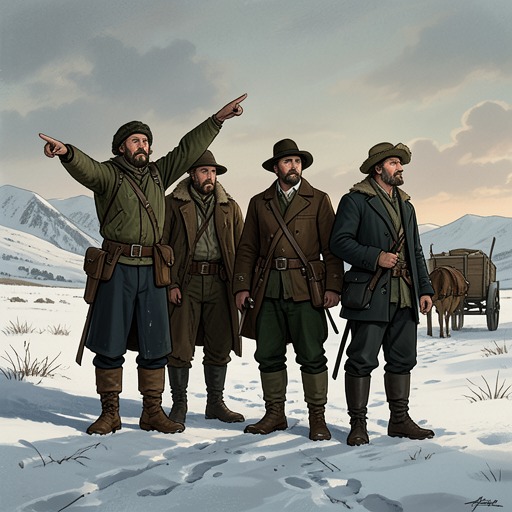
The confinement unfolds through repeated, sharply contrasting conditions. Some days are warm, bright, and so still that the snow lodged on pine branches does not move. At other times, cold grey winds funnel along the valley between the mountain slopes. Snow falls gently through the still air or is driven into great drifts around the shelter, making it seem from outside like a cave cut into the snow.
Night brings a more constant hardship. Even when the men huddle together or wrap themselves in bison-hide blankets, the cold remains severe and their sleep poor. Weeks blur into months; changing weather does not offer a reliable sign that the thaw is near. The physical shelter protects them, but its snowbound surroundings also make the party’s isolation visible.
Time becomes nearly as difficult to bear as the weather. Schneider marks the days with notches on a pine branch, and Andrews checks them for a while, but counting grows mechanical and the number loses meaning. He registers the passing months more clearly when Schneider regularly asks for his pay: Andrews counts out the money and hands it over, yet this repeated transaction feels like a duty rather than evidence that time is moving. The calendar continues, but Andrews experiences himself as fixed in place.
The snow also imposes a lasting physical limit. After wandering away from camp without snow goggles, Andrews is blinded by sunlight reflected from the hard snow. He reaches the shelter with Schneider’s help and lies in darkness for nearly three days while his eyes recover. Thereafter he does not look at the snow without protection and never returns to the immense white valley. The ordeal shows how even a brief movement beyond camp can expose a trapped person to the landscape’s hazards.
Confinement’s Psychological Pressure
As departure approaches, Andrews’s impatience intensifies, though he cannot explain it to himself. He understands Schneider’s plainly bodily hopes for decent food, a clean bed, and sexual release; his own desire is at once more diffuse and more acute. He wonders what he expects to recover and what he hopes to escape, but the questions do not resolve the painful urgency he feels.
He repeatedly follows the tracks Miller and Schneider have made while scouting the pass, stopping where thick snow still covers the narrow opening between two rocks. The reddish-brown peaks stand against the blue sky, but Schneider’s crooked track through the snow gives Andrews no clear view of the country beyond. The blocked gap concentrates his longing into a visible boundary: the way out is there, yet remains inaccessible.
Thaw and Departure
The party waits even as snow gathered in the forest’s shade begins to melt and trickle past the camp. Miller remains composed, and the others continue to wait until the end of April. Then, one night by the fire, he announces that they will load the wagon and leave the following day.
The announcement breaks the long suspension at once. Schneider springs up with a jubilant shout, slaps Miller on the shoulder, and circles around laughing and repeating himself. His exuberance contrasts with the months of cold, poor sleep, and monotonous waiting that preceded it. The snowbound season ends not through a dramatic rescue but through the gradual change in the weather and Miller’s decision that the party can finally move.