
McDonald’s Hide Trade and Collapse
Butcher's CrossingThis flow traces J.D. McDonald’s rise as a hide merchant, his dependence on a booming trade, and the financial collapse that leaves him unable to honor his agreement with Miller.
increasing Bearing strength in each event
 decreasing
Bearing strength in each eventdecreasingA Crowded Trading Office
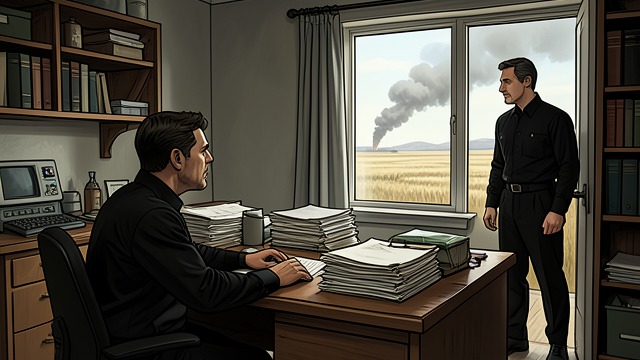
A Merchant Among the Hides
A growing business
J.D. McDonald receives Will Andrews in a cramped office crowded with ledgers, loose papers, and accounts. His trade in bison hides has expanded quickly, and he says that he processed nearly a hundred thousand hides the previous year, with still greater volume expected.
Confidence in expansion
McDonald presents himself as a practical man with a future-oriented plan. He believes that growing settlement and the coming railway will transform Butcher’s Crossing into a genuine town, and he urges Will Andrews to join him in business rather than spend time with hunters.
The disorder in the office hints at the cost of that confidence: McDonald is already overwhelmed by paperwork and relies on a market whose scale seems to promise endless demand.
The Buyers’ Agreement
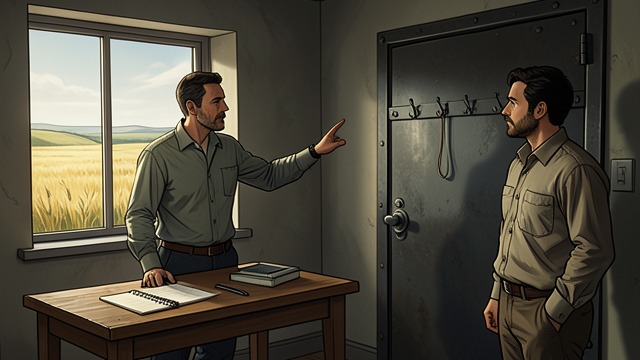
A Contract for Winter Hides
A promised market
On his return to Butcher’s Crossing, Miller tells Fred Schneider and Will Andrews that he has spoken with J.D. McDonald. McDonald has agreed to buy winter hides for four dollars apiece, with an eastern buyer already secured. The price makes the difficult journey appear commercially worthwhile.
Risk made concrete
Fred Schneider questions the delay before winter hides can be sold and doubts Miller’s claim that the distant herd still exists. Miller argues that a large haul could bring in thousands of dollars, while Will Andrews has already supplied the expedition’s capital.
McDonald’s promise links the hunt to a broader commercial system: the expedition is not merely a private adventure, because its success depends on a buyer, a price, and a market that can change while the hunters are away.
The Deserted Office
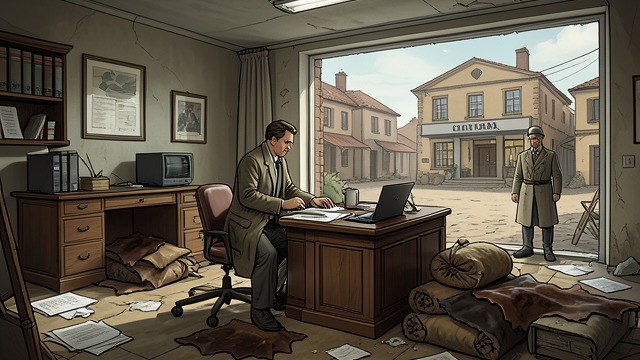
A Business Left Behind
Signs of abandonment
After returning from the mountains, Miller and Will Andrews find bales of hides and abandoned wagons gathered around J.D. McDonald’s office. Inside, papers and ledgers lie scattered, the chair is overturned, and the office appears to have been unattended for a long time.
A changed settlement
The village itself seems almost vacant. A new hotel keeper knows little about McDonald, and familiar commercial activity has given way to dust, idle buildings, and strangers. Miller reads the neglected office as evidence that their buyer may have disappeared.
The expedition’s return exposes how fragile its economic plans were. The men have survived a winter in the mountains, but the business structure they expected to receive them has deteriorated in their absence.
The Hide Market Fails
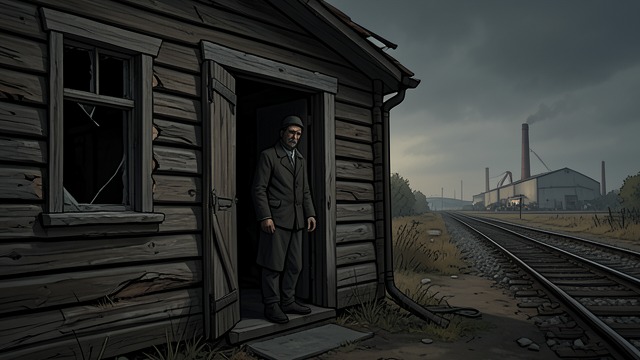
The Price Falls Away
A failed promise
In the empty dormitory, J.D. McDonald explains that the bison-hide market has collapsed. He had invested everything in tens of thousands of hides, but demand has vanished, leaving him unable to pay Miller the agreed price or buy the expedition’s remaining stock.
A trade without a future
McDonald compares the collapse to the earlier decline in beaver-hat fashion: a commodity that once seemed valuable can become unwanted without warning. The railway will pass far to the north, and the meat trade has begun to matter more than the hides that once sustained Butcher’s Crossing.
Miller insists that their agreement was made between men, but McDonald can offer neither money nor a viable market. The expedition’s labor and risk cannot restore the economic world on which its calculations depended.
The Burning of the Stock
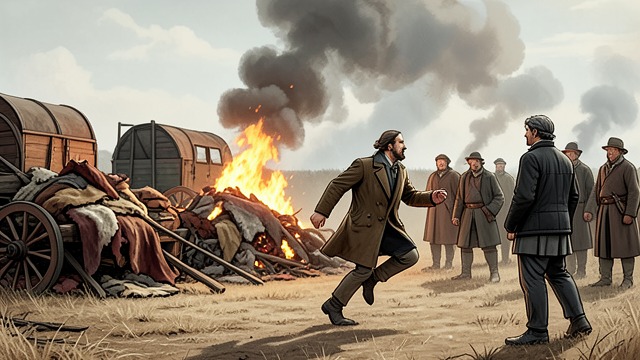
The Merchant’s Stock in Flames
McDonald confronts the fire
When J.D. McDonald discovers that Miller is burning the stored hides and wagons, he rushes toward the blaze in disbelief. Will Andrews stops him from running into danger, while the villagers stand watching the fire consume the remains of the trade.
Ownership beyond price
McDonald tells Will Andrews that the hides still mattered because they were his, even though they had lost their market value. His attempt to strike Miller fails; exhausted, he abandons the chase and watches the destruction from a distance.
The fire turns a financial collapse into a personal reckoning. McDonald’s enterprise, Miller’s haul, and the settlement’s hide economy are all reduced to ash, while McDonald is left to contemplate leaving the country that had once seemed to promise him a future.
Soon after Will Andrews arrives in Butcher’s Crossing
After Miller returns from Ellsworth, before the expedition leaves
On the expedition’s return to Butcher’s Crossing in late May
That evening, shortly after the party finds J.D. McDonald
Later that night, after Miller learns the hides have no market
