Bison Valley
Butcher's CrossingBison Valley is the remote mountain basin at the center of Miller’s hunting expedition: a place whose stillness and apparent abundance become the setting for the systematic destruction of its bison herd. For William Andrews, the valley first appears almost untouched, an immense landscape that overwhelms the boundaries of the familiar world; for Miller, its rich grass and difficult exits make it a hunting ground with a plan. The valley’s transformation from sanctuary-like wilderness into slaughter site—and then into a place of confinement—makes it the expedition’s defining landscape.
Setting and Discovery
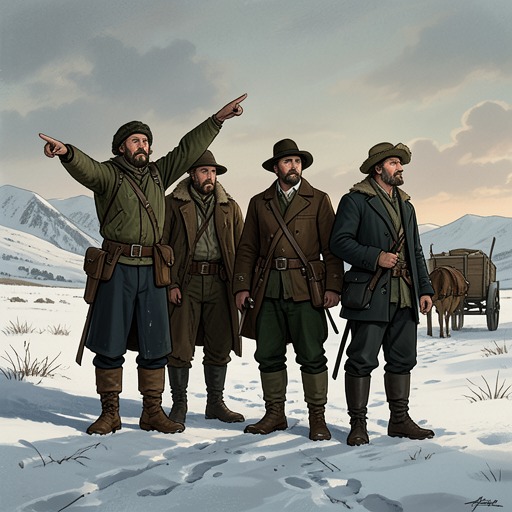
The expedition approaches through foothills and a wooded mountain landscape. After a long, slow descent, the men reach a narrow, level valley whose grass extends beneath the mountains. The view initially seems to Andrews to belong to a land no human has entered. Exhausted, he catches his breath rather than disturb its quiet. When Miller points out a moving black mass in the distance, the apparent emptiness gives way to the sight of a herd so large that it seems to ripple across the valley.
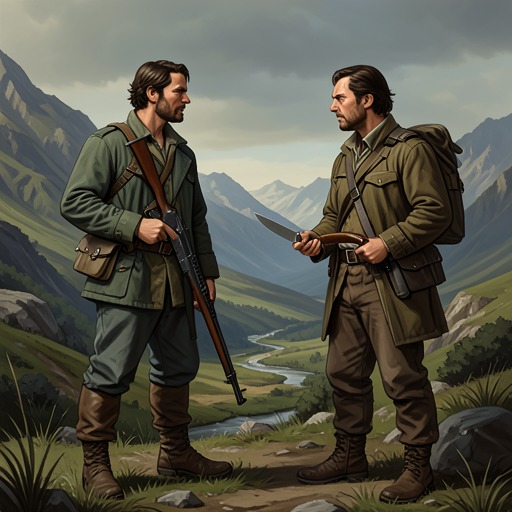
The valley has both an inviting surface and a difficult geography. The men make their first camp beside a small spring, where water runs over smooth rock into a pool and then disappears beneath the dense grass. Miller says that a lake lies a few miles farther south, where the bison drink. Around the first bend, he recalls, the valley broadens to roughly four or five miles across and continues for twenty or twenty-five miles. He describes its grass as thick and quick to grow back, and estimates that it can support an enormous number of animals. Steep mountains and stretches of sheer rock, however, hem in the basin; Miller regards the approach they came through as the only practical escape route for the herd.
A Landscape Already Altered by Hunting
The valley’s abundance stands against the depletion Miller has witnessed elsewhere. He recalls arriving in Kansas four years earlier, when spring plains were black with bison for miles and a small hunting party could take a thousand or fifteen hundred animals in two weeks. By the time he speaks, the great herds have broken into smaller groups, and a successful hunt may yield only two or three hundred. He expects Kansas to have little left to hunt within another year or two. The valley promises a new frontier for a trade whose older hunting grounds are being emptied.
The remains of that earlier abundance are visible in the prairie’s bones. Miller remembers riding among heaps of them from Pawnee Fork toward the end of Smoky Hill, a landscape made by years of Kansas hunts. He kicks a rib from a large skeleton and says that even these scattered remains may soon be collected by farmers for fertilizer. His recollection of bison bone as a versatile material—used for tools, arrow points, jewelry, combs, and toys—contrasts with the prospect of its reduction to agricultural waste. The valley’s living herd thus enters a history already marked by the conversion of bison into usable parts and by the disappearance of the animals themselves.
The Hunt and the Herd’s Decline
Miller treats the valley’s enclosing terrain as an advantage. At first, his plan is to begin with the small herd the men have seen and continue farther along the basin, where the steep slopes leave the bison few routes out. His confidence rests on a combination of geography and numbers: the animals are numerous, the grass is good, and the terrain appears to let the hunters control where the hunt unfolds.
The work soon gives the valley a different character. Miller shoots continuously while William Andrews and Fred Schneider struggle to skin and butcher the animals quickly enough. They work late and rise before dawn to deal with carcasses stiffened overnight. The sound of Miller’s rifle becomes a monotonous pressure on the men as well as a recurring feature of the landscape. At camp, Miller’s face remains blackened with gunpowder, the residue so embedded that it resembles a mask. The animals’ bodies cover the ground, and their rancid odor becomes so familiar to Andrews that he nearly stops noticing it. The survivors continue to graze among the dead.
By the twenty-fifth day, more than three weeks into the hunt, the herd has fallen from about five thousand to fewer than three hundred. The remaining bison have begun dividing into very small groups, and Miller rarely kills more than twelve or fourteen at a time. The hunt slows, but its direction does not change: Miller continues closing in on the survivors. Andrews understands that Miller will not leave while a single bison remains. This expectation also alters Andrews’s sense of time. He measures the prospect of departure by the number of animals left, not by the succession of days, while the world beyond the mountain-ringed valley becomes dim and dreamlike in his memory.
Exposure and Confinement
The herd is not simply a collection of targets. When thirty or forty bison charge across the valley, they move with the force and apparent unity of a single body. The ground shakes, dust rises and vanishes in the wind, and the animals swerve as they advance. Andrews is momentarily unable to believe that his rifle can affect the oncoming mass or that it will alter course. The scene reverses the hunters’ usual relation to the herd: for a moment, the men face the power of the animals as a collective force rather than pursuing them as separate kills.
The valley’s isolation also exposes the expedition to weather it cannot control. Snow begins falling while the men are still out in the basin. The storm lasts two days and three nights, leaving them trapped on the plateau beneath the drifts. They lie under bison hides in cramped shelters, sometimes emerging to relieve themselves or dig air holes into the snow. When Miller returns from scouting, he reports that he had to turn back half a mile from the pass, where the snow had reached twelve feet and was deeper farther on. The same enclosed terrain that had seemed to keep the bison from escaping now helps hold the hunters in place.
Significance and Afterlife
For Andrews, the valley is both a physical landscape and an experience of scale that unsettles ordinary identity. Earlier, while contemplating the immense western horizon from Butcher’s Crossing, he had remembered the disorientation of childhood before the Atlantic. In the valley, the forest itself seems to lose its dimensions: its pine trunks merge into a motionless green expanse, like a frozen sea. The vision draws him toward absorption in the wilderness, but the work of killing and processing animals makes the landscape concrete, laborious, and materially costly. Awe does not protect the valley from exploitation; it coexists with it.
The expedition’s pursuit of value also belongs to a changing market. Later, McDonald tells Miller that hunters are selling bison meat to the railroad company while leaving hides to rot where the animals were skinned, and points out the money that could have been made from the meat. His remark describes a market shift in which the same animal can be treated as valuable in one form and discarded in another. Against that history, Bison Valley’s apparent abundance proves temporary: its grass can renew itself, but the relentless removal of its herd changes what the landscape contains. The basin remains immense in Andrews’s memory, yet the expedition’s actions make it a record of how quickly a seemingly inexhaustible wilderness can be turned into a depleted resource and a trap for those who believed they could master it.