Jackson’s Saloon
Butcher's CrossingJackson’s Saloon is the principal public meeting place shown in Butcher’s Crossing, where William Andrews first encounters Miller and the others who will shape his expedition. Set among the settlement’s few rough buildings, it joins the town’s everyday traffic to its commercial and personal dealings: behind its long awning and marked entrance, men drink and play cards, while decisions about the hunt are made at tables in the dim interior. The saloon is not merely a backdrop to Andrews’s arrival. Its rooms repeatedly bring him into contact with the people and choices that draw him into the story.
Setting and Exterior
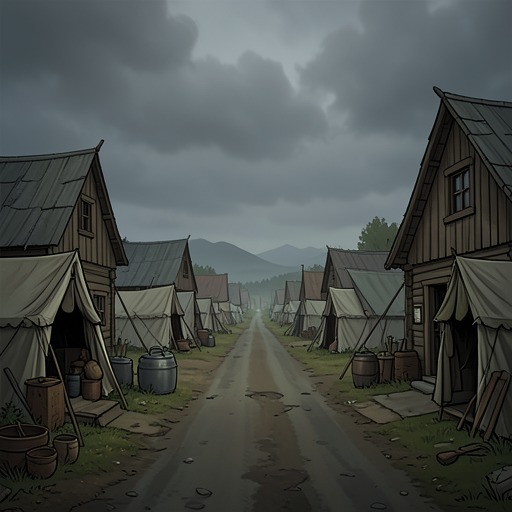
Butcher’s Crossing appears small enough to take in almost at a glance: six wooden shacks stand along a dirt street, with scattered tents beyond them. Jackson’s Saloon occupies a long, two-story rectangular building. A broad awning shades the entrance, above which an elaborate sign in red letters edged with black identifies the place. Men sit on a bench outside and watch the stagecoach stop; from within come a continuous murmur of voices and the clink of glasses. The sound makes the saloon a conspicuous center of activity amid the town’s rough, spare structures.
The surrounding street remains visible in the saloon’s nighttime scenes. Yellow light spills from open doors and windows, and figures moving near the textile shop opposite seem enlarged by their shadows. Horses stand tied to a crooked outer fence, their coats and eyes catching the light from the saloon. Beyond the building, two lanterns mark the stable, while a blacksmith’s forge glows red and its hammer strikes metal. These nearby details place the saloon within a working settlement rather than apart from it: lodging, animal care, trade, and drink occupy the same short stretch of street.
Rooms and Activity
The entrance room is long and narrow, with a large bar made from two thick boards set on half-logs over an uneven plank floor. Half a dozen lanterns hang from unpainted black beams. Their harsh yellow light falls on the objects below and leaves the rest of the room in indistinct shadow. The burned smell of paraffin mingles with sweat and alcohol. The saloon’s interior is therefore not a single open public room but a sequence of spaces, with a closed door leading from the narrow front room into a larger, less brightly lit hall.
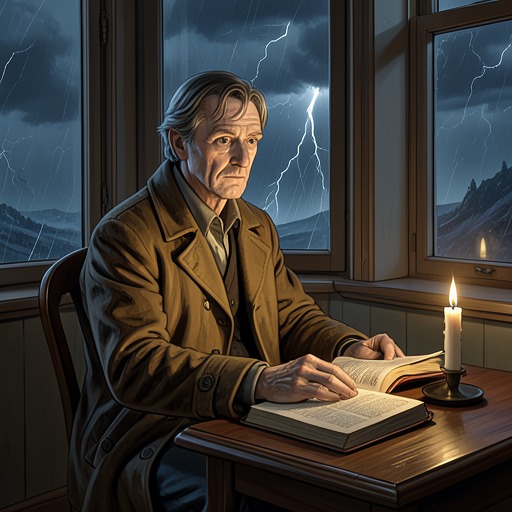
In the back room, tables leave an oval space open at the center, and a straight staircase rises at the far end. Some of the lanterns hanging from the soot-covered beams are unlit, so cones of light alternate with broad patches of darkness. Men play cards without turning to acknowledge Andrews; the sounds of cards and chips on wood stand out against the quiet. Nearby, two young women whisper together, a man and a woman sit close by, and other small groups occupy tables in the shadows. The room’s activity is varied but subdued. Its slow, almost absorbed atmosphere briefly makes Andrews forget why he entered, before he notices Miller watching him from a table at the back.
The Saloon as a Place of Business
Andrews comes to Jackson’s Saloon after J. D. McDonald has told him he may find Miller there. The first encounter establishes the saloon as the place where Andrews’s proposal becomes a practical arrangement. Miller asks what he wants, and their talk turns to the costs of the expedition. Miller says Andrews can join the hunt if he pays for the wagon and provisions; the party will use oxen, which can graze along the route and pull heavy loads, though they travel slowly. The setting makes the shift from ambition to commitment tangible: Andrews is not only hearing about a journey but agreeing to finance its essential transport and supplies.
The agreement is sealed at the table in the presence of Francine and Charley Hoge. Miller calls for more whiskey and proposes a toast before Andrews hands over the money. The lantern catches the amber-red reflection in Miller’s raised glass; Andrews, dulled by heat and drink, sees the mountains in his mind as fragments that turn into kaleidoscopic patterns. Francine returns with the bottle, and her smile catches his attention through the tears brought on by the whiskey. The transaction is thus presented alongside sensory confusion and attraction, not as a detached business exchange. The saloon gathers together the financial terms, the ritual of the toast, and Andrews’s unsettled response.
Later, Miller brings Fred Schneider into the saloon’s larger room for a discussion with Andrews and Charley Hoge. Miller reports that, after returning from the river, he spoke with McDonald, who will buy the hides so the party need not carry them to Ellsworth. At their table, Schneider sits with his back to the stairs and his face toward the room; Andrews faces him, with Charley Hoge on one side and Miller on the other. The conversation connects the saloon to the expedition’s commercial arrangements as well as its departure: the place serves as a meeting room where the hunters can consider how the products of the hunt will be sold.
Encounters and Narrative Role
Jackson’s Saloon also frames Andrews’s encounters with the people around Miller. On his first evening, he crosses the open space in the back room toward Miller’s table, where Francine and Charley Hoge are seated. The silence before he speaks and the dark, smoky distance he crosses give the introduction a quality of hesitation. Later, the saloon’s rooms accommodate a different kind of tension: after becoming angry while Schneider speaks with Francine, Andrews leaves for the night air. Francine calls to him from an angle of the building and waits on the first step of a steep exterior staircase. She tells him she expected him and had been waiting for him to come out. The threshold and stair place their meeting between the public room he has left and the street beyond.
Across these scenes, Jackson’s Saloon links public sociability with private decisions without separating them into distinct worlds. Card games and whispered conversations continue around the tables where the expedition is arranged; the bar, the larger hall, the staircase, and the street-facing entrance each become points in Andrews’s passage through the town. The saloon’s alternating light and shadow also shapes how he sees it: people appear first as figures in a dim room, then as participants in negotiations or personal encounters. Its importance lies in this repeated convergence. Andrews arrives seeking Miller, commits money to the journey, learns that the hides already have a prospective buyer, and leaves the building only to meet Francine waiting at its edge.