Miller’s discovery of the Colorado bison valley
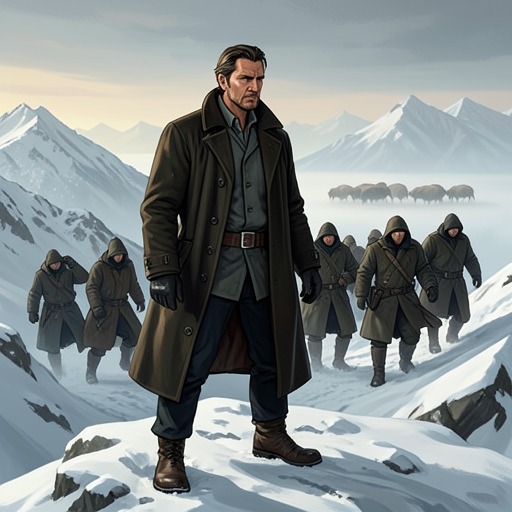
Butcher's CrossingMiller’s discovery of the Colorado bison valley is the moment a chance detour reveals a vast, concealed refuge for American bison—and the beginning of its transformation into a hunting ground. While seeking bears in Colorado in 1863, Miller followed a bison-worn track into an isolated mountain valley. Its apparent seclusion made it seem untouched; the hunting expedition that later reached it made that isolation temporary.
Background: Dwindling herds on the plains
By the time Miller told the story of his discovery, the Kansas hunting grounds that had sustained him were already depleted. Four years earlier, he recalled, bison had covered the plains in dense numbers, and a hunter could bring back a thousand or fifteen hundred hides after a fortnight. Now the animals traveled in small herds, and two or three hundred per hunt counted as a good return. Miller expected that within another year or two there would be nothing left to hunt in Kansas.
The local trade treated hides as a commercial resource. McDonald organized thirty or forty hunting expeditions at a time and paid fifty cents per head for raw summer hides, while Miller insisted that he hunted for himself or not at all. His account of the shrinking herds establishes the economic setting for the discovery: the valley represented a place where bison remained plentiful just as hunting elsewhere was becoming less productive.
The discovery in Colorado
In the autumn of 1863, Miller was trapping beavers in Colorado. The beavers were late shedding their coats, so he left his traps by the river and rode his mule into the mountains in search of bears. Charley Hoge, whose hand had been lost the previous year, stayed in Denver rather than accompany him. Miller climbed the mountains for nearly three days without finding a bear.
On the fourth day, while continuing north, he came to a sudden opening in the mountain and noticed a small gorge. Expecting a stream where animals might drink, he descended; the descent took nearly the whole day. There was no stream at the bottom. Instead, he found a level strip of bare, hard-packed earth, ten or twelve feet wide, resembling a road cut through the mountain. He recognized it as a trail made by bison repeatedly passing over the ground.
Miller followed the track along the mountain for the rest of the day. By evening it led into a flat valley that wound through the mountains as far as he could see. Small herds of American bison were scattered across it. Their autumn hides were thick and full, and from where he stood Miller estimated that three or four thousand animals were visible; more occupied recesses of the valley beyond his sight. The discovery was therefore not simply of a hidden passage but of a substantial population concealed within difficult terrain.
Seclusion and the shape of the landscape
Miller spent two days in the valley and found no sign of another person. He saw no human tracks on his return either. Near the river, the bison trail bent along the mountain and disappeared among trees, so a traveler following the river could pass without seeing it. The concealment was practical as well as visual: the entrance was not obvious, and the route itself vanished into the landscape.
Years later, when Miller led Andrews and the others toward the valley, the approach again unfolded as a discovery. They crossed the railroad tracks as the line advanced across the plains, reached the foothills, and followed a descent toward the river and the mountains. At the end of a steep trail through the pines, the land opened abruptly into a long, narrow, level valley. Andrews saw its grass and stillness before Miller pointed out a dark, moving mass beneath the trees: the herd. His first view conveyed both the place’s extraordinary quiet and the scale of the life within it.
The forest along the approach also unsettled Andrews’ sense of scale. Looking into the ranks of pine trunks, he lost sight of the mountain’s outline and imagined the trees as a motionless sea. The valley’s apparent immensity and remoteness helped make it seem beyond ordinary human reach. Yet the expedition’s arrival demonstrated that remoteness was not protection once someone knew the route.
From refuge to hunting ground
The later hunt exposed the cost of turning Miller’s discovery into a destination. Andrews and Schneider struggled to skin the animals as quickly as Miller killed them, working after dark and rising before dawn to keep pace. The herd diminished while carcasses accumulated across the valley. Andrews understood that Miller would not leave while a single bison remained; he measured the time by the shrinking number of animals rather than by the passing days.
That destruction echoed the earlier history of the Kansas plains. Miller had described riding for miles through mountains of bison bones, from Pawnee Fork toward the end of Smoky Hill, the remains of the great hunts. He expected the bones themselves to be gathered by farmers and used as fertilizer. In the Colorado valley, the same conversion of animals into usable material and commercial value reached a more concentrated setting: a place that had seemed hidden from human use became the site of a mass killing.
The valley’s isolation did not make it outside history. By the time Miller discussed the expedition’s losses with McDonald, the railroad was being laid fifty miles to the north, and hunters were selling bison meat to the railway company while leaving hides to rot where the animals had been skinned. McDonald pointed out the value of the meat Miller had left behind. The discovery thus stands at the intersection of ecological abundance and changing markets: the valley first appears as a refuge from the depleted plains, then as a resource exposed to hunting, transport, and waste.