Miller’s policy of exterminating entire bison herds
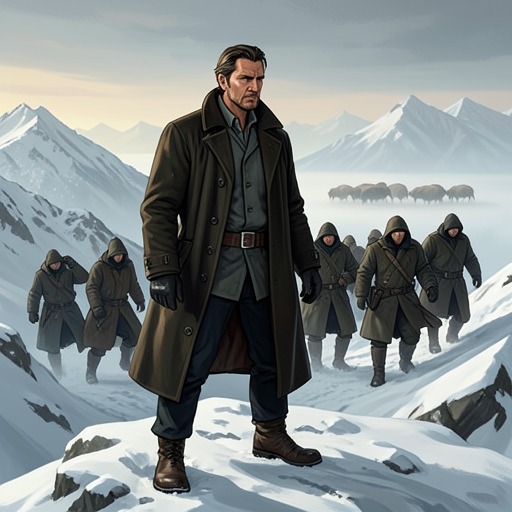
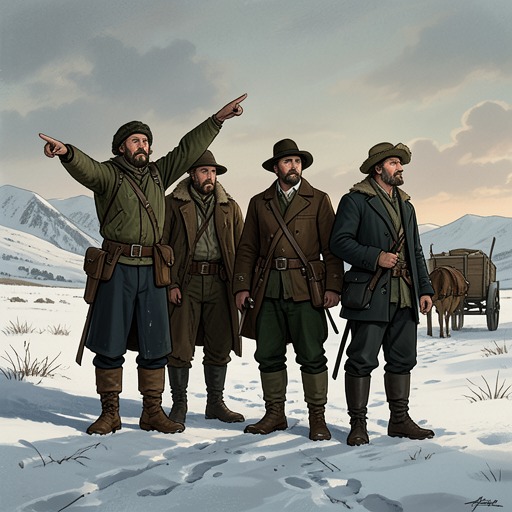
Butcher's CrossingMiller’s policy of exterminating entire bison herds is the governing logic of his hunting expedition in the Colorado valley: he intends to keep killing until not one animal remains. What begins as a venture tied to the sale of hides becomes an absolute objective, overriding the limits of labor, the practical question of transporting the yield, and the objections of his companions. Its consequences are both ecological and personal: the herd dwindles into a landscape of carcasses, while the men’s expected profit is eventually undone by the collapse of demand for bison fur.
Commercial Origins and Ecological Warning
Miller’s approach emerges from a trade already transforming the plains. He tells William Andrews that he arrived in Kansas four years earlier, when vast spring herds could be seen stretching across the prairie. In those days, a two-week hunt could bring in a thousand or fifteen hundred animals, including valuable spring hides. By the time of their conversation, the great herds had broken into small bands; a hunter was fortunate to take two or three hundred animals in a trip. Miller expects that within another year or two Kansas will have nothing left to hunt.
The scale of the trade makes this depletion more than a distant prospect. J.D. McDonald buys and resells bison hides, processes them himself, and says that he handled nearly one hundred thousand the previous year, with this year’s volume expected to be two or three times greater. His operation depends on hunters supplying hides and on wholesale buyers, linking the killing on the plains to processing and distant markets such as Saint Louis. Miller rejects the low-paid arrangement used by McDonald’s hunting expeditions, which pays fifty cents a head for raw summer hides. He says he hunts for himself or not at all; the valley expedition thus joins his independence as a hunter to the prospect of a much larger return.
The remains of earlier hunts make the costs of that system visible. Beside a large skeleton, Miller recalls a time when mountains of bones extended for miles, from Pawnee Fork to the end of the Smoky Hill River. He kicks a rib loose and describes the remains as the result of the Kansas hunts. Farmers, he predicts, will collect such bones for fertilizer, although he doubts they will be of much use. He also remembers the many things made from bison bone, including tools, arrow points, jewelry, toys, and combs. The discarded skeleton records a change in how the animal’s remains are valued: once used in many forms, they may now be treated as little more than a field amendment.
The Decision to Kill the Whole Herd
Before the valley hunt, Miller arranges for J.D. McDonald to buy the expedition’s hides at four dollars apiece for winter skins, with a buyer already secured in the East. The price and outlet make the journey appear commercially grounded. But when Fred Schneider questions the work required to skin the animals, Miller insists that every bison they kill will be skinned, even if he has to keep shooting until the next day. He offers to help with the skinning, then makes clear that Schneider will do it regardless. The policy demands not only the deaths but also the exhausting conversion of each carcass into a hide.
The plan’s total scale becomes explicit when Schneider asks what they will do with all the hides. Miller says they will load as many as they can and leave the rest in the mountains to retrieve in spring, as they had discussed at Butcher’s Crossing. Schneider understands the implication and asks whether they will remain until Miller has killed the entire herd. Miller confirms that they will. He estimates that the work will take about ten more days, two weeks at most, and says there is time before the weather changes. Schneider calls the plan madness and objects that Miller cannot kill every bison in the country. Miller answers that discussion is pointless: it is his expedition, and he has already decided. His authority over the venture turns the extermination policy from an ambition into the rule governing the others’ work.
Labor, Exhaustion, and a Vanishing Herd
The policy makes the hunters’ days answer to the rifle. Fred Schneider and William Andrews work faster and faster to skin the animals Miller leaves scattered across the ground, yet they rarely finish before sunset. Almost every morning they rise before dawn to cut into bison that have stiffened, their hides hard to handle. While they sweat and struggle to keep up, Miller’s rifle continues its steady, repetitive report. The sound wears on them as relentlessly as the work itself.
At night, Miller sits by the fire, grim and nearly motionless, his face darkened by the soot he has stopped washing away. Against that stillness, the herd’s decline is registered through what Andrews sees each day: bare bison bodies cover the ground, and the remaining animals graze among their dead companions on grass marked by dried blood. The stench has become so familiar to him that he scarcely notices it. Miller’s intention is no longer merely something Schneider has inferred from his orders. Andrews realizes that Miller will not leave while even one bison remains alive; he has been measuring the return not by the passing days, but by the number of animals left to kill.
The valley also displaces Andrews’s sense of the world beyond it. The mountains and the plateau seem to close around the hunt, while the route back, the plains they crossed, and even Butcher’s Crossing recede into confused memory. He cannot readily imagine leaving. This altered perspective gives the policy an inward consequence as well as a physical one: the hunt’s demand to continue shapes not only the work but Andrews’s sense of time, place, and return.
The Hides and the Failure of the Calculation
When Miller later insists that the expedition has not returned empty-handed, he points to three thousand winter hides left in the mountains. He calls them first-choice skins and values them at more than ten thousand dollars even after accounting for transport. The count seems to vindicate the slaughter’s commercial scale, and Miller invokes the agreement with J.D. McDonald: four dollars for each winter hide. But McDonald laughs at the expectation that the hides will make the men wealthy. Their quantity and quality cannot guarantee that anyone will buy them.
McDonald explains that demand for bison fur has disappeared. He compares the change to the beaver trade: when beaver hats went out of fashion, buyers stopped wanting the pelts. In his view, consumers who wanted bison fur have already purchased it, and he cannot explain why they wanted it in the first place. He allows that another use might emerge in four or five years, but then winter hides could be worth no more than summer ones, selling for thirty or forty cents apiece. The agreed price that helped justify the expedition has become meaningless because the market itself has changed.
A further irony appears in the railroad McDonald had expected to raise the value of local land. The tracks are being laid, but fifty miles north. Meanwhile, hunters are selling bison meat to the railroad company and leaving the hides to rot where they were skinned. McDonald points out that Miller could have earned nearly five cents a pound for the meat left to flies and gray wolves. The comparison exposes the narrowness of the expedition’s calculation: Miller pursued the hides and the whole herd, while another part of each killed animal acquired a buyer through a market the hunters had not used. The hides remain in the mountains, but their promised value has collapsed.
Significance
The policy makes the difference between killing for a saleable yield and killing until nothing remains. Its immediate measure is the shrinking herd; its working method is the relentless cycle of shooting and skinning; its human cost is exhaustion and Andrews’s estrangement from the world beyond the valley. Yet the final commercial reversal prevents the slaughter from resolving into a simple story of successful accumulation. Three thousand prized hides cannot restore the vanished demand, and the railroad’s arrival benefits the sale of meat even as the skins decay. Miller’s certainty governs the hunt, but it cannot govern either the market or the consequences of depletion.