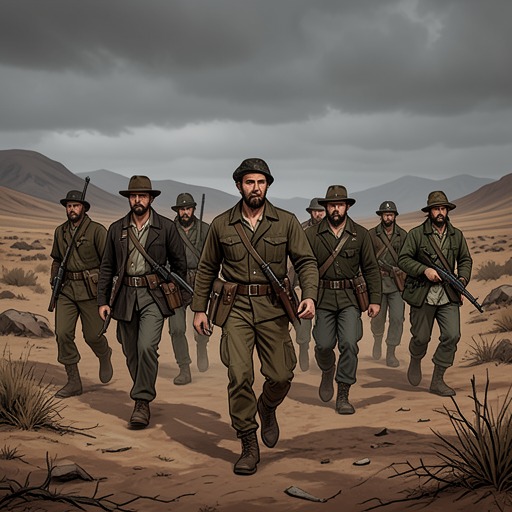
The expedition gets lost and runs short of water on the arid plains
Butcher's CrossingThe expedition gets lost and runs short of water on the arid plains when Miller’s confidence in a remembered landmark proves insufficient to keep the party on course. The crisis turns navigation into a test of authority and endurance: with no dependable water in sight, Miller insists on continuing, Schneider urges a detour south, and William Andrews chooses to trust the guide whose judgment has brought them this far. The consequences are measured in dwindling water, failing oxen, and the men’s increasingly painful struggle to keep moving.
Background and Loss of the Route
After resting beside the Smoky Hill River, the party turns away from its green bank and enters an open plain without trees or a visible trail. As the river’s strip of vegetation disappears behind them, Andrews has to watch Miller’s back to discern the direction of travel. By dusk they seem to have made little progress from the bend in the river, yet they are now camping in open country without a water source. The plain provides no tree, ravine, or hill to confirm their course, and the wagon’s passage leaves marks too faint to make retracing the route dependable.
The party’s first rationing measures make the problem visible before anyone openly disputes Miller’s direction. Under a lantern, Miller lets each ox drink only its allotted portion from the canvas container, stopping the animal and moving it away once its turn is over. After the oxen and horses have drunk, the container is still only a quarter full. Schneider remarks on the danger of camping without water, but no one answers. The men’s silence does not mean the risk has passed; it marks the beginning of a journey in which even an ordinary evening’s supply has to be counted against the animals’ needs.
Dispute over Direction
The following day, the men sit in the wagon’s narrow band of shade. Schneider asks Miller directly whether he knows where water is. Miller says that a small pile of stones seems familiar and estimates that a stream should lie another half day ahead. When Schneider presses him to say where they are, Miller maintains that some landmarks have changed since his last passage and assures the others that the route will come right. Schneider laughs at that assurance and names the predicament plainly: they are lost.
Schneider proposes turning south toward Arkansas, estimating that they could reach it in a day or a day and a half and that the animals could hold out that long. Miller rejects the detour. It would cost a week, he argues, and he believes they can still reach their destination by continuing in the same direction. Schneider answers that the scale of the country makes certainty impossible. The disagreement is not merely over a map: it concerns whether the party should accept delay in exchange for a different chance at water, or preserve Miller’s chosen line despite the growing evidence against his confidence.
Charley Hoge refuses to take sides, saying he will go where God leads them and trusting that water will come when they need it. Schneider then turns to Andrews. Since the wagon and team belong to him, Andrews could decide that they should turn south, making it harder for Miller to insist on continuing. Andrews looks down at the dust-like earth between the dry grass and chooses to follow Miller. Schneider objects that they are all behaving foolishly but accepts that he has no choice. Miller responds with a small smile and points to Charley’s remaining whiskey as a reserve, estimating that nine or ten gallons may still be available. His remark supplies a contingency, not a source of water for the animals or proof that his route is sound.
Rationing and Physical Ordeal
By the next stage of the journey, the oxen are in visible distress. Schneider warns that their tongues will swell and that they will soon be unable to pull and breathe at the same time. Andrews, suffering from an intolerable dryness in his throat, takes two long swallows from his own canteen before forcing himself to stop. Shortly before noon, Miller halts the wagon and says they will wait out the hottest part of the day. Charley Hoge shakes his head when Schneider asks how the animals are doing.
Charley brings Miller the canteens and a small wooden keg. Miller sets the keg upright and empties the canteens into it one by one, holding each inverted until the last drops fall. All the water collected amounts to about four inches in the keg. Schneider hurls his empty canteen against the wagon and protests that such a small quantity is being wasted. Miller ignores the outburst and asks Charley to bring the oxen one at a time. He wets a dirty handkerchief, carefully wringing it over the keg so that no water is lost, and has Schneider and Andrews hold each animal by the horns while Charley restrains it. Miller uses the damp cloth to moisten the ox’s lips, then wets it again for the next animal.
The work takes nearly an hour. Schneider curses, Andrews struggles to hold the oxen’s smooth, hot horns as his arms tremble, and Charley repeatedly leads one animal back to the yoke before bringing forward the next. Miller judges that the oxen can last until night and points to the roughly inch and a half of cloudy water still in the keg. Schneider counters that this is scarcely a pint for eight oxen and three horses. Miller’s method is not to give the animals a drink in the ordinary sense, but to use each remnant to ease their swollen tongues and keep them moving.
The party finds no relief in a shallow depression where cracked mud marks a dried-up pool. In mid-afternoon Miller makes each man swallow a little of Charley’s whiskey, warning them not to drink much. For Andrews, the liquor burns his dry tongue and split lips; even the brief attempt to wet his mouth brings pain rather than comfort. The contrast between the keg’s carefully guarded drops and the whiskey’s harsh, limited use makes plain how little the party can do to replenish its supplies.
Continued Movement and Aftermath
At sunset the oxen begin to groan again. Their tongues are so swollen that they walk with their mouths partly open, their heads drooping and swaying. Miller refuses to stop, reasoning that they should keep moving while they can still stand. He uses the last of the water to wet the horses’ mouths; by the time he has finished, the handkerchief is nearly dry. The decision extends the march, but it does not restore the animals or resolve the uncertainty about the route.
Night brings another measure of the crisis. One ox falls and cannot get up. The men dismount and haul and urge it to its feet, but the team no longer has enough strength to start the wagon unaided. The three men push at the wheel spokes while Charley cracks his whip until the wagon begins to move and the oxen follow. Andrews tries to drink a little whiskey, but most of it runs from his lips. He rides through the night between delirium and acute pain, at one point waking in the darkness unable to tell where he is or which way the party is going. The loss of orientation that began as a dispute over landmarks has become a bodily experience: the exhausted traveler cannot even place himself within the landscape.
The expedition does eventually reach water farther along its westward journey. After spotting the railroad across the plains and continuing toward the foothills, the party reaches a broad river whose stream runs clear through a much wider bed. The later arrival establishes that the march out of the waterless plain continues, but it does not erase the cost or make Miller’s earlier certainty reliable. The crisis exposes the gap between remembered routes and an altered landscape, while the party’s survival depends on minute rationing, strenuous labor, and decisions made without assurance. Andrews’s choice to stay with Miller binds him to that risk; Schneider’s warnings, meanwhile, remain a running counterpoint to the guide’s insistence that the water will be found.