The spring thaw and release from confinement
Butcher's CrossingThe spring thaw and release from confinement is the transition that ends the hunting party’s winter isolation in Bison Valley and makes its descent from the mountains possible. Between late March and early April, snow recedes, grass begins to grow, and game returns; yet the opening pass leads the men away from a landscape still marked by the bison slaughter. When Miller finally announces their departure at the end of April, release comes as a practical decision, not a restoration of the world they entered in autumn.
The Slow Return of Spring
For William Andrews, the approach of spring initially offers little sense of movement. During the winter, Fred Schneider has scratched marks into a pine branch to count the days, but William Andrews continues checking them mechanically, without feeling that they measure meaningful time. The months register more clearly through Schneider’s regular requests for his wages: William Andrews counts out the money and hands it over, while the passage of time itself seems to have stopped.
Between late March and early April, the weather steadies and the thaw advances with exhausting slowness. Snow first disappears where it lies thinnest, breaking the valley’s flat white surface into patches of grass and dirty drifts. Meltwater seeps into the ground, and new grass pushes through the winter-killed growth, laying a light green cover over the old yellow-gray vegetation. Spring appears not as a sudden transformation but as the gradual alteration of the valley’s surface.
The returning vegetation draws wildlife back into view. Deer graze within a few hundred yards of camp, lifting their heads at a noise before bending again to the tender grass; mountain quail call from the trees and forage nearby. With game abundant, Miller no longer needs to range through the forest. He can supply the camp by walking only a short distance and using William Andrews’s small automatic rifle. The men eat their fill of deer, quail, and elk, while what they cannot consume spoils in the growing warmth. The animals and fresh grass signal seasonal renewal, but the abundance is local and immediate: it sustains the camp as the party waits for its route out to open.
The Pass and the Waiting Men
The thaw does not release the party at once. Fred Schneider repeatedly climbs between camp and the snowbound pass, returning sometimes excited by the softening snow beneath its crust, sometimes discouraged that the crust still holds the cold. He measures the route in terms of whether it can soon be crossed; Miller watches the sun and the widening areas of bare ground in silence. William Andrews, meanwhile, experiences the impending departure as a desire he cannot explain. He follows the others’ tracks toward the narrow opening between two rocks, but the crooked trail through the snow gives him no clear view of the country beyond.
As the snow begins running in little streams past camp, the men continue waiting under Miller’s calm. At the end of April, he tells them that they will load the wagon the next morning. Fred Schneider’s response makes the delay’s strain visible: he jumps up, cheers, claps Miller on the shoulder, and laughs to himself, repeating excited words as he circles the camp. The same announcement that ends the waiting is, for Schneider, an occasion for unrestrained relief.
The Departure Through the Pass
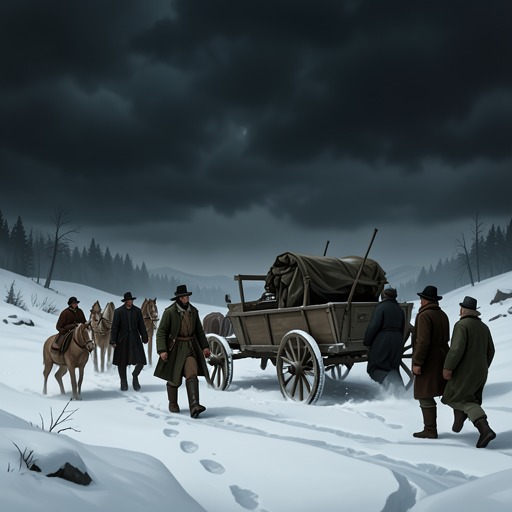
The party’s exit is a laborious operation. They leave some of the hides packed where they are, treat the bales with the remaining strychnine to deter pests, and secure their personal belongings behind their saddles. Charley Hoge climbs onto the wagon seat and uses his whip to start the oxen. The heavily loaded wheels sink into the soft ground, cutting deep parallel tracks through the new grass.
At the pass, roughly a hand’s breadth of snow remains, but it is soft enough for the oxen to cross. Miller and Fred Schneider inspect the wagon’s brake before the descent; William Andrews turns to look back at the valley. From the height between the two peaks, the new grass appears as a pale green haze in the morning light. The view does not conceal what happened there: even from the pass, William Andrews can make out the dark carcasses scattered across the valley floor. He rides beyond the pass ahead of the wagon, then the horses’ hoofbeats and the wagon’s slow creaking follow as the procession begins its long descent.
Renewal Against the Evidence of Slaughter
The spring landscape holds renewal and devastation together. Green growth covers ground that had been bloodied before winter, and the valley’s changing colors make it difficult for William Andrews to reconcile the present view with the earlier rush of dying bison and the desolation beneath the snow. The thaw changes what the men can do, but it does not undo the hunt: carcasses remain among the grass, and the surviving herd had already dwindled under Miller’s relentless shooting.
That depletion belongs to a larger pattern the book traces beyond the valley. Miller recalls that, four years earlier, the Kansas plains had been black with bison in spring; hunters could take a thousand or fifteen hundred in two weeks. By the time he speaks, only small herds remain, and he expects Kansas to be hunted out within a year or two. He also recalls the miles of bones left by the great hunts, from Pawnee Fork to the end of Smoky Hill, some of which farmers may later collect for fertilizer. The spring return to grass therefore follows, rather than cancels, the physical evidence of commercial killing.
Nor does leaving the valley guarantee that the hides will recover their value. After the party returns, J.D. McDonald tells Miller that the railroad is being built fifty miles north and that hunters are selling bison meat to the railway company while leaving the hides to rot. The spring opening of the pass makes the party’s loaded wagon mobile again, but the wider market has shifted around the very goods that motivated the expedition. In that contrast, the thaw offers freedom of movement without promising repair: the men can leave the winter-bound valley, while neither its dead bison nor the failed economic purpose of their return can be restored.