Dance Dress
CEO's Beloved Honey GirlThe Dance Dress is not merely clothing in the story. It is a treasured possession of Su Xiangwan, first associated with Lu Xun’s violence and later restored through his deliberate attempt to acknowledge the hurt he caused. Its torn and duplicated forms make the object a visible measure of the marriage’s changing emotional balance: what cannot be undone can at least be named, replaced, and offered back with an apology.
Definition and First Significance
The dress appears as a beautiful red dance garment that Su Xiangwan has always regarded as a treasure. Its value is therefore personal rather than financial. The narrative does not treat it as an interchangeable article of clothing when Lu Xun tears it; the damage marks a night in which intimacy, anger, and physical power have crossed into harm. The garment becomes conspicuous precisely because it has ceased to function as an ordinary useful object. Its torn materiality forces both characters to confront what the scene has done to their relationship.
The dress also gathers together the story’s recurring conflict between affection and control. Lu Xun’s conduct toward Su Xiangwan is repeatedly framed through possessive marital power, while her body and possessions remain exposed to the consequences of that power. The dress gives the conflict a concrete surface. It is easier to see the damage in the fabric than to settle the moral meaning of the night that destroyed it, yet the object keeps that unresolved meaning present.
Destruction and Replacement
Lu Xun later presents Su Xiangwan with a new dress made exactly like the one he tore. The replacement is introduced as a gift and as a surprise: Su Xiangwan opens the box after removing its ribbon and is stunned when she recognizes what it contains. The gesture attempts to reproduce the lost object with precision, but its emotional function is more complicated than simple restitution. A duplicate can restore the dress’s appearance without erasing the fact that the original was destroyed.
Lu Xun explicitly connects the new garment to the earlier injury. He apologizes for making Su Xiangwan cry and says that Su Qingrou told him she had always regarded the dance dress as a treasure. His apology gives the garment a new narrative role: it is now evidence that he has learned something about the meaning Su Xiangwan assigns to her possessions and has recognized that his actions caused more than momentary material damage. Su Xiangwan’s immediate tears show that the gift touches the wound rather than bypassing it.
The Dress in the Reconciliation Scene
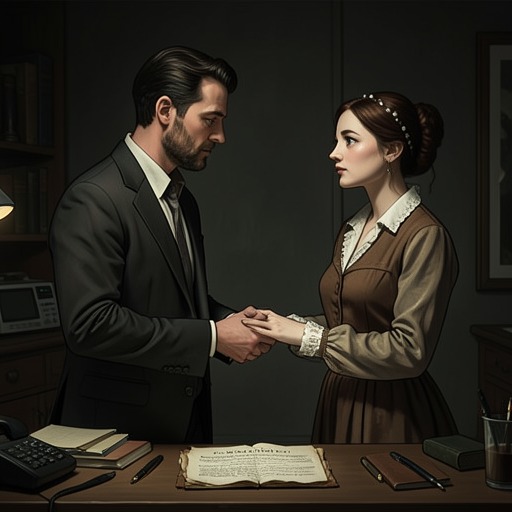
The replacement dress becomes part of a flirtatious but tense exchange between the married couple. Lu Xun points to the beautiful red garment and asks whether Su Xiangwan wants to try it, while warning that he might lose control if he becomes too agitated. She answers by teasing him about his supposedly beastlike nature, and he replies that he is a beast only toward a woman like her. The dialogue preserves the danger embedded in the object’s history even as it converts that danger into marital banter.
This scene does not make the earlier destruction disappear. Instead, the dress allows the relationship to move between apology, attraction, resistance, and renewed play. Lu Xun’s gentler claim that he wants Su Xiangwan to live a better life, together with his reference to a lifetime, expands the object’s meaning beyond the immediate gift. The garment becomes a test of whether the couple can imagine continuity after an act that exposed the destructive side of his desire. Su Xiangwan’s laughter and tears coexist: the dress is both a reminder of pain and a prop in their attempt to resume intimacy.
Material Symbolism and Narrative Function
The Dance Dress gives physical form to an unequal emotional economy. Su Xiangwan treasures it, Lu Xun destroys it, and Lu Xun later uses wealth and effort to provide an exact replacement. The sequence resembles repair, but it also reveals the limits of compensation. The person who possesses the greater power can replace the object, yet cannot simply purchase the original meaning back. The replacement matters because Lu Xun admits responsibility, not because the material object alone settles the debt.
The garment’s significance is sharpened by later conflicts surrounding marriage, property, and consent. Su Xiangwan eventually demands divorce, refuses Lu Xun’s property and alimony, and proposes converting the five hundred million in contract capital into shares to return it with interest. That insistence contrasts with the earlier dress gift: she is not willing to let material provision define the value of her body or her marriage. The dress thus stands at the intersection of two competing ideas of care—one expressed through an expensive replacement, the other through recognition of personal dignity and freedom.
The object’s memory also resonates with the wider violence surrounding the women in the story. Su Qingrou is imprisoned and marked by deep and shallow kiss marks, while Lu Xun is condemned for torturing his woman to the point of fainting by the roadside. Against these harsher bodily consequences, the torn dress serves as a comparatively contained but still unmistakable trace of coercion. It makes visible the same structure in miniature: a man’s force leaves damage behind, and the woman must live with both the physical evidence and the emotional aftermath.
Thematic Significance
As a recurring material symbol, the Dance Dress turns romance into an argument about whether love can repair what power has broken. Its first form records loss; its second form records remorse, but not absolution. The dress is treasured because Su Xiangwan invests it with memory, and it becomes narratively important because Lu Xun must finally understand that its value lies in her attachment to it rather than in its price or appearance.
The object also gives the marriage a visible pattern of rupture and attempted restoration. A torn dress, a carefully prepared duplicate, tears, laughter, and renewed negotiation all belong to the same emotional chain. The story’s treatment of the garment therefore refuses to leave love in the realm of abstract declarations. Devotion is measured against concrete conduct: who caused the damage, who names it, who tries to repair it, and whether the injured person accepts the offered repair. In that sense, the Dance Dress remains both a gift and an indictment, carrying the history that its replacement cannot fully conceal.