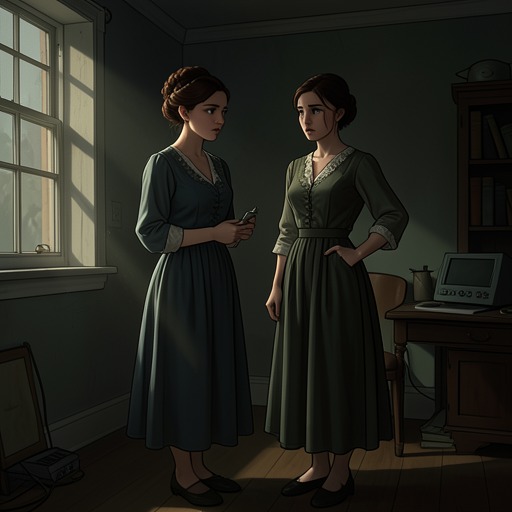
Five-Hundred-Million Contract Marriage
CEO's Beloved Honey GirlFive-Hundred-Million Contract Marriage is the governing arrangement between Su Xiangwan and Lu Xun, and its decisive significance lies in the contradiction between its numerical precision and emotional instability. Five hundred million yuan gives the relationship an apparently rational foundation, yet the marriage repeatedly turns that price into a question of ownership, obligation, protection, and consent. What begins as an exchange of capital for marital status develops into a volatile struggle over whether either partner can remain free inside the bond.
Financial Foundation and Unequal Bargaining Power
The contract is introduced through the language of money and corporate survival. Su Xiangwan’s family company faces difficulty competing for a Western District parcel scheduled for bidding, so Bian Jiang asks her to approach Lu Xun and determine whether he will help. The request places the marriage inside a wider system in which land, family companies, political influence, and private intimacy are interchangeable resources. Her access to Lu Xun is not merely personal; it is treated as a possible route to capital and strategic protection.
Su Xiangwan understands the arrangement as a purchase rather than an equal partnership. When Lu Xun promises a European honeymoon, an eventual wedding, and freedom to choose the timing, she remains skeptical because she sees herself as the wife he bought for five hundred million yuan. Her bitterness exposes the contract’s hidden premise: a formal promise of care cannot erase the fact that her marital position was created through a massive financial transaction. The money gives Lu Xun power to define the terms, while Su Xiangwan must continually test whether the relationship contains anything beyond the original payment.
Her own proposal for escape reveals how thoroughly she has learned to speak in the contract’s economic language. She offers divorce, refuses property and alimony, and proposes converting the original five hundred million yuan into shares, with interest, so that the capital can be returned. Even intimacy is counted as part of the settlement when she says that Lu Xun may regard the money as payment for the nights he spent with her. This attempt to calculate an emotional and bodily debt is both practical and defensive: by restoring the money, she hopes to reclaim the right to leave without owing him anything.
Marriage as Freedom Versus Possession
The contract’s deepest conflict is not financial but ideological. Su Xiangwan describes herself as someone forced aboard a ship by need, with only two possible outcomes: jumping overboard halfway through or being pushed off when the voyage ends. In her account, Lu Xun does not need a wife so much as a companion who can fill his loneliness. She can offer temporary happiness, but she cannot cure the emptiness that motivates his possession of her. The metaphor transforms the marriage from a romantic refuge into a dangerous passage in which dependency and abandonment remain equally possible.
Lu Xun’s response reveals the emotional force behind the financial structure. He asks whether marriage to him will truly make her miserable and demands to know where he should go. His attachment is not presented as a neutral contractual duty; it is bound to fear of losing the person who has become his chosen companion. Yet the story repeatedly shows that his attachment can become coercive. His insistence that Su Xiangwan remain within the marriage is inseparable from his power to control money, movement, and access to protection, making the contract’s romantic surface rest on an unequal ability to impose consequences.
The contrast becomes especially stark in Lu Xun’s dealings with Lin Yanche. Lu Xun uses the East District land as the price for Lin Yanche’s non-interference in his affairs with Su Xiangwan. Although Lu Xun is not interested in the land itself, he gives it to secure Lin Yanche’s withdrawal, and Lin Yanche accepts. The transaction makes visible what the marriage often disguises: Lu Xun converts corporate assets into emotional leverage. His protection may be genuine, but it is exercised through the same bargaining logic that created the marriage.
Protection, Threat, and the Limits of Consent
The surrounding plot demonstrates that the contract cannot be separated from a broader culture of coercion. Lin Yanche threatens Su Qingrou with harm to Jin Zhengnan if she leaves the manor, using another person’s hospitalization and safety to imprison her. Lu Xun’s conduct is placed in sharp moral tension with this threat: protection and possessiveness repeatedly approach one another, and the language of love does not automatically guarantee freedom or consent.
This tension is made explicit when Mo Beiyu condemns Lu Xun after Su Xiangwan collapses by the roadside. He accuses Lu Xun of torturing his woman until she fainted and questions what qualifications a rapist has to stand in the sunlight. The scene does not allow the contract’s five-hundred-million price to settle the ethical question. A marriage certificate, financial payment, or claim of emotional attachment cannot by itself transform forced sex or physical harm into legitimate marital intimacy. The accusation forces the relationship’s romanticized control into public view.
The contract also governs bodily vulnerability in quieter ways. Su Xiangwan develops a fever and severe weakness after becoming ill during the night, then asks Manager Wu to buy antipyretic medicine. Her illness exposes the fragility behind the contractual arrangement: the wife who appears to be an asset within family and corporate negotiations is also a physically vulnerable person requiring care. The marriage’s promises are therefore tested not only by dramatic declarations and business deals but by whether protection exists when she is powerless.
Public Status and Family Recognition
Although the relationship begins as a secretive financial arrangement, it gradually seeks the signs of an ordinary marriage. Lu Xun promises a wedding and arranges a European honeymoon, while Su Xiangwan remains alert to the possibility that these gestures merely decorate a purchase. The tension between private contract and public recognition becomes one of the relationship’s recurring measures of sincerity. A wedding could transform the arrangement from a hidden bargain into a socially acknowledged union, but it could also make possession appear respectable without resolving the underlying imbalance.
Family expectations add another layer of pressure. Shen Hui tells Su Xiangwan that, because of her age and Lu Xun’s age, having a child sooner would allow her to recover earlier. Su Xiangwan obediently agrees, and Shen Hui also recommends Chinese medicine because she appears weak. The exchange shows how quickly a contractual marriage is absorbed into conventional family obligations: reproduction, physical recovery, and marital duty become expectations attached to her status as Lu Xun’s wife. The apparent informality of the original deal cannot protect her from the social demands that follow once the marriage is treated as real.
Lu Xun also uses ceremonial gifts to enter the family as a husband. When the group returns to the old residence, he presents Su Xiangwan’s grandfather with an antique jade ruyi, hoping the elder will accept it and wishing him well. The gift is materially modest compared with five hundred million yuan, but symbolically important: it stages respect toward the older generation and seeks recognition beyond the private bargain. The grandfather accepts the object without examining it closely, leaving the gesture acknowledged but not fully endorsed.
Relational Reclassification and Continuing Instability
The contract’s boundaries remain vulnerable to competing relationships. Lu Xun’s connection with Shen Yiyun is explained as a family relationship: she is the child adopted by his uncle and therefore his cousin, and he arranged a residence for her near the theater when she came to Cloud City to perform. Su Xiangwan nevertheless resents the secrecy and compares the situation with the earlier problem involving Song Yuner. Her reaction shows that marital security depends not only on legal or nominal definitions but also on disclosure, trust, and the husband’s willingness to explain relationships that may appear threatening.
Su Xiangwan later challenges the meaning of non-blood kinship directly. She argues that a relative connected only by name remains a man or woman rather than a blood relation, and that accepting every such relationship at face value would make Lu Xun’s position impossible to manage. The argument strips away the protective power of labels such as cousin and relative. Within the contract marriage, names are not stable guarantees; they can serve as boundaries, excuses, or disguises for emotional claims.
The same instability appears in her exchange with Lu Xun when she identifies him as her husband. The declaration is playful and intimate, but it also confirms that the contractual title has acquired emotional force. Lu Xun is uncertain whether she recognizes him clearly, while she answers through the marital identity that the arrangement created. The moment does not erase the coercive history of the contract, yet it shows why the relationship cannot be reduced to a simple financial transaction: the title that began as a purchased status becomes a language through which attachment is expressed.
Narrative and Thematic Significance
Five-Hundred-Million Contract Marriage organizes the novel’s recurring exchange system. Land can purchase non-interference, money can establish a marriage, shares can be offered as repayment, gifts can seek family approval, and protection can be presented as proof of love. The pattern gives the story its central irony: characters repeatedly use economic instruments to manage emotional crises, then discover that affection, dignity, and freedom cannot be settled as cleanly as a land deal.
The concept also exposes the unequal risks carried by the partners. Lu Xun can deploy property, influence, and threats to preserve the relationship, while Su Xiangwan must defend her body, mobility, and right to leave. Her attempt to return the five hundred million yuan is therefore more than a financial proposal; it is an attempt to convert an intimate debt back into a measurable sum and reclaim an unencumbered self. The story’s continuing force comes from the fact that the conversion never fully succeeds. The marriage remains simultaneously contract, protection, family status, emotional refuge, and contested form of control.