Lin Yanche Bids Farewell to Su Qingrou
CEO's Beloved Honey GirlLin Yanche Bids Farewell to Su Qingrou is a quiet but decisive turning point in the relationship between Lin Yanche and Su Qingrou. The encounter takes place after Lin has been diagnosed with liver cancer and is waiting for a suitable donor; without treatment, he faces death. His visit is therefore both an act of attachment and an apparent farewell. The scene strips away the intimidation, manipulation, and overt conflict that previously defined their relationship, leaving two people confronted with illness, memory, and the impossibility of returning to what they were.
Causes and Background
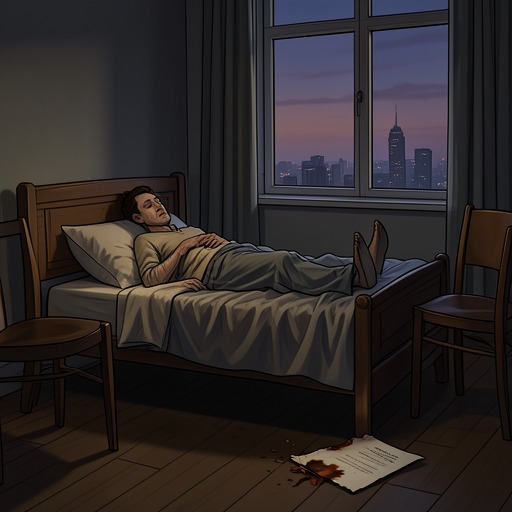
Lin’s condition changes the meaning of his appearance before he says anything. Yun Xiao reveals that Lin Yanche has liver cancer and is waiting for a suitable source for a liver transplant; otherwise, he can only wait for death. His thinness, previously unexplained, is immediately reinterpreted through this diagnosis. The illness is not presented as a distant medical fact but as a force already altering his body, his authority, and the responses of people around him. Even Chu Fei, who had been prepared to act against Lin, finds himself unable to continue confronting a man on the verge of death.
This background contrasts sharply with Lin’s earlier conduct toward Su Qingrou. He had been associated with coercion, volatility, and emotional aggression, while Su Qingrou had learned to protect herself through distance. His illness does not erase that history, but it changes the balance of the scene. The person who once occupied the room through force now enters it without demanding that anyone receive him. The disease therefore produces a severe reversal: it does not redeem Lin, but it removes the certainty that he can continue controlling the future through strength alone.
The Farewell Visit
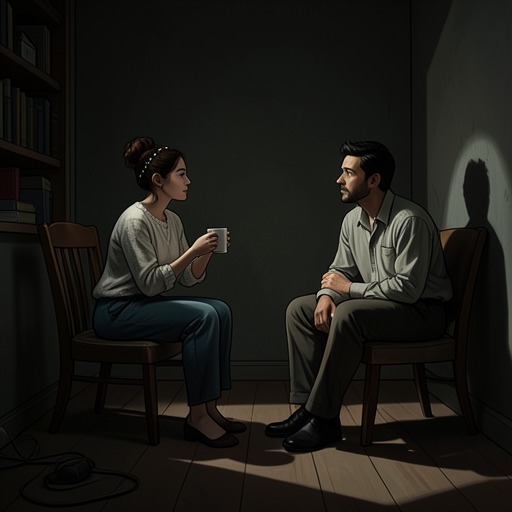
Lin tells Su Qingrou that he has come to see her and is leaving. He does not invite anyone to sit down, and he chooses the seat closest to her, where he can see her most clearly without being able to reach out and touch her. The physical arrangement expresses the relationship more precisely than a declaration would. He remains near enough to look, yet accepts a boundary that prevents contact. His purpose is presence rather than possession.
Su Qingrou is surprised both by his visit and by his appearance. When she raises her gaze and meets his deep eyes, her heart still trembles, showing that emotional separation has not produced indifference. Yet she does not allow that reaction to restore their former intimacy. She tells him that, if there is nothing else, they should leave, because it is better for them not to see one another too often and because there is nothing more to say. Her words establish distance as a necessary condition of survival, even while her response reveals that the distance remains painful.
Lin’s conduct is marked by an unusual silence. He does not mock the people around Su Qingrou or answer their implied judgments, although he would ordinarily have refuted or ridiculed them. When Su Qingrou orders him to leave, he remains silent for a while and then agrees. The simple response is significant because it shows that the encounter is not another contest in which he must win the last word. His farewell is enacted through compliance, restraint, and departure rather than through a final claim over her.
Illness, Disclosure, and Emotional Reversal
When Lin stops after Su Qingrou calls his name, she asks whether something is wrong. He answers that there is, forcing a smile while retaining a cold expression that is no longer as fierce as before. The narration compares his altered presence to that of an old man in his seventies: everything has gone pale, he has no remaining desire to struggle, and he waits only for the moment when his life will go out. The comparison emphasizes not merely physical weakness but the exhaustion of a personality previously organized around pursuit and confrontation.
Su Qingrou asks whether the illness is serious. Lin first minimizes it, saying that it is all right and that he will not die. The reassurance is visibly unconvincing because his body and manner have already disclosed the opposite possibility. His answer is an attempt to preserve dignity, not a credible medical assessment. He will not give Su Qingrou the full emotional burden of his fear, and he will not ask her to resume responsibility for him. The disease is thus both revealed and withheld: its seriousness enters the conversation, but Lin refuses to turn that knowledge into a plea.
The scene also places different forms of bodily vulnerability within the wider narrative. Lu Xun’s recurring illness requires emergency medicine; Su Xiangwan’s fever causes her to collapse before reaching an elevator; Su Qingrou undergoes surgery for acute appendicitis; and Su Xiangwan is fed water by Mo Beiyu after being ill for two days. In Lin’s case, however, illness does not lead to rescue or active recovery. It produces a waiting state, one in which treatment depends on finding a suitable liver and the alternative is death. That difference gives his farewell its finality: the body is no longer an obstacle to be overcome within the next scene but the condition governing what remains of his life.
Su Qingrou’s Appeal and Lin’s Departure
Su Qingrou’s final appeal is directed away from herself. She tells Lin that he should have a good life with Song Yuner, who has waited for him for a long time, and that he cannot abandon her either. The statement acknowledges the unresolved claims of another relationship while refusing to compete for Lin’s remaining time. It is neither a declaration of reconciliation nor an invitation to begin again. Su Qingrou converts the possibility of renewed intimacy into an instruction to choose a different obligation.
Lin responds only with a bitter, indistinct laugh. He does not defend himself, reject Song Yuner, or ask Su Qingrou to accompany him. In the end, he says nothing and walks out. His silence is the scene’s final action. Earlier, he could use words to dominate, wound, or provoke; here, language fails to produce the reunion that illness might have made tempting. Leaving without an answer preserves the contradiction at the heart of the relationship: he has come because Su Qingrou still matters, but he departs because that importance cannot restore trust or erase what happened between them.
The farewell also echoes other moments in which illness exposes the fragility of intimate bonds. Lu Xun’s alarm at hearing that Su Xiangwan may be dangerously ill turns fear into urgent movement, while his embrace and reassurance make protection an active response. Lin’s cancer produces the opposite motion. Su Qingrou does not rush toward him, and Lin does not ask to be carried back into her life. Their scene is defined by recognition without repair, concern without surrender, and proximity that ends in separation.
Narrative Significance
Lin Yanche Bids Farewell to Su Qingrou marks the temporary collapse of the relationship’s former grammar of pursuit and resistance. Lin’s liver cancer makes death the unspoken third presence in the room, but the scene does not use that threat to absolve him or force Su Qingrou into forgiveness. Instead, it tests whether affection can survive without possession. Su Qingrou’s trembling gaze suggests that feeling remains; her command to leave demonstrates that feeling no longer governs her decisions.
The event therefore shifts the value of the relationship from control to relinquishment. Lin’s visit begins with the possibility that he might still demand recognition, yet it ends with his acceptance of exclusion. Su Qingrou begins in guarded surprise and ends by directing him toward another future, however uncertain that future may be. His failure to answer leaves the separation unresolved emotionally but conclusive in action. He has seen her, disclosed enough of his condition to be understood, received her final counsel, and walked away.
Within the broader story, the encounter gives Lin’s decline a human scale. His illness is not only a plot mechanism involving a transplant and the prospect of death; it changes how he occupies space, how others speak to him, and what he can ask from the woman he once tried to hold. The scene’s power lies in that narrowing of possibilities. A man who once acted as though force could determine every relationship can now do only one thing that does not violate Su Qingrou’s boundary: leave.