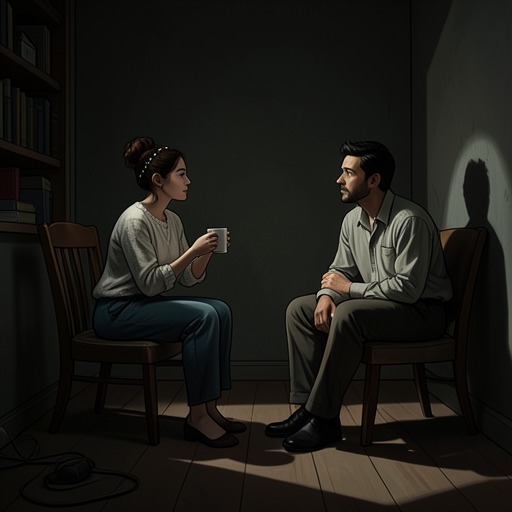
Lin Yanche and Su Qingrou’s estrangement
CEO's Beloved Honey GirlLin Yanche and Su Qingrou’s estrangement defines one of the book’s most painful relational aftermaths: intimacy survives as memory and bodily reaction after trust, safety, and ordinary communication have been destroyed. Su Qingrou refuses to resume the old relationship and directs her future toward Jin Zhengnan, while Lin Yanche, physically ruined and emotionally subdued, accepts that he may have no right to ask for more than the chance to see her.
Origins of the Rupture
The estrangement grows out of a relationship marked by coercion and injury rather than a single misunderstanding. When Su Xiangcheng finds Su Qingrou, she is weeping silently, with deep and shallow kiss marks visible on her body. The scene makes the cost of Lin Yanche’s treatment of her physical and unmistakable. At the same time, Su Xiangcheng discovers a photograph of Lin Yanche passionately embracing Song Yun’er, taken at almost exactly the same time. The image turns private harm into a crisis of betrayal: Su Qingrou has been subjected to violence while Lin Yanche is visibly bound to another woman.
The wider family history gives Su Qingrou’s vulnerability an additional depth. She recalls that her mother had a terminal illness and chose to leave so that the family would not be implicated; her grandfather believed she could not remember, but she remembers drawing her parents holding her hand before her mother walked onto the balcony. This memory connects present-day abandonment to an earlier scene of maternal loss. Su Qingrou’s later refusal to return to Lin Yanche therefore occurs within a life already shaped by disappearance, secrecy, and the fear that love can end in irreversible harm.
The Hospital Meeting
The estrangement becomes visible in a controlled hospital encounter. Lin Yanche enters to see Su Qingrou and immediately says that he will leave after doing so. He does not invite anyone to sit, and the visit has none of the ease of an ordinary reunion. Su Qingrou knows that, after she left the hospital, he remained in the ward where she had recuperated, a room arranged by Chu Fei. His continued proximity suggests attachment, but it does not restore trust or give him access to her life.
Su Qingrou responds by sending him away. She tells him that they should return as soon as possible because Song Yun’er must be anxious, a remark that places him back within his obligation to another woman and refuses to treat his presence as a claim upon her. Lin Yanche gives no sharp retort. His silence is itself a reversal of the old pattern: where he might once have mocked or contradicted her, he now remains quiet, listens, and agrees to leave.
The change is also registered through the body. When Su Qingrou meets his deep eyes, her heart still trembles. The reaction does not amount to forgiveness; it shows that emotional severance is harder than physical distance. She can order him out and still be affected by his presence. The scene holds those truths together without resolving them into reunion.
Illness and the Collapse of Power
When Su Qingrou asks whether something is wrong, Lin Yanche admits that there is. His expression remains cold, but it is no longer fierce. He is described as resembling an old man in his seventies, with everything faded and no remaining impulse to struggle, merely waiting for life to end. He tries to reduce the danger by saying that he will not die, but the reassurance is unconvincing beside his appearance and resignation.
His illness changes the balance between the two characters without erasing the past. Lin Yanche’s physical decline prevents Chu Fei from continuing to act against him, but it does not make Su Qingrou responsible for saving him. The man who once possessed the power to confine and hurt her now appears powerless, yet Su Qingrou does not mistake vulnerability for repaired intimacy. His near-death condition alters the scene’s immediate threat; it cannot by itself undo the history that produced the estrangement.
Su Qingrou’s response remains deliberately distant. She urges him to have a good life with Song Yun’er, who has waited for him for a long time, and tells him that he should stay with her. The advice sounds almost generous, but it is also a boundary: Su Qingrou directs him elsewhere instead of allowing his illness to reopen their relationship.
A New Form of Attachment
Later, Su Xiangcheng asks Lin Yanche what he still wants from Su Qingrou. Lin Yanche answers that what she owes him and what he owes her have been tangled for a long time. He no longer wants to sort out the debt; he only wants to be able to see her and remain near her for the rest of his life. His language changes the relationship from possession to distance. He does not claim that Su Qingrou loves him, ask her to abandon Jin Zhengnan, or demand that the past be judged in his favor.
That restraint is fragile rather than triumphant. Su Xiangcheng warns him not to push her too far because her personality is capable of decisive action under pressure. She tells him to remain calm when he sees Su Qingrou with Jin Zhengnan and insists that Su Qingrou is now completely devoted to Jin Zhengnan. Lin Yanche listens seriously, apparently seeking practical instruction on how to coexist peacefully with her rather than a strategy for winning her back.
The final condition of the estrangement is therefore a narrow, painful permission: Lin Yanche wants to look at Su Qingrou, and wants her to accept that he is looking, but he must not force contact beyond that. Su Qingrou retains the authority to refuse him. The relationship is neither restored nor cleanly erased; it survives as a controlled distance in which longing remains, accountability remains unresolved, and the possibility of peaceful coexistence replaces the expectation of romantic reconciliation.
Narrative Significance
The estrangement contrasts two kinds of attachment. Su Qingrou’s attachment is expressed through memory and involuntary trembling, but her conscious decisions favor safety, autonomy, and Jin Zhengnan. Lin Yanche’s attachment persists through illness and loss of power, yet the only acceptable form it can take is one moderated by restraint. The book thus separates feeling from entitlement: continued love, regret, or desire does not grant access to the person who has been harmed.
The state also echoes the novel’s recurring pattern of pursuit and withdrawal. Lin Yanche remains near the hospital ward and returns to Su Qingrou, while Su Qingrou limits the encounter, orders him to leave, and redirects him toward Song Yun’er. Earlier wounds—her mother’s death, the marks left on her body, and the image of Lin Yanche with Song Yun’er—make reconciliation impossible through a single confession or gesture. Their estrangement is consequently not an empty pause before reunion, but the lasting consequence of a relationship in which proximity has become dangerous and distance, though painful, is necessary.