Lin Yanche’s Revenge against the Su Family
CEO's Beloved Honey GirlLin Yanche’s Revenge against the Su Family is not a single confrontation but a sustained campaign in which family history, corporate power, marriage, and personal trauma reinforce one another. Lin Yanche treats the Su family as the descendant of an enemy, yet his revenge becomes inseparable from his attachment to Su Qingrou, the daughter of that enemy. The resulting contradiction gives the action its central shape: every attempt to punish the Su family also damages the woman closest to him, while every act of intimacy threatens to expose the emotional weakness beneath his hostility.
Causes and Historical Grievance
Lin Yanche’s hostility is rooted in a prior conflict between the Lin and Su families. The evidence presents the Su family as responsible for an injury serious enough to make revenge a governing principle rather than a passing resentment. Lin Yanche later identifies Su Qingrou as the enemy’s daughter, making her family position morally decisive in his eyes even when she has not personally committed the original wrong. His anger therefore follows a logic of inherited culpability: Su Qingrou is judged not only as an individual but as a representative of the family he believes harmed his own.
The family feud also has an economic dimension. Before Lin Yanche acted against the Su Clan, Su Xiangwan’s grandfather had planned to develop tourism and had specifically intended the project as Su Xiangwan’s future responsibility after graduation. The plan was overtaken by the Su Clan’s bankruptcy, showing that the revenge campaign was felt not merely as emotional hostility but as a material destruction of the family’s prospects. A proposed land bid in the Western District becomes another sign of the Su company’s weakened position: Bian Jiang explains that the company will struggle to compete and asks Su Xiangwan to seek Lu Xun’s support. Business decisions are consequently filtered through private alliances, family obligation, and the unequal capital controlled by Lu Xun.
Instruments of Retaliation
Lin Yanche’s revenge operates through the vulnerability created by the Su family’s decline. The family’s loss of financial security limits its ability to defend itself, while marriage turns Su Qingrou into both a personal attachment and a symbolic target. Lin Yanche’s relationship with her does not neutralize his hatred; instead, it gives the feud a direct domestic arena. His resentment becomes more destructive because the person through whom he can hurt the Su family is also the person with whom he is emotionally entangled.
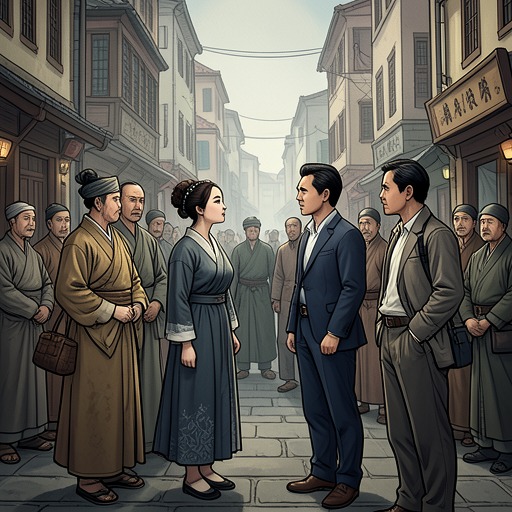
His position is further complicated by the older bond between the Lin and Lu families. Su Xiangwan recalls that her uncle treated Uncle Lin as his own brother and had married his only precious daughter to Lin Yanche. From her perspective, this history makes Lin Yanche’s conduct a betrayal of received kindness. She condemns him for repaying kindness with enmity, while Lin Yanche rejects her right to judge him as a member of the Su family. Their exchange exposes two incompatible moral ledgers: Su Xiangwan measures conduct by loyalty and obligation, whereas Lin Yanche measures it by the injury he believes the Su family caused.
Lu Xun becomes the decisive counterforce to this economic pressure. When Lin Yanche seeks or requires control of the Western District land, Lu Xun grants it to him directly, stating that he had not been interested in it from the beginning. The gesture is outwardly a business concession, but it also demonstrates Lu Xun’s ability to decide the terms of the conflict. Lin Yanche’s pride has been associated with his resistance to Lu Xun’s dominance; obtaining something from him therefore carries humiliation as well as practical benefit. The land functions as a transferable form of power, showing how corporate resources can be used to settle or redirect personal enmity.
Revenge and Intimate Violence
The campaign’s most painful consequences appear in Su Qingrou’s treatment. When Su Xiangwan finds her weeping silently, with deep and shallow kiss marks on her body, the physical evidence makes the revenge impossible to keep at the level of abstract family politics. Su Qingrou is not simply a corporate casualty; she is a woman whose body has become a site where Lin Yanche’s possession, anger, and family hatred are enacted. The discovery leaves Su Xiangwan heartbroken and clarifies why the feud cannot be separated from coercion and emotional injury.
The conflict is intensified by a photograph showing Lin Yanche and Song Yun’er passionately embracing at the same time that Su Qingrou is suffering. The image turns private betrayal into a weapon of interpretation. Su Qingrou is confronted not only with Lin Yanche’s violence but with the possibility that his attachment to another woman has made her pain part of a larger pattern of abandonment. Her later proposal to Jin Zhengnan for a small engagement ceremony, arranged principally for the benefit of their two companies, shows how she attempts to recover strategic protection through another alliance. The proposed ceremony is therefore both a corporate maneuver and a response to the insecurity created by Lin Yanche’s revenge.
Lin Yanche’s resentment is also linked to abandonment and humiliation. Song Yun’er tells Lu Xun that she has received her due retribution and has been abandoned, while Lu Xun answers her with cold mockery. Although this exchange is not identical to Lin Yanche’s campaign, it illuminates the emotional environment in which the revenge unfolds: lovers and former allies interpret suffering as punishment, and each character attempts to assign blame through the language of betrayal. Lin Yanche’s campaign similarly transforms emotional injury into a claim for retaliation, allowing personal pain to masquerade as an enforceable family debt.
Counterforces and Consequences
Lu Xun repeatedly intervenes when the family conflict threatens Su Xiangwan. After she is frightened, he returns with hot milk and comforts her, telling her that he has been there all along. His protection contrasts with Lin Yanche’s use of intimacy as an instrument of punishment. Yet Lu Xun’s protection is itself entangled with authority, since he can alter corporate outcomes, control access to land, and decide whether an adversary receives or loses a valuable opportunity.
The revenge also runs into the wider history of trauma. Su Xiangwan remembers that her mother had a terminal illness and believed that leaving the family would spare it from being implicated. As a child, Su Xiangwan drew an image of her parents holding her hand; after seeing it, her mother walked onto the balcony. This memory explains why family conflict carries a depth beyond property and status. The older generation’s suffering has already shaped the younger generation’s fears, guilt, and loyalties, so Lin Yanche’s retaliation enters a family system marked by loss before his campaign even reaches its later crises.
Lu Xun’s own childhood kidnapping provides another parallel history of vulnerability. At twelve, he was kidnapped and nearly lost his life after the kidnappers administered various medicines, leaving him resistant to drugs. The memory makes him suspicious of manipulation and unusually alert to attempts to control him. His response to danger is therefore not detached from the revenge plot’s atmosphere of coercion: he meets hidden threats with investigation, force, and protective control, helping to turn the family feud into a contest among men who each believe that survival depends on dominating the terms of the encounter.
The consequences are bodily as well as psychological. Su Xiangwan becomes so weak and feverish that she collapses at an elevator before she can press the button. Her physical collapse follows a pattern in which family turmoil is registered through exhaustion, illness, and helplessness. The scene makes visible the cost borne by people who are not directing the feud but are repeatedly required to endure its consequences. Revenge may be conceived by one actor, yet its pressure spreads through marriages, siblings, business negotiations, and the bodies of women caught between rival family claims.
Narrative Significance
Lin Yanche’s revenge gives the novel a classic revenge structure while complicating it with romance and corporate exchange. Its apparent objective is the punishment of the Su family, but its actual movement repeatedly produces reversals: the enemy’s daughter becomes the beloved woman, the marriage meant to embody victory becomes a source of mutual injury, and the financial weakness of the Su family forces private relationships to function as business instruments. The plot’s tension comes from asking whether inherited grievance can remain intact once it is carried into intimate life.
The action also exposes the instability of moral accounting. Lin Yanche believes that the Su family owes him and that retaliation restores balance. Su Xiangwan believes that he has violated the obligations created by family trust. Su Qingrou seeks another engagement to protect both herself and the companies involved. Lu Xun treats land as a negotiable asset that can redirect the conflict. Each position claims a different form of justice, but none escapes consequence. The revenge therefore becomes less a clean act of retribution than a chain reaction in which every attempt to settle an old debt creates a new one.
Its most significant result is the erosion of the boundary between family feud and personal relationship. Lin Yanche’s campaign damages the Su family materially, places Su Qingrou in danger, challenges the loyalty owed between the Lin and Su households, and draws Lu Xun into direct strategic opposition. By the time Lu Xun and Lin Yanche travel to Yan City and find Chu Fei’s men waiting at the airport, the story’s conflict has expanded beyond the original two families into a broader struggle over territory, influence, and control. Lin Yanche’s revenge is thus both a personal motive and a plot engine: it converts buried history into present action and ensures that no relationship remains untouched by the demand to choose sides.