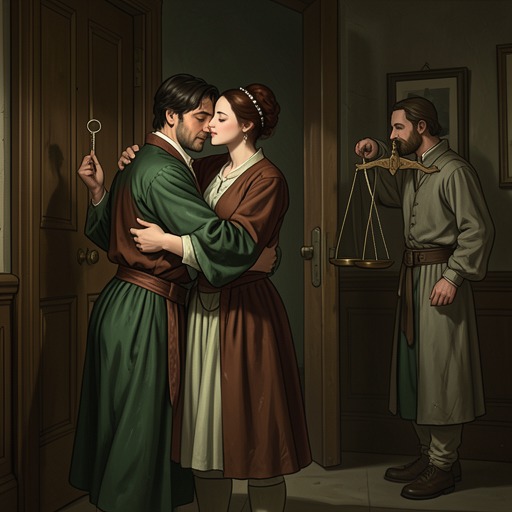
Love and Marriage Agreement
CEO's Beloved Honey GirlLove and Marriage Agreement is the central intimate bargain between Su Xiangcheng and Lu Xun, but it never remains merely a private promise. It begins as something Lu Xun can dismiss as a joke, yet he later invokes it while offering a honeymoon in Europe and a wedding arranged according to Su Xiangcheng’s wishes. The agreement therefore occupies an unstable space between romance and contract: it gives emotional language to a relationship shaped by Lu Xun’s purchase of a wife for 500 million yuan, while repeatedly exposing how little security a written or spoken promise provides when one party controls the money, the marriage, and the terms of departure.
Definition and Initial Terms
Love and Marriage Agreement is presented as an arrangement made before Su Xiangcheng and Lu Xun’s quarrel. When Lu Xun asks whether she remembers it, Su Xiangcheng dismisses it as a joke. Her response reflects the agreement’s original fragility: a relationship that has barely begun has already reached the language of separation, so the supposed foundation of their intimacy appears reversible and unserious.
The agreement is also inseparable from the financial structure of the marriage. Su Xiangcheng understands herself as the wife Lu Xun bought for 500 million yuan, a formulation that turns intimacy into an investment with an implied price. The contrast between emotional commitment and purchased status is decisive. Even when Lu Xun speaks tenderly, the arrangement carries the pressure of ownership, making Su Xiangcheng question whether his promises express love or merely extend a transaction.
From Joke to Romantic Promise
Lu Xun’s response attempts to transform the agreement from discarded fiction into a serious declaration. After Su Xiangcheng says she would not believe him even if he confessed his love, he chooses not to make that confession immediately. Instead, he kisses her forehead and insists that he is serious. His gesture treats physical tenderness as a substitute for proof, while the agreement becomes the setting in which seriousness must be demonstrated rather than simply asserted.
His proposed future is concrete. Lu Xun says he has already planned a honeymoon in Europe, intends to arrange his work in advance, and will provide a wedding whenever Su Xiangcheng wants one. He presents the arrangements as accommodations to her preferences, telling her to raise any objection. The effect is both reassuring and revealing: he offers travel, time, and public marital recognition, yet all of these promises still come from the person with the greater practical power.
When Lu Xun tells Su Xiangcheng that nothing is unnecessary as long as she likes it, he frames care as the removal of every obstacle to her happiness. The statement accompanies reassurance about her birthday and her recovery from illness, placing the agreement inside a broader pattern in which Lu Xun uses planning and provision to establish emotional certainty. Su Xiangcheng responds by accepting his confidence and concentrating on recovering so that she can celebrate her birthday happily, but her compliance does not erase the underlying question of whether dependence can become trust.
Money, Divorce, and the Limits of Consent
The agreement’s contractual logic becomes explicit when Su Xiangcheng asks for a divorce. She says she will take none of Lu Xun’s property and does not need alimony. Instead, she proposes converting the 500 million yuan he invested into shares and returning both the capital and its interest. Her attempt to settle the marriage mathematically is a bid to recover autonomy through accounting: if the relationship began as an investment, she will calculate the return and close the account.
Su Xiangcheng’s proposed settlement also contains a bitter acknowledgment that the marriage has given Lu Xun physical access without giving her corresponding security. She describes herself as having allowed him to sleep with her in vain, reducing the intimacy to a debt that she can choose not to monetize. Lu Xun answers with contempt, questioning whether she is worth 500 million yuan merely because he slept with her a few times. His response rejects her effort to define the relationship on financial terms while simultaneously using that same financial valuation to diminish her.
The exchange reveals the agreement’s central contradiction. Money is treated as both the source of the marriage and an inadequate measure of its meaning. Su Xiangcheng uses financial restitution to claim freedom, whereas Lu Xun uses the language of value to deny that she possesses equivalent bargaining power. The agreement consequently fails as a neutral contract: its apparent terms are continually reshaped by desire, humiliation, and unequal control.
Coercion and the Body
The surrounding relationship shows why the agreement cannot be read as an uncomplicated romance. When Su Qingrou attempts to leave Lin Yanche’s manor, Lin Yanche threatens that Jin Zhengnan will never leave the hospital if she steps outside. The threat binds a woman’s movement to the safety of a man she cares about, turning affection and loyalty into instruments of confinement. This parallel illuminates the darker legal and emotional environment in which Love and Marriage Agreement operates: promises and obligations can be made to sound intimate while functioning as restraints.
The distinction between care and coercion becomes even sharper when Su Xiangcheng is found unconscious by the roadside after being tortured by Lu Xun. Liu Xi condemns Lu Xun for reducing his woman to such a condition, while Mo Beiyu confronts him as someone unqualified to stand openly after acting as a rapist. Whatever romantic language surrounds the marriage agreement, this aftermath places bodily harm and the absence of meaningful consent at its center. The agreement cannot legitimize violence, and its romantic framing is directly challenged by the people who witness the consequences.
Su Xiangcheng’s physical vulnerability recurs in a quieter form when she develops a fever after sleeping without adequate covering. Her body becomes sore and weak, forcing her to ask Manager Wu to buy antipyretic medicine. The illness contrasts with the grand scale of Lu Xun’s promises about Europe and a wedding: the agreement speaks in terms of future ceremony, but the immediate reality of the marriage is measured by whether a weakened woman can obtain care and recover safely. This contrast keeps the concept grounded in the body rather than allowing it to remain an abstract declaration.
Narrative and Thematic Significance
Love and Marriage Agreement embodies a romance structure in which the promise of union repeatedly collides with the demand for freedom. Lu Xun’s planned honeymoon and wedding represent a movement toward recognition and permanence, while Su Xiangcheng’s request for divorce represents the agreement’s collapse as a source of trust. The same relationship thus produces gestures of reassurance, calculations of repayment, and scenes of coercion without resolving the power imbalance that connects them.
The concept also exposes an affective economy in which love is evaluated through investment, repayment, interest, property, shares, and the cost of access to another person’s body. Su Xiangcheng’s proposed return of 500 million yuan and Lu Xun’s rejection of her valuation show two opposing attempts to control the meaning of intimacy. One seeks liberation by converting marriage back into finance; the other claims emotional authority while retaining the logic of purchase.
Its deepest significance is therefore not that the agreement successfully guarantees love, but that it tests whether love can survive contractual origins and unequal power. Lu Xun’s promises become more elaborate as Su Xiangcheng’s belief weakens, and practical care exists beside threats and bodily danger. The agreement remains a recurring measure of the relationship’s instability: it is invoked as proof of seriousness, dismissed as a joke, challenged through divorce, and undermined whenever possession is treated as a substitute for consent.