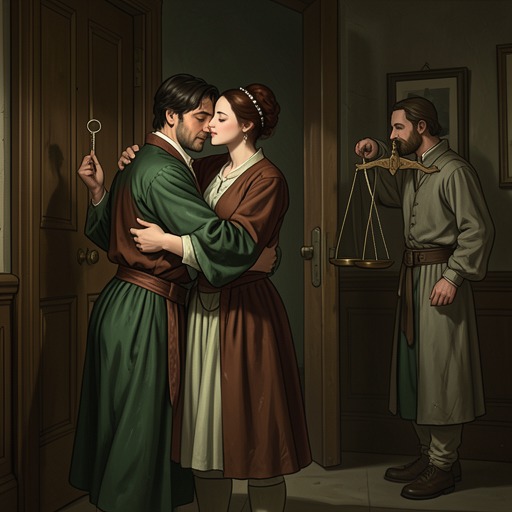
Lu Family Birthday Banquet
CEO's Beloved Honey GirlThe Lu Family Birthday Banquet is presented as far more than a birthday celebration: it is a social arena in which family hierarchy, marital legitimacy, romantic rivalry, and personal performance are tested before an audience. The event gives Su Xiangwan an opportunity to secure her place within the Lu family through courtesy and exceptional musicianship, while Lu Xun uses public partnership and private protection to mark their bond. At the same time, the banquet’s polished surface contains jealousy, exhaustion, old trauma, and the unstable boundaries between relatives, spouses, and rivals.
Sudden Preparation and Family Occasion
The banquet is introduced through an abrupt note from Lu Xun. He has learned that Shen Yi is holding a small gathering at home and that the day is his mother-in-law’s birthday, leaving Su Xiangwan only half a day to prepare a dress and a present. The compressed timetable makes the celebration feel less like a carefully planned ceremony than a domestic obligation suddenly imposed on the household. It also places Su Xiangwan in the familiar position of having to convert limited time into visible competence, while Lu Xun appears, from her perspective, unreliable for disclosing the important news so late. At ten in the evening, Lu Shengxun returns early to Jingshan Villa to accompany Su Xiangwan for dinner while she goes upstairs to put on makeup and change clothes. Lu Xun, smoking in the living room, follows her upstairs and sees her in her gown. His narrowed eyes register the force of her appearance: the wife who had been occupied with practical preparations becomes the dazzling center of his attention. The change from household management to formal presentation establishes one of the banquet’s central contrasts: Su Xiangwan is valued not only as a capable member of the family but also as a woman whose presence commands attention.
Gift, Courtesy, and Social Recognition
At the gathering, Su Xiangwan approaches Shen Yi with a birthday blessing and presents a gift with both hands. Her formal gesture is humble in language but decisive in social effect. Shen Yi receives it warmly, asks whether Su Xiangwan has spent her own money, and recalls that Lu Xun has said she keeps the family accounts in good order. The gift therefore carries two meanings at once: it is an affectionate offering to a mother-in-law and evidence of Su Xiangwan’s practical responsibility within the household. The banquet’s audience notices the same combination. Su Xiangwan is described as humble and polite before her elders, with a sweet manner that wins the favor of the senior members of the Su Clan. Her conduct turns the celebration into a public evaluation of belonging. She is not merely tolerated as Lu Xun’s wife; through controlled speech, generosity, and deference, she becomes someone the family can admire. The ceremonial exchange briefly stabilizes the marriage’s public image, even though other relationships in the room remain strained.
Rivalry Beneath the Celebration
The banquet gathers several relationships whose outward labels do not settle their emotional meaning. Lu Xun chats with Lin Yanche and Song Yun’er, while Su Qingrou and Jin Zhengnan speak in a corner. Hua Shuo is absent, apparently recovering from injuries away from public view. Su Qingrou warns Su Xiangwan that Song Yun’er is deliberately targeting her and worries that someone may bully her, offering to remain at the gathering rather than leave immediately for the airport. The birthday setting thus functions as a temporary truce that never fully suppresses hostility. Song Yun’er’s position is especially unstable. Her presence beside Lu Xun recalls an older intimacy, while her performance and later response to Su Xiangwan turn the celebration into a contest of recognition. After Song Yun’er plays a birthday song, Su Qingrou pointedly suggests that the version Su Xiangwan will perform is more worthy of attention, mocking the limitations of Song Yun’er’s violin performance. Song Yun’er reacts angrily, breaks free from Su Qingrou’s grasp, and leaves arrogantly. The exchange converts a supposedly harmonious family entertainment into a public contest in which musical ability becomes a weapon. The broader emotional history surrounding the banquet is equally severe. Elsewhere in the narrative, Song Yun’er describes herself to Lu Xun as abandoned and claims that she has received her due retribution, while Lu Xun answers with cold humiliation. That history explains why a family celebration can become a stage for accusation rather than reconciliation. The banquet does not resolve the rivalry; it gives the rivalry an audience and a ceremonial setting in which every smile, performance, and gesture can be interpreted as a declaration of allegiance.
Lu Xun and Su Xiangwan’s Joint Performance
Lu Xun makes the evening’s most conspicuous marital gesture when he takes Su Xiangwan’s hand and walks with her to the piano. He tells the gathering that Su Xiangwan is shy and that he will play the first song with her. The small boy beside Shen Hui treats the gesture as delightful, but its importance for the adults is more complicated. Lu Xun is not simply accompanying a musician: he is publicly placing himself beside his wife and presenting their partnership as the evening’s opening performance. The first piece is Ode to Joy, and the room falls silent as the cheerful music begins. The performance temporarily reorganizes the social hierarchy. Conversation stops, attention gathers around the couple, and the marriage becomes visible through coordinated action rather than explanation. In a banquet shaped by suspicion and rivalry, shared music offers Lu Xun and Su Xiangwan a form of public unity that neither argument nor family title could establish as immediately. After Lu Xun leaves at the appropriate moment, Su Xiangwan continues alone. Her repertoire ranges from Chopin’s Nocturne to contemporary popular songs, and after roughly a dozen pieces she is reluctant to stop. The audience is astonished that she can perform such varied and demanding music with apparent ease, including Grief and Dvorak’s Humor. Her playing overturns the audience’s assumptions repeatedly: each new instrument and song reveals another capacity, extending the performance beyond the expectations attached to a young wife at a family party. Su Xiangwan then approaches the zither and explains that Shen Yi loves High Mountains and Running Water, asking to perform it despite her modesty. The melody leaves the guests unable to remain seated and draws continuous applause. The sequence expands beyond the piano to violin, accordion, erhu, and pipa, making her ability appear not as a single accomplishment but as an entire repertoire of cultivated skills. Shen Yi’s smile does not fade whenever she looks at Su Xiangwan, and the older woman eventually stops the performance because she fears Su Xiangwan is too tired. Music is replaced by recorded music and dancing so that the guests can disperse from the dance hall.
Consequences and Narrative Significance
The banquet consolidates Su Xiangwan’s standing through three linked forms of recognition: the elders accept her gift, the guests admire her conduct, and the family witnesses her artistic command. Lu Xun’s hand on hers at the piano gives that recognition a marital frame. Yet the event also exposes how precarious such recognition is. Song Yun’er’s hostility, Su Qingrou’s protective concern, Hua Shuo’s absence, and the separate conversations around the room all show that family celebration cannot erase competing loyalties. The banquet’s aftereffects extend into a narrative shaped by bodily vulnerability and buried trauma. Su Xiangwan later becomes so weak and feverish that she faints before reaching an elevator button. Lu Xun’s own history also includes a kidnapping at age twelve, during which the kidnappers administered various medicines and left him nearly dead; the experience made him resistant to drugs. These details deepen the contrast between the banquet’s polished bodies and the injuries carried beneath formal clothing and social performance. The celebration offers brightness, music, and belonging, but the surrounding story repeatedly returns to fever, collapse, captivity, suicide, and coercive control. The same instability appears in the family’s language of kinship. Shen Yiyun is identified as Lu Xun’s adopted uncle’s child and therefore his cousin, yet Lu Xun later argues that a relative without blood ties is still a man or woman rather than an unquestionable familial boundary. Chu Fei similarly admits that he regards Su Xiangwan as attractive and prefers the prolonged process of pursuit, while Su Xiangwan, in an intoxicated moment, identifies Lu Xun as her husband. These episodes clarify why the banquet matters: it is a public ceremony that attempts to fix relationships through names such as wife, cousin, sister, and mother, even as desire and distrust continually challenge those names. In that tension, the birthday celebration becomes a compact image of the novel’s wider world, where family ritual promises order but performance reveals how easily that order can be contested.