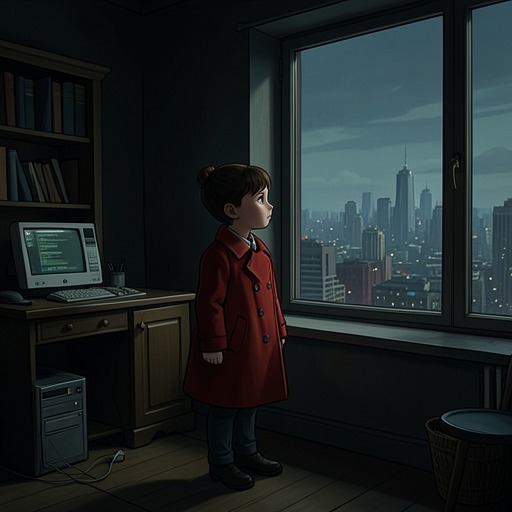
Lu Xun—Su Xiangcheng
CEO's Beloved Honey GirlLu Xun—Su Xiangcheng is the central marriage relationship through which the narrative tests the difference between legal status, emotional dependence, and genuine freedom. Their bond is not simply a romance: it is a five-hundred-million contract marriage in which money, property, sexual access, family reputation, and marital authority are repeatedly placed against Su Xiangcheng’s right to leave. Lu Xun’s possessiveness gives the relationship its coercive force, while Su Xiangcheng’s refusals, jealousy, illness, and eventual recognition of him as her husband create a volatile pattern of resistance and return.
Contract, Status, and Unequal Power
The relationship is initially structured by capital and possession. When Su Xiangcheng asks for a divorce, she says that Lu Xun may keep all his property and that she will take neither assets nor alimony. She proposes converting the five hundred million he invested into shares and returning it with interest, presenting the arrangement as a debt that can be calculated and repaid rather than as a permanent claim over her life. Lu Xun answers by reducing the marriage to its most humiliating terms, questioning whether sleeping with her a few times could make her worth five hundred million. His response reveals the relationship’s central imbalance: he treats the contract as proof of ownership, while she tries to turn its financial structure into a route toward independence.
This imbalance is intensified by Lu Xun’s conduct when intimacy becomes a question of obedience. His apology for the night on which he hurt her is gentle in tone, but he continues holding her arm rather than releasing her. Su Xiangcheng therefore rejects the apology as inadequate and describes herself as a pet bought and played with at home. Her language identifies the emotional reality beneath the marital title: Lu Xun may call her his wife, but his treatment has made marriage resemble captivity and abuse. The narrative keeps the two meanings in deliberate collision, allowing tenderness and coercion to occupy the same domestic space without making the coercion disappear.
Repeated Conflict and the Pursuit of Control
Lu Xun’s jealousy repeatedly turns ordinary relationships into tests of marital loyalty. When Su Xiangcheng secretly reads popular comics, he asks whether she thinks her husband is not handsome or good enough and contrasts her interest in the comics with her lack of fascination with his interviews. His complaint is less about the object she is reading than about the attention he believes marriage entitles him to receive. The scene shows how his possessiveness operates in daily life: not only through dramatic confrontation, but also through demands that Su Xiangcheng continually confirm his desirability and priority.
The same insecurity appears in the dispute over Shen Yiyun. Lu Xun explains that Shen Yiyun is his cousin through an uncle’s adoption and that he arranged for her to stay near the theater because she came to Cloud City to perform. Su Xiangcheng’s anger comes from his failure to tell her this directly, especially because she associates the secrecy with the earlier Song Yun’er situation. Lu Xun accepts the rebuke and promises that he will correct his mistakes in the future. The exchange matters because it marks a limited movement from unilateral control toward explanation: he does not merely insist on his authority, but acknowledges that concealment has damaged trust.
Su Xiangcheng’s own suspicions are also shaped by the unstable boundary between kinship and desire surrounding the couple. Lu Xun’s household contains relationships described through cousin-like or adopted-family language, while romantic rivalry repeatedly exposes how fragile those labels can be. Chu Fei states that the woman he once regarded as a close relative was not actually related to him and that he liked her; he calls Lu Xun an eyesore and says he prefers the process of pursuing Su Xiangcheng rather than forcing her. Later, Su Xiangcheng rejects the idea that a non-blood relative should automatically be treated as harmless, arguing that such a person is still a man and a woman rather than a true blood relation. These confrontations turn marital jealousy into a dispute over who has the authority to define kinship and who may claim emotional access to Su Xiangcheng.
Care, Illness, and the Making of a Home
The marriage is not sustained by control alone. Lu Xun and Su Xiangcheng also develop a practical rhythm of mutual attention, particularly when illness exposes their physical dependence. After sleeping without enough covering, Su Xiangcheng wakes with a fever, body aches, and almost no strength. She asks Manager Wu to buy antipyretic medicine, and the household immediately anticipates Lu Xun’s concern. Her fever places her not as a contractual asset or a jealous wife but as a vulnerable person whose body requires care, and the episode shows how domestic life makes their relationship concrete even when affection remains difficult to name.
The emotional meaning of Lu Xun’s care becomes clearest after he brings her back. He tells her that the house is empty without her and that, with her there, it has become like a home. Su Xiangcheng responds with a cold sneer and refuses to be persuaded by words, yet she allows him to apply medicine to the wounds on her body before pulling up the blanket to sleep. The scene does not erase the violence that produced those wounds. Instead, it places Lu Xun’s longing for a home beside the evidence of the harm he has caused, making domestic tenderness morally unstable rather than uncomplicated.
Their bond also includes gestures that move beyond crisis. When Lu Xun agrees to visit Su Xiangcheng’s grandfather in the hospital and help bring him home for recuperation, he responds quickly to her wish for a family meal. Su Xiangcheng is so pleased that she embraces him, kisses him, and accepts his willingness to enter her family sphere. The proposed visit gives the marriage a social and intergenerational dimension: Lu Xun is no longer only the powerful husband who controls the household, but also the man being invited to meet and assist the elder whom Su Xiangcheng cares about.
Rescue, Violence, and External Judgment
The relationship is repeatedly judged by outsiders because Lu Xun’s authority becomes indistinguishable from violence. After Su Xiangcheng is found unconscious by the roadside in a severely injured state, Mo Beiyu condemns the man who tortured his woman and says that, without Mo Beiyu’s sister, Lu Xun might already have been facing a body-identification notice. Mo Beiyu then confronts Lu Xun directly, asking what qualifications a rapist has to stand in the sunlight. The police have already connected Su Xiangcheng’s return to the apartment with the surrounding circumstances, so the confrontation transforms a private marital conflict into a public moral and legal crisis.
Lu Xun’s response in another moment is protective and intimate but still rooted in the danger surrounding their lives. When Su Xiangcheng trembles and says that she is cold and afraid, he ignores the wounds on his own face, crouches down, embraces her, and tells her not to be afraid because he is there. She immediately notices the blood at the corner of his mouth and shifts from fear for herself to concern for his injury. This reciprocal movement is one of the relationship’s clearest signs of attachment: even after violence and outside threats have destabilized them, each can still become the other’s immediate object of fear and care.
Yet Lu Xun’s protective role cannot be separated from the fact that Su Xiangcheng has also had to be protected from him. His claim to be the person who keeps her safe is therefore structurally contradictory. He is husband, rescuer, source of security, and source of bodily danger at different points in the relationship. The narrative’s strongest tension lies in this contradiction rather than in a simple conversion from cruelty to kindness.
Recognition and the Relationship’s Unstable Future
The relationship’s most revealing moment of recognition comes when Lu Xun asks Su Xiangcheng what their relationship is. She calls him annoying, pulls off his shirt flirtatiously, and answers that he is her husband. His uncertainty shows that even the marital title, formally established by the contract, does not guarantee emotional certainty. He wonders whether she truly knows who he is, because the social world around her contains many powerful and attractive men who could also be called a husband in flirtation or fantasy. Her answer therefore functions as both a declaration and a test: she identifies him through the intimate status he has fought to possess, even while the circumstances of that possession remain troubled.
Su Xiangcheng’s later argument with Shen Hui gives the marriage a sharper boundary against Lu Xun’s female relatives and quasi-relatives. She insists that a relative without blood connection is, apart from the name, still a man and a woman, and she rejects the expectation that Lu Xun’s cousin-like relationship with Shen Yiyun should automatically command her trust. Her defiance protects the marriage as a chosen bond, but it also exposes how much emotional security depends on exclusion. Lu Xun wants the privileges of being husband without always providing transparency; Su Xiangcheng wants the recognition and exclusivity of being wife without surrendering judgment or autonomy.
Lu Xun—Su Xiangcheng therefore remains unresolved in a productive and painful sense. It contains attraction, domestic tenderness, family participation, jealousy, illness, public accusation, and repeated attempts to recover after harm. Su Xiangcheng does not simply submit, because she asks for divorce, rejects alimony, challenges Lu Xun’s explanations, and names his treatment as abuse. Lu Xun does not simply reform, because his apologies coexist with physical restraint and possessive demands. Their marriage becomes a continuing negotiation between the house Lu Xun says is empty without her and the freedom Su Xiangcheng insists cannot be purchased with five hundred million.