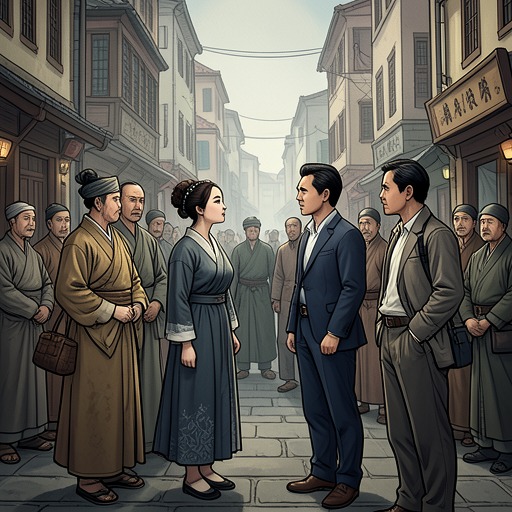
Su Clan
CEO's Beloved Honey GirlSu Clan is the family enterprise at the center of the novel’s business and kinship struggles. Once stronger than it is in the present, it suffers financial and political pressure but retains a valuable foundation, inherited assets, and the possibility of revival. Its fate is never treated as a purely corporate matter: decisions about land, shares, marriage, protection, and family honor determine whether the enterprise can stand again.
Condition and Corporate Position
Su Clan’s immediate condition is one of partial recovery without restored power. With Bian Jiang’s help, the company’s performance improves, yet Bian Jiang makes clear that the enterprise is no longer what it was. The distinction matters: improved results do not erase the loss of influence, and ordinary managerial effort may not be enough to secure the company’s future. He warns that if Su Clan falls once more, his strength alone may be insufficient to raise it again.
The company’s weakness becomes concrete in its inability to compete confidently for a Western District plot scheduled for bidding the following month. Bian Jiang therefore asks Su Xiangcheng to approach Lu Xun and discover whether he is interested in the land. The request reveals how closely Su Clan’s commercial prospects depend on access to a more powerful network. Corporate survival requires not only performance but also a relationship with the person who can alter the competitive field.
Bian Jiang’s assessment is also shaped by the enterprise’s underlying value. He considers the Su Clan’s foundation genuinely strong and regards its abandonment as wasteful. Even after its decline, the company possesses enough accumulated assets and reputation to make recovery plausible if its principal adversaries stop targeting it. The enterprise is therefore neither secure nor ruined; it occupies an unstable middle ground in which one hostile rival or one favorable alliance can change its prospects.
Capital, Land, and Inherited Shares
The Su Clan’s future is tied to concrete forms of capital rather than to goodwill alone. A substantial birthday gift transfers to Su Xiangwan all the shares originally left by her grandfather, consolidating the grandfather’s holdings in her hands. Although the company is weaker than before, these shares give the family enterprise a renewed material basis and make its recovery more than sentimental wishful thinking.
Land becomes the clearest instrument through which corporate power is redistributed. Lu Xun is involved in negotiations over the East District, while Lin Yanche recognizes that Lu Xun is not personally interested in the land and asks what conditions he intends to impose. Lu Xun’s condition is that Lin Yanche stop interfering in his affairs with Su Xiangcheng. He then gives Lin Yanche the land directly, stating that he had not wanted it in the first place. The transaction transforms a development asset into leverage: Lu Xun uses commercial value to protect Su Xiangcheng and force a boundary around Lin Yanche’s conduct.
This exchange shows that Su Clan’s business interests cannot be separated from the private conflicts surrounding it. The land is not merely an investment opportunity. It becomes a bargaining chip in a struggle over Su Xiangcheng’s relationships, allowing Lu Xun to convert economic power into personal protection while making Lin Yanche’s rivalry with the Lu household serve the Su family’s interests indirectly.
Family and External Alliances
Su Clan functions through a family structure in which business responsibility and emotional obligation continually overlap. Su Xiangcheng remains concerned about the enterprise even when she feels unwell and still insists on going to the company. Her presence signals that the company’s crisis is also a crisis of family duty: she is expected to help preserve the enterprise while navigating the personal costs of seeking assistance from Lu Xun.
The family’s position is further complicated by the contrast between Su Xiangcheng’s vulnerability and the protection available through marriage. Lu Xun’s intervention in the land dispute is understood as an act performed for her sake, but the same act also stabilizes the interests of Su Clan. The enterprise benefits from a private alliance that is emotionally charged and structurally unequal, illustrating how family firms in the novel survive by converting intimate bonds into access to capital and authority.
Su Qingrou’s proposed engagement ceremony with Jin Zhengnan is likewise discussed partly as a matter for the two companies. The ceremony is presented as a small preliminary engagement intended mainly to serve both enterprises. Its commercial purpose demonstrates that marriage and corporate strategy operate on the same field: family relationships can be used to consolidate business positions, while business pressures shape the acceptable forms of family commitment.
Rivals, Protection, and Exposure to Violence
Lin Yanche’s hostility is one of the principal threats to Su Clan’s recovery. The evidence repeatedly frames the family enterprise’s chance of rising again as conditional on Lin Yanche ceasing to target it. His pressure prevents the company from advancing freely, making corporate decline an effect of personal and family feud as much as of market competition.
The organization is also embedded in a wider network of danger. When Lu Xun and Lin Yanche travel to Yan City, Chu Fei’s men are already waiting at the airport, apparently having calculated their arrival time. The two men bring substantial personnel and are not immediately worried about their safety, but the encounter confirms that business and territorial expansion are accompanied by organized confrontation. Su Clan’s surrounding network is consequently not a stable commercial ecosystem; it is connected to rival forces capable of surveillance, interception, and coercion.
The enterprise’s vulnerability is mirrored in the bodily crises of its members. Su Qingrou is found weeping, bearing deep and shallow kiss marks, after being confined by Lin Yanche, while Su Xiangcheng later develops a debilitating fever and lacks the strength to care for herself without help. These episodes do not constitute corporate transactions, but they show the human cost of the pressures that also threaten the family’s economic position. The company’s survival is pursued through people whose bodies and relationships are repeatedly exposed to control.
Narrative Significance and Prospects of Revival
Su Clan gives the novel a material structure for its conflicts. Its decline and possible resurgence organize the movement of shares, land, marriage arrangements, protection, and revenge. Bian Jiang’s changing confidence illustrates this shifting balance: he once placed his hopes on Lu Xun, but after the transfer of inherited shares to Su Xiangwan, he begins to see that the family’s internal assets may justify a different calculation. Recovery depends on both external power and the family’s ability to retain or reclaim what belongs to it.
The organization also exposes the limits of formal corporate independence in the novel’s world. Bidding decisions are shaped by private negotiations; land is exchanged to settle personal boundaries; engagement ceremonies are evaluated for their value to two companies; and family members are expected to endure emotional or physical danger in order to preserve collective interests. Su Clan is therefore both an enterprise and a pressure system, converting kinship into economic obligation while allowing economic resources to determine personal freedom.
Its position at the end of the documented arc remains precarious but not hopeless. The company has improved performance, retains a strong foundation, receives the benefit of consolidated inherited shares, and may rise again if Lin Yanche’s targeting ends. Yet its prospects remain tied to alliances that can change abruptly. Su Clan’s significance lies precisely in that conditional survival: it is the family’s promise of continuity, but also the institution that keeps every private conflict attached to money, land, status, and power.