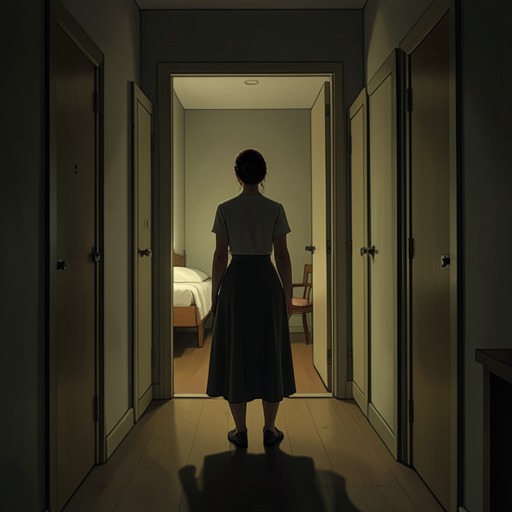
Su Family Ancestral Home
CEO's Beloved Honey GirlThe Su Family Ancestral Home functions as both a physical refuge and an emotional counterweight to the controlled spaces surrounding Su Xiangwan’s marriage. Most decisively, it is where she returns after Lu Xun fails to come home, transforming a marital quarrel into a temporary separation and placing her once again under her grandfather’s protection. The residence therefore represents family continuity, but not uncomplicated freedom: it shelters Su Xiangwan while also returning her to the expectations, alliances, and vulnerabilities of the Su Family.
A Family Refuge in a Moment of Separation
The residence becomes important when Su Xiangwan packs her luggage the morning after Lu Xun does not return. She moves back to the Su Family Ancestral Home and enters with the unmistakable sign of departure: a suitcase. Her grandfather is seated in the living room reading a newspaper, and his frown registers the seriousness of her return even though he does not immediately demand an explanation. Su Xiangwan tells him that she has taken leave from Lu Xun and asks to stay for several days, making the home a deliberate alternative to the marital residence rather than merely a place she happens to visit.
The grandfather’s response contains both welcome and concern. He is pleased that she has come back, yet he recognizes that the marriage may be in trouble. The home consequently absorbs the first consequences of the couple’s conflict: luggage, guarded questions, and an older relative’s apprehension. Its living room is not an abstract symbol of family; it is the precise domestic setting in which Su Xiangwan’s private marital distress becomes legible to the family that remains behind her.
The Threshold and Lu Xun’s Return
The separation does not remain sealed within the ancestral residence. At ten o’clock that night, Lu Xun personally appears at its gate. He drives himself instead of allowing Butler Wu to drive, and his changed manner suggests that the distance between them has unsettled him. When Su Xiangwan comes out through the main entrance in a white dress, Lu Xun looks at her with a frown rather than his earlier ease. The gate thus becomes a threshold between two competing forms of domestic authority: Su Xiangwan’s return to her grandfather and Lu Xun’s attempt to draw her back toward their marriage.
The encounter ultimately leads to renewed intimacy without erasing the significance of the separation. After spending time together, Su Xiangwan and Lu Xun return by car to the old mansion. Lu Xun warms the vehicle and speaks to her gently, while Su Xiangwan remains conscious of the hour and worries that her grandfather may be unhappy if she does not return promptly. Her insistence on going back shows that the ancestral home still governs her immediate loyalties, even after Lu Xun has made a conciliatory appearance. The residence remains a destination to which she must answer, not merely a backdrop to romance.
Kinship, Protection, and the Limits of the Home
The ancestral home is also part of the novel’s wider examination of kinship labels and intimate boundaries. Shen Yiyun is described as Lu Xun’s adopted uncle’s child and therefore his cousin, and Lu Xun explains that he arranged for her to stay in a house nearer the theater when she came to Cloud City to perform. This information becomes relevant to Su Xiangwan’s jealousy and to the couple’s effort to distinguish legitimate family connection from romantic threat. Although the temporary lodging is not explicitly identified as the ancestral home, the explanation belongs to the same domestic network in which residences are assigned, relatives are protected, and marriage is tested by proximity to other women.
That boundary becomes sharper in Lu Xun’s confrontation with Chu Fei. Chu Fei dismisses the protective language of kinship by contrasting a woman who merely appeared to be a close relative with a woman he actually desired, and he openly identifies Su Xiangwan as someone he likes. His pursuit is framed as a chase rather than immediate force. Against that threat, Lu Xun’s claim to Su Xiangwan as his wife is set beside the family’s claims upon her as granddaughter and member of the Su Family. The ancestral home is the place to which she retreats when those claims collide, even though the evidence does not show it as a fully secure or independent sanctuary.
Domestic Crisis Within the Su Family
The residence’s protective meaning is complicated by the suffering carried into the Su family sphere. Su Xiangwan’s return to the family home occurs against the broader crisis involving Su Qingrou. When Su Xiangwan sees Su Qingrou weeping and notices deep kiss marks on her body, she experiences the pain of a sister confronting the physical evidence of coercion and abandonment. The same moment includes a picture of Lin Yanche passionately embracing Song Yun’er, taken at the relevant time, connecting private bodily harm to betrayal within the surrounding romantic network.
The family’s domestic concerns also extend to corporate survival and marriage strategy. Su Qingrou proposes that she and Jin Zhengnan hold a small engagement ceremony, chiefly for the benefit of their two companies. Her proposal shows how the family’s residences and relationships are not separated from business pressure: engagement, protection, and corporate interests are negotiated together. The ancestral home therefore stands within a family system where emotional refuge can coexist with strategic marriage arrangements and where personal decisions carry consequences for the Su Family’s economic position.
A Shelter That Cannot End the Conflict
Illness further reveals the limitations of domestic protection. Su Xiangwan later develops a fever after sleeping without sufficient covering and asks Manager Wu to buy antipyretic medicine. The episode presents bodily vulnerability within the household sphere, while the concern that Lu Xun will become anxious shows how strongly the marital bond still reaches into her daily care. The home can contain illness and provide attendants, but it cannot prevent the relationship’s tensions from following her indoors.
In this sense, the Su Family Ancestral Home is neither a simple haven nor merely a symbolic ancestral setting. It is a recurring node linking the family’s past authority, Su Xiangwan’s physical and emotional vulnerability, Lu Xun’s attempts to reclaim proximity, and the wider disputes over marriage, kinship, and desire. Its most important narrative function is to give separation a visible address. When Su Xiangwan crosses its threshold with a suitcase, she asserts distance; when Lu Xun arrives at its gate, the marriage crosses that distance after her. The home preserves the possibility of return, but it does not resolve the conflicts that make return necessary.