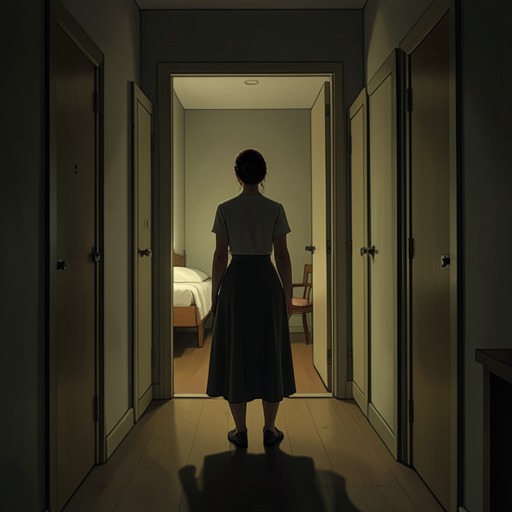
Su Family Old Residence
CEO's Beloved Honey GirlSu Family Old Residence is the principal domestic repository of the Su family’s past and one of the novel’s most important emotional spaces. It is where Su Xiangwan and Su Qingrou grew up together, where old memories remain materially present, and where family life repeatedly collides with romance, illness, obligation, and danger. The residence therefore matters not merely as a backdrop: returning to it means entering the family’s remembered history, while leaving it often signals a temporary break from that history or a new alignment with Lu Xun.
A House of Memory
Su Family Old Residence is explicitly associated with the childhood shared by Su Xiangwan and Su Qingrou. When Su Xiangnan moves back into the old house, the return is accompanied by a night of recollection; the residence contains memories of both sisters and stands as the place where they grew up together. Its rooms thus hold more than furniture or family possessions. They preserve an earlier version of the sisters’ lives, before later conflicts and romantic entanglements reorganize their identities.
The house also becomes a place where the past is disclosed rather than simply remembered. Within its family history lies the story of Su Xiangwan’s mother, whom her grandfather said had a terminal illness and who believed that leaving the family was the only way to avoid implicating it. Su Xiangwan remembers drawing her parents holding her hand and then seeing her mother walk onto the balcony. The old residence consequently carries an intimate and traumatic family secret: the domestic setting that once represented childhood security is also bound to the memory of maternal suicide.
Domestic Life and Changing Intimacy
At the old residence, Su Xiangwan sits cleaning up her belongings while Lu Xun examines her childhood notes and occasionally teases her. The scene creates a temporarily harmonious household atmosphere, but the calm is interrupted by Su Qingrou’s unexpected return. Her pale appearance immediately prompts concern, and Su Xiangwan asks whether she has been drinking or has a fever. The exchange shows the house functioning as a familial care network even when unresolved tensions remain beneath the surface.
Su Xiangwan’s packing gives the domestic scene a second meaning. She is not simply tidying a room; she is preparing to move away from the old household with Lu Xun. Her hesitation when explaining this to Su Qingrou reveals the emotional difficulty of transferring her daily life from the family home into her marriage. Lu Xun responds by standing up and offering the sisters privacy, going to the study to read while they talk. The study, bedroom, doorway, and stairs divide the house into zones of intimacy, observation, and withdrawal, allowing the residence to stage family negotiations without dissolving the underlying conflict.
The arrangement also makes the old residence a counterpoint to Lu Xun’s marital world. Su Xiangwan has difficulty sleeping in the bed she knows best and wonders whether she has already begun to regard Lu Xun’s bed as her own. The contrast between the familiar bed at the Su residence and the bed associated with her husband measures her changing attachment through domestic habit. Her ambivalence is not expressed through a formal declaration but through the ordinary problem of where sleep feels possible.
Hospitality, Ceremony, and Family Authority
The residence becomes a formal family setting when Lu Xun arranges a caravan to bring Su Xiangwan’s grandfather home comfortably after his hospital stay. Su Qingrou and Jin Zhengnan spend time speaking with him before leaving for the company, while Su Xiangnan goes out to see them off. The sequence turns the house into a meeting point between recovery, work, kinship, and social duty: the grandfather returns from medical care, younger family members attend to him, and business life continues beyond the gates.
Lu Xun’s gift to the grandfather further formalizes his position within the family. He presents an antique jade ruyi with both hands and addresses the older man respectfully, hoping that the gift will please him and that everything will go well. The grandfather accepts the object but does not examine it closely, placing it aside instead. The gesture therefore contains both courtesy and reserve. Lu Xun can perform respect inside the Su family’s home, but acceptance of the gift does not erase the distance between an established elder and the man entering the family through marriage.
The house also accommodates everyday acts of hospitality. Su Xiangwan explains that Jin Zhengnan cannot eat with them that evening but that Su Qingrou will return soon. Later, after dinner, Lu Xun prepares to leave with Su Xiangwan, bids farewell to her grandfather, and is seen out by Su Qingrou at the main gate. At the threshold, the sisters exchange a warning and a reassurance: Su Xiangwan urges Su Qingrou not to do anything foolish, while Su Qingrou tells her to go back quickly because it is cold outside. The metal gate becomes a literal boundary between continued residence and departure, between the sister remaining inside and the sister leaving with her husband.
A Space of Vulnerability and Control
Although Su Family Old Residence often offers familiarity, it is not untouched by danger or coercive power. The broader domestic spaces connected to the family are repeatedly used to regulate movement and relationships. Lin Yanche threatens Su Qingrou with harm to Jin Zhengnan if she leaves his manor, demonstrating the violent alternative to the old residence’s nominal protection. Against that threat, the family home represents a place where kin can gather, watch over one another, and attempt to restore ordinary relations, even though it cannot resolve every external danger.
The residence is also connected to bodily vulnerability. Su Xiangwan’s high fever culminates in her fainting at an elevator entrance, and Lu Xun’s response combines practical urgency with possessive anger toward anyone he believes has endangered or inconvenienced her. In another scene, after she admits that she is frightened, Lu Xun holds her and comforts her while she cries. These moments extend the meaning of home beyond architecture: safety is repeatedly sought through a person’s body and presence, yet the same protective intimacy can shade into control.
Boundaries of Kinship and Belonging
The old residence is a particularly charged setting because its inhabitants must continually distinguish blood relations, adopted relations, cousins, spouses, and friends. Shen Yiyun is described as the child adopted by Lu Xun’s uncle and therefore Lu Xun’s cousin in family terms, despite the absence of a blood tie. Lu Xun later challenges the idea that a non-blood relative should automatically be treated as an unambiguous familial boundary. His reasoning exposes how labels such as cousin, sister, wife, and husband can regulate desire while also concealing or intensifying it.
That instability appears in Su Xiangwan’s own interaction with Lu Xun. When he asks what their relationship is, she identifies him as her husband while pulling off his shirt flirtatiously. The answer is comic and intimate, but its force depends on the contrast between public uncertainty and private recognition. At the old residence, where family titles and inherited memories dominate the social order, marriage offers Su Xiangwan another form of belonging. Her movement away from the house with Lu Xun is therefore not a simple escape from family; it is a negotiation between two households and two competing definitions of intimacy.