Su Xiangwan's Flight from Home
CEO's Beloved Honey GirlSu Xiangwan's Flight from Home is the story's central break between enforced marital possession and the possibility of personal escape. It follows a confrontation in which Lu Xun's jealousy, sexual coercion, and demand for a child turn the Lu residence into a place of danger rather than protection. Su Xiangwan does not leave with luggage, money, or a prepared destination. After Lu Xun finally releases her, she puts on casual pajamas, runs from the bedroom at dawn without even putting on her shoes, and hides so completely that his power, wealth, and organized search cannot immediately bring her back.
Causes and Background
The flight grows out of the unequal terms governing the marriage. Su Xiangwan had already proposed divorce and offered to convert Lu Xun's five hundred million in capital into shares, returning both the principal and interest while claiming nothing for herself. Her proposal treats separation as a settlement of accounts, but Lu Xun answers by belittling the idea that her value could equal the money he had invested in the marriage. The dispute therefore carries both emotional and material stakes: she seeks freedom without exploiting his property, while he measures the relationship through possession, expenditure, and sexual access.
The immediate trigger is Lu Xun's resentment over Su Xiangwan speaking with an old lover. He accuses her of being lively with another man but depressed in his presence, turning jealousy into an excuse for confrontation. When she says she has no strength to argue and wants to sleep, he presses his body onto hers, bites her lips, and begins to take what she has not consented to give. Her explicit refusal does not stop him. The scene makes the flight a response not to an ordinary marital quarrel but to a pattern in which Lu Xun's authority overrides Su Xiangwan's stated wishes.
His later question about childbirth intensifies the threat. In the bathroom, Lu Xun demands to know whether she cannot have a child or simply does not want to have one for him, speaking down to her as though she were a servant before a king. Su Xiangwan answers that he is not worthy of receiving a child from her. The conflict consequently shifts from jealousy to reproductive control: her body, consent, and future motherhood become objects over which he assumes entitlement. Her resistance is bitter and exhausted, but it identifies the underlying issue more clearly than the earlier argument does.
What Happens
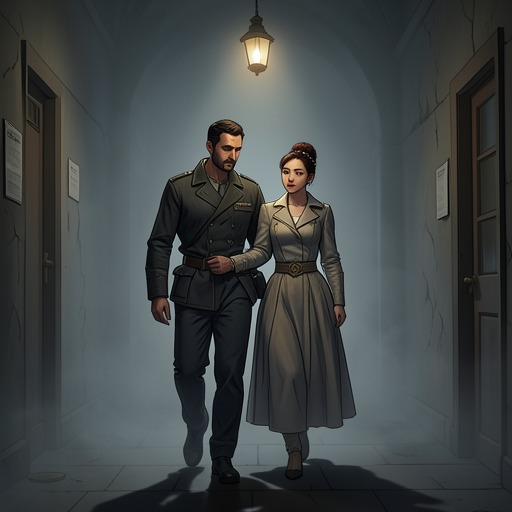
Lu Xun's assault continues until ten in the morning, when he finally leaves the bedroom. Su Xiangwan is left in despair, pain, and hatred, regretting that she had fallen in love with a man she now experiences as crude and oppressive. She forces herself into a pair of casual pajamas and runs outside as quickly as she can. The flight is physically stark: she leaves her shoes beside the bed and disappears into the cold dawn without them, transforming a domestic room filled with marital claims into the starting point of an improvised escape.
When Lu Xun returns, he realizes that she is gone and that her absence is not a temporary act of anger. The discovery of her shoes makes the danger visible even to him: she has fled in such haste that she did not stop to dress properly or protect her feet. His anger vanishes, replaced by alarm, and he searches the streets for three hours. As traffic and pedestrians increase, he understands that Su Xiangwan is not merely wandering away from home; she is deliberately hiding from him, which means that she will not simply appear in the places where he expects to find her.
Lu Xun then expands the search through his police connections and orders everyone in his group to look for her. Gordon reports that the areas assigned to the search have been investigated without finding any trace of Madame Lu. Two days later, Lu Xun is still drumming his fingers impatiently on the table and ordering Gordon to continue. The repeated command reveals the limits of his usual methods. A man accustomed to solving problems through command can deploy police and corporate personnel, but he cannot compel the missing woman to reveal herself when she has made concealment the purpose of her departure.
Immediate Consequences
The flight exposes the violence concealed by the marriage's public status. Su Xiangwan is eventually found after collapsing near the entrance of an elevator. She is so weak that her legs feel insubstantial, her body is burning with fever, and her consciousness is fading; before her fingertips reach the elevator button, she faints. Her physical collapse links escape with bodily cost. The act that gives her a chance to evade Lu Xun also leaves her vulnerable, ill, and dependent on the intervention of strangers.
Mo Beiyu and Liu Xi become part of the aftermath because they find and assist her rather than leaving her on the road. Mo Beiyu condemns the man who has driven his woman into such a state that she collapses by the roadside, saying that without his sister's intervention Lu Xun might already have received a notice to identify a body. He then confronts Lu Xun directly and questions what qualification a rapist has to stand in the sunlight. The public accusation strips away the marital language Lu Xun has used to frame his conduct and names the violence as violence.
The event also produces a crisis of responsibility for Lu Xun. Earlier, when Su Xiangwan was feverish, Manager Wu was asked to buy antipyretic medicine, and concern about her illness circulated through the household. After the flight, however, care and control become inseparable. Lu Xun's search can be read as panic over her life, but it is also the extension of the same possessive system from which she has escaped. The narrative therefore refuses to make pursuit automatically equivalent to repair: his fear is genuine within the scene, yet the conditions producing it are his own coercive actions.
Trauma and Repeated Patterns
Su Xiangwan's response is shaped by earlier experiences of loss and danger. She recalls that her mother had a terminal illness and left the family because she did not want to implicate them. As a child, Su Xiangwan drew an image of her parents holding her hand; after seeing it, her mother walked onto the balcony and died by suicide. The memory gives the later flight a deeper emotional structure. Departure is not merely an argument tactic but an action haunted by abandonment, guilt, and the fear that a family member's suffering will again culminate in irreversible loss.
Lu Xun's own history contains a parallel trauma. He reveals that he was kidnapped at the age of twelve, drugged by his captors, and nearly lost his life; the experience left him resistant to drugs. He speaks of the past with an unwavering gaze, as though describing someone else, suggesting that remembered danger has been contained rather than resolved. The two characters therefore carry different histories of bodily threat into the marriage: Su Xiangwan remembers a mother's fatal withdrawal, while Lu Xun remembers captivity and survival. Their responses move in opposite directions, with her flight seeking distance and his pursuit attempting to restore control.
The flight is followed by scenes in which protection and possession continue to overlap. Lu Xun brings hot milk and comforts a frightened Su Xiangwan, telling her not to be afraid because he has been there all along. He later explains that Shen Yiyun is his cousin through adoption and that he arranged nearby housing for her because she came to Cloud City to perform. These gestures and explanations present him as caretaker and husband, yet they occur within a relationship already marked by surveillance, jealousy, and coercion. The contrast is crucial: tenderness does not erase the conditions that made escape necessary, and reassurance cannot by itself restore trust.
Narrative Significance
The event changes the marriage's dramatic direction from pursuit within the home to pursuit across the city. Su Xiangwan's disappearance forces Lu Xun to recognize that she is not simply angry but actively evading him. That distinction gives the episode its decisive value shift: the husband who believed marital authority could secure obedience discovers that the wife he treated as possessed can remove herself from his reach. Her bare feet, fever, and fading consciousness make freedom neither comfortable nor safe, but they make it materially real.
The surrounding relationship conflicts reinforce this meaning. Lu Xun reacts defensively when Chu Fei says that Su Xiangwan resembles a close relative in appearance but is not related to him, and that he likes her and prefers the process of pursuing her rather than forcing her. Lu Xun also becomes uncertain when a disoriented Su Xiangwan calls him her husband, since her recognition may not be reliable in that moment. Later, she rejects Lu Xun's distinction between blood relatives and nominal relatives when discussing Shen Yiyun, insisting that a non-blood relative is still a man and woman rather than an innocent category. Across these encounters, the story repeatedly tests whether labels such as wife, cousin, and relative protect intimacy or conceal desire and control.
Su Xiangwan's Flight from Home consequently functions as more than a temporary separation. It gathers the novel's recurring tensions—five-hundred-million contractual marriage, marital obedience, jealousy, sexual consent, illness, childhood trauma, and the struggle between love and freedom—into one physical act. Su Xiangwan leaves because the home has ceased to be a place where her refusal matters. Lu Xun searches because her absence reveals that possession cannot guarantee attachment. The aftermath does not resolve that contradiction; it makes the contradiction impossible to ignore.