The Su–Lin Family Feud
CEO's Beloved Honey GirlThe Su–Lin Family Feud is a long-running conflict between two powerful families whose history transforms romance into a battlefield of obligation, accusation, and revenge. It is expressed through disputes over family honor, marriage, corporate interests, sexual loyalty, and the right to define who has harmed whom. Rather than remaining an abstract struggle between households, the feud repeatedly becomes intimate: Su Qingrou loves and hates Lin Yanche at once, Su Xiangwan is judged through the conduct of people around her, and Lu Xun’s protection of the Su Family places him directly against Lin Yanche. The result is a cycle in which favors become debts, debts become accusations, and attempts to settle old injuries create new ones.
Origins in Family Loyalty and Retaliation
The feud is structured around competing ideas of family loyalty. Su Xiangwan observes that her uncle treats Uncle Lin like a real brother and that her uncle would not have married his only precious daughter into the Lin Family without trust. To her, that history makes Lin Yanche’s later conduct not merely a private failure but a betrayal of a relationship that once joined the families. Her charge that he repays kindness with enmity therefore carries the weight of inherited grievance: the offense is measured against an earlier act of trust, not only against what happens between two individuals.
Lin Yanche rejects that moral accounting. When Su Xiangwan invokes the Su Family’s past generosity, he throws the accusation back at her, arguing that the phrase should come from Song Yun’er or from an outsider rather than from a member of the Su Family. His response reveals how the feud protects itself through rival definitions of legitimacy. The Su Family sees its history of assistance as a claim to gratitude; Lin Yanche treats that same history as a reason for Su Xiangwan to lack the authority to condemn him. Family membership, which should provide belonging, becomes a contested jurisdiction over who may speak.
The conflict also overlaps with Lu Xun’s own unresolved history. In conversation with Lin Yanche, Lu Xun recalls that the woman whose identity he is investigating was known from childhood for attracting attention and had been kidnapped when young. He proposes checking skeletal age because age can be forged, showing that personal recognition has become an investigative and adversarial process. Lin Yanche understands the danger and states that if the woman is the person Lu Xun suspects, he will not allow Lu Xun to touch her or point a gun at her again. Their exchange places the Su–Lin antagonism beside an older contest over protection, responsibility, and past violence.
Love as the Feud’s Most Intimate Battlefield
Su Qingrou’s relationship with Lin Yanche gives the feud its most psychologically complex form. She tells him that she hates him, yet the intensity of that hatred exists alongside an equally powerful love. She has imagined abandoning everything to remain with him, but memories of what he did to her and to her family turn being with him into daily self-torture. The family conflict therefore does not simply separate lovers; it makes love itself the mechanism through which injury is repeatedly remembered.
Her later declaration that their grievances have been written off marks a significant change in the feud’s emotional balance. Su Qingrou admits that she had once been intensely jealous of Lin Yanche’s love and care for Song Yun’er, but she no longer sees herself as competing for that affection. She interprets his conduct as the fulfillment of a promise to Song Yun’er and, by doing so, removes the romantic rivalry that had kept her bound to him. Her decision to avoid him from then on is not a claim that the past never happened. It is an attempt to stop converting resentment into continued attachment.
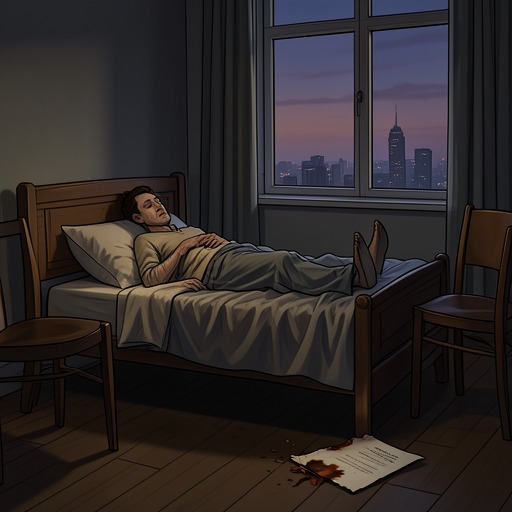
That attempted release remains painful rather than triumphant. Su Qingrou leaves after expressing both love and hatred, while Lin Yanche lies on the hospital bed with his eyes closed and then opens them, clear and cold, after the door has shut. The scene preserves the feud’s characteristic uncertainty: emotional truth is spoken, but reconciliation does not follow. The family struggle has produced a relationship in which confession may clarify the past without making a shared future possible.
Marriage, Property, and Coercive Power
The feud is reinforced by unequal control over marriage and money. Su Xiangwan proposes divorce and refuses Lu Xun’s property or alimony, offering instead to convert his five hundred million in capital into shares and return it with interest. Her proposal treats the marriage as an account that can be settled, even reducing her own contribution to the time she spent with him. Lu Xun answers by mocking the idea that she could be worth five hundred million merely because of their sexual relationship. Their argument shows how the broader family conflict is entangled with the valuation of women, marital status, and corporate capital.
The same pattern appears in the entertainment world, where Lu Xun realizes the connection between a celebrity and a financial backer after meeting Luo Jingjing. He recognizes that such arrangements may be common in that industry, yet feels pity when the situation is associated with Su Xiangye. The observation links public reputation to economic dependence: a woman’s social identity can be reduced to the person who funds her, while the family’s concern is expressed through shame, protection, and capital.
Coercion becomes even more direct in Lin Yanche’s treatment of Su Qingrou. When she tries to leave the manor, he threatens that Jin Zhengnan will never leave the hospital if she takes even half a step outside. Su Qingrou immediately protests that Jin Zhengnan is only her friend, but Lin Yanche uses suspicion and sexual accusation to justify confinement. He claims that her having lived under the same roof with Jin Zhengnan must mean she has already violated the relationship between them. The feud thus moves beyond verbal hostility into imprisonment, threats against a third party, and the policing of a woman’s body and loyalty.
Public Shame and Competing Claims to Innocence
The family conflict is sustained by public and private humiliation. At the wedding shop, Song Yun’er praises a wedding dress with a colored diamond at the waist as her dream dress, and Lin Yanche immediately offers to buy it for her. The scene is witnessed by Su Xiangwan and Su Qingrou before they even enter the shop. The dress becomes more than a luxury object: it displays whose desire is being indulged and whose emotional position is being disregarded.
Su Xiangwan later confronts Song Yun’er during a meal, asking whether it is appropriate to discuss a secret marriage with her husband in front of her. She insists that even a close relationship does not grant Song Yun’er the right to discuss men with her husband as though the wife were absent. Song Yun’er falls silent and soon leaves. The confrontation exposes how secrecy and public familiarity can work together: the marriage may be hidden, but its emotional consequences are visible in every social encounter.
Song Yun’er’s own language turns the same shame back toward Lu Xun. In a tearful appeal, she says that she is not like him and could not casually marry a woman or make do with one; she accepts that her actions helped make him what he is, but also says that she has received her punishment through abandonment. Later, she accuses him of treating dirty matters involving Su Xiangwan as more important than her concerns and declares that she looks down on him before ending the call. Her claims present abandonment as retribution, while Lu Xun’s reaction suggests that he has become unable to separate compassion from judgment.
Consequences, Solidarity, and the Possibility of Release
The feud’s consequences are repeatedly carried by women whose bodies and health register the violence of family conflict. Su Qingrou is found weeping, with deep and shallow kiss marks visible on her body, and Su Xiangwan’s heart aches at the sight. At another point, Su Xiangwan develops a fever after a night in which she has thrown off her pajamas and blanket; weakened and sore, she asks Manager Wu to buy antipyretic medicine. These details place bodily vulnerability beside the larger disputes over marriage and family power. The feud is not only argued in offices or through inherited loyalties; it appears as illness, exhaustion, tears, and visible marks.
Su Qingrou attempts to protect herself by redirecting her future toward Jin Zhengnan. She considers holding a small engagement ceremony with him, chiefly to benefit their two companies, and asks Su Xiangwan’s opinion. The proposed engagement is therefore both emotional refuge and corporate strategy. Su Qingrou also relies on the existence of a brother whom she believes can protect her from Lin Yanche. Family connection, which has been the source of the feud’s obligations, becomes the same network through which she seeks safety.
The conflict reaches a stark confrontation when Mo Beiyu condemns Lu Xun for reducing his partner to such a condition that she fainted by the roadside. He says that without his sister, Lu Xun might already have received a notice to identify a body, and calls him a scum. He then asks what qualification a rapist has to stand in the sunlight. Lu Xun and Mo Beiyu face each other as police surround them, converting the private history of the feud into a public moral confrontation. The language is deliberately absolute, but it also exposes a central contradiction: men who claim to protect women may simultaneously exercise coercive power over them.
The Su–Lin Family Feud therefore has no simple settlement in the supplied episodes. Its closest approach to resolution comes through Su Qingrou’s decision to write off her grievances and leave Lin Yanche’s path, not through a restored alliance between the families. Her withdrawal breaks one link in the chain of love, jealousy, retaliation, and obligation, while other disputes remain active around Lu Xun, Su Xiangwan, Lin Yanche, Song Yun’er, and their families. The feud’s lasting significance lies in this contrast between inherited loyalty and chosen release: the family past demands repayment, but survival may require refusing to keep the account open.