Aṅgikaṃ Bhuvanaṃ Yasya
CEO's Unexpected Love: A sweet office romance with a guaranteed HEAAṅgikaṃ Bhuvanaṃ Yasya is a devotional verse and choreographic passage in Aparna Mahadevan’s Bharatanatyam arangetram. Framed by the emcee as a tribute to Bharatanatyam’s universal reach and divine nature, it gives the performance a cosmological scale: the dancer’s body represents the universe, her expressive language encompasses all the world’s languages, and the deity’s adornment is imagined through the moon and stars. In the auditorium, however, the verse also becomes a meeting point between sacred performance and wounded human memory, because Shivam Goyal hears his own name within its repeated invocation of Shiva and watches Aparna’s smile falter before she continues dancing.
Devotional and Choreographic Identity
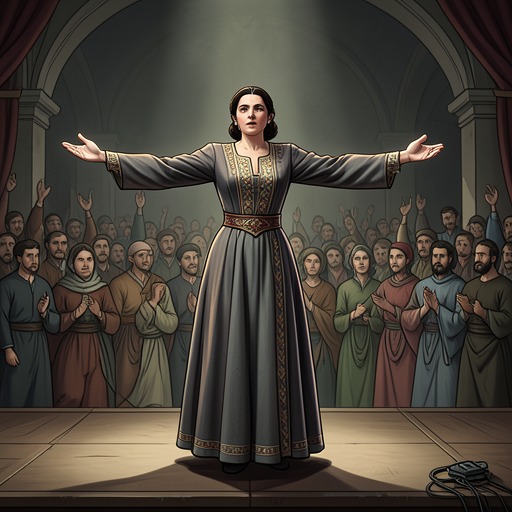
Aṅgikaṃ Bhuvanaṃ Yasya appears as part of a formal Bharatanatyam presentation rather than as an isolated spoken text. Before the performance begins, the stage is arranged around an elaborately decorated sculpture of Lord Nataraja. The musical instruments test their pitch, the emcee explains the antiquity and divine nature of Bharatanatyam, and the verse is introduced as a shloka honoring the dance form as an embodiment of Lord Shiva. This setting places the expression within a ritualized artistic world in which movement, music, deity, and performer are joined.
The verse is first presented in transliterated form as “Aangikam Bhuvanam Yasya Vaachikam Sarva Vaangmayam.” Its accompanying explanation identifies the figure being praised as one whose body is the whole universe and whose speech consists of the languages of the entire world. The lines therefore establish a correspondence between physical form and totality: the body is not merely the dancer’s instrument but a vast visual field, while speech is translated into gesture and expression rather than delivered through ordinary conversation.
Performance at Aparna’s Arangetram
Rahul Ramachandran begins the sequence with a short alaapana, after which the sound of anklets announces Aparna’s arrival. She enters with a measured, graceful gait synchronized to the rhythm and offers the customary obeisance to Mother Earth. The mridangam then bursts into action, giving the verse a precise rhythmic foundation. Aparna depicts the scale of the universe through her movement, turning the theological claim of the text into a visible composition.
The singer repeats the opening line while Aparna interprets its meaning through dance. Her body represents the universe, and her expressive vocabulary conveys the breadth of languages. The performance thus depends on repetition with transformation: the singer supplies the words again, while the dancer continually re-forms those words as spatial scale, gesture, and embodied meaning. The next passage, “Ahaaryam Chandra taaraadi TamVande Saatvikam,” describes the deity as adorned by the moon and stars as jewels. Aparna answers the imagery with a complex jati as the mridangam fills the musical spaces between the vocal phrases.
The performance’s formal discipline is matched by its emotional clarity. Shivam watches from the audience with bated breath, captivated by Aparna’s poised, expressive eyes. His response makes the dance more than a display of technical accomplishment: the eyes through which Aparna depicts divine expansiveness also become the means by which Shivam experiences renewed attraction and remorse. The sacred choreography carries a private history into a public performance without requiring the dancer to explain it.
The Shiva Invocation and Emotional Disruption
The sequence culminates, for Shivam, in the repeated sound “Shivam Shivam Shivam Shivam.” The name is simultaneously a devotional reference to Shiva and the name of the man watching from the auditorium. That overlap produces a moment of painful ambiguity. Aparna’s smile fades briefly, though she maintains the rhythm and continues the performance. Shivam’s chest tightens as he wonders whether the sound of his name has brought her heartbreak back in the middle of her arangetram.
This instant gives Aṅgikaṃ Bhuvanaṃ Yasya a second register. The verse enlarges the dancer into the universe, but its repetition narrows Shivam’s attention to a single personal association. The divine name does not erase the lovers’ damaged history; instead, it makes that history audible inside a ceremonial performance. Aparna’s continued control of the rhythm is especially significant. Her expression changes, but the choreography does not collapse, so the scene holds private pain and artistic composure together.
Place in the Wider Ritual Context
The verse belongs to an arangetram that has been prepared through discipline, teaching, and social recognition. Aparna observes a Monday fast even when beginning work at Ascent Brandz, treating the practice as a continuing part of her identity rather than abandoning it for professional convenience. At her performance, she receives Rati Goyal’s warm approval after depicting the glory of Lord Shiva; Rati calls her Shanti Rao’s finest student and tells her not to forget what she has learned. Rati also expresses confidence that Aparna will make everyone proud in her arangetram.
The invitation to the event later becomes crucial to Shivam’s recognition of what he has misunderstood. Seeing the card, he first confronts the fact that he has mistaken it for a wedding invitation. Its image shows Aparna in a maroon Bharatanatyam costume, with a floral string spiraling around her long plait and her hands forming the Hamsasya and alapadma mudras. The card identifies the event as “Arangetram of Kum Aparna Mahadevan” and includes further photographs of Aparna in specific Bharatanatyam poses. A performance expression that might otherwise remain ceremonial therefore becomes part of the plot’s discovery structure: it helps Shivam understand the significance of the day he has nearly missed.
Literary and Narrative Significance
Aṅgikaṃ Bhuvanaṃ Yasya links bodily presence to cosmic meaning. Its central conceit asks the dancer’s body to hold the universe and her expressive speech to encompass every language, while the moon and stars become ornaments of the divine figure. In the arangetram, these ideas are not explained abstractly; they are rendered through gait, eyes, mudras, rhythmic patterns, jati, anklets, voice, and mridangam. The verse therefore demonstrates Bharatanatyam’s claim to communicate through an integrated vocabulary of body, music, and sacred image.
At the same time, the passage shows how ritual art can preserve meanings that exceed the performer’s immediate intention. For Aparna, the fading of her smile remains contained within the demands of the dance. For Shivam, the repeated “Shivam” turns the sacred text into an intimate summons and a reminder of the heartbreak between them. The expression’s decisive narrative force lies in that tension: it presents universality onstage while exposing the singular vulnerability of two people who hear the same word differently.