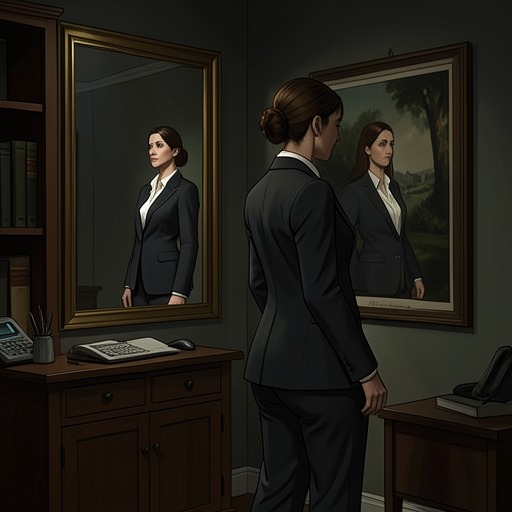
Indu Ganesh
CEO's Unexpected Love: A sweet office romance with a guaranteed HEAIndu Ganesh is a self-published author, a mother, and a determined creative professional whose novel becomes the basis for a Dream Come True Productions film. Her decisive significance lies in the conflict she brings into the adaptation process: a female-centered period story is attractive to a major production house, yet the proposed star vehicle threatens to reorganize it around a male superstar. Indu refuses to treat that alteration as a neutral commercial adjustment. She understands that the struggle over the screenplay is also a struggle over whose voice, history, and imagination may occupy the center of the film.
Identity and Personal World
Indu is introduced through her connection with Aparna Mahadevan. Aparna knows her as Indu akka and has met her repeatedly because Indu was her cousin’s best friend and, until recently, her cousin’s neighbor. When Aparna and Prashant Joshi arrive for a business presentation, Indu greets Prashant warmly, mockingly reproaches Aparna for using the more formal Indu mam, playfully smacks her on the head, and ushers both visitors into a lavish conference room. The familiarity of the gesture establishes Indu not merely as a professional contact but as someone embedded in Aparna’s emotional and social world.
Prashant initially reduces Indu to her association with Vineet Kaushal, describing her as the Bollywood star and producer’s girlfriend or partner. Aparna immediately objects to that framing. Indu is also a successful, self-made author and writer in her own right, with thirty-five years of ground experience behind her. The contrast matters: public proximity to a powerful man threatens to eclipse the labor and achievement that define Indu’s own identity, while Aparna insists that the author must be seen before the relationship label.
Indu’s private life gives her professional anxiety a concrete emotional weight. After the novel is acquired, she remains responsible for her five-year-old daughter, Vaishnavi. Her morning includes collecting groceries, waking Vaishnavi, persuading her to attend school, performing daily pooja, and returning to work. A modest powdered-wood bookshelf and a photograph of Adi remind her of a promise he made more than two years earlier: a rosewood bookshelf by the following year. The frame brings tears to her eyes, but she pushes herself back into routine because Vaishnavi deserves the love of both parents and Indu tries to provide what she can.
The Novel and Its Adaptation
Indu regards the acquisition of her self-published novel as a blessing. Dream Come True Productions, a new studio established by Bollywood actor-producer Vineet Kaushal, has purchased the work for a film, bringing her a substantial payment. The success, however, quickly turns into a problem once the first cheque has been cashed. The production wants Vineet Kaushal to appear in the film and proposes changing the story to suit an actor associated with macho secret-agent roles and spectacle-driven commercial cinema.
Indu’s objection is specific. The novel is female-centered and set in ancient times; she does not want it transformed into a vehicle for stunts that displace the heroine’s rightful space. Her anger is directed not at adaptation in the abstract but at the hierarchy that treats a male star’s market value as more authoritative than the narrative’s existing center. Gautam Sanghvi, her agent, answers that films sell on star cast rather than story and urges her to speak with Nisha Singh, Vineet’s manager, in search of a compromise. Indu recognizes the commercial truth in his argument, but recognition does not become surrender. She asks how a production can call the deal a win-win if a nuanced period story is manipulated to accommodate a superstar.
Rather than enter the discussion unprepared, Indu researches how novels are converted into screenplays. She learns that films often add characters or alter existing ones for mass appeal, including age changes and major transformations of familiar comic-book figures. She then constructs an alternative storyline of her own. Her strategy is neither a simple refusal nor passive acceptance: she will permit Vineet his “macho moments” while defending the heroine’s narrative territory. The research turns her anxiety into bargaining power and shows her attempting to master the production process without abandoning the work’s central identity.
Creative Conflict and Commercial Power
During Aparna’s presentation to Dream Come True, Indu is present as the author whose book is being adapted. Aparna describes the film, The forgotten Queen, as more than a historical production or a short-lived commercial blockbuster. She presents it as a source of hope for women seeking empowerment, growth, and the release of their inner selves. Indu smiles with pride, signaling that Aparna’s marketing language recognizes the political and emotional value Indu sees in the novel.
Aparna’s proposed campaign would use hundreds of women influencers to explain how the film personally connects with them. Such a campaign would move the film beyond critics and opening-week publicity into ordinary conversation, encouraging parents to show it to their children and helping Dream Come True Productions establish itself as a company with a distinctive purpose. Indu and Vineet exchange an approving glance after the pitch, suggesting that the author and producer can share an ambition for the film even while disagreeing over how its screenplay should be shaped.
Vineet, however, initially interprets Indu’s resistance through the assumptions of commercial authority. He wonders whether a self-published newcomer is negotiating too aggressively and considers the possibility that her “artistic tantrums” are a bid for attention. He tells Nisha to invite Indu to the announcement party, believing that technical explanations and an attractive perk, such as a photoshoot, will overwhelm her resistance. His plan treats authorship as a pressure point to be managed. Nisha is less dismissive; she observes that Indu seems different from the people Vineet usually classifies in that way.
The imbalance is further complicated by Vineet’s private response to Indu. He searches for her online intending to find a negotiation advantage, but instead watches a video of her reading a chapter from the novel before an audience. Her dramatic intonation, controlled changes in expression, and evident passion impress him. The author’s performance briefly displaces the business purpose of his search. He ends by replaying the video and addressing her as Miss Indu Ganesh, now treating the negotiation as something interesting and potentially unpredictable. His curiosity does not erase the power difference, but it reveals that Indu’s creative presence resists the role he had prepared for her.
Relationships and Professional Network
Indu’s relationship with Aparna is affectionate and longstanding. Aparna calls her Indu akka, while Indu’s mock complaint about the change to Indu mam becomes a playful physical exchange rather than a formal reprimand. Later, when Indu asks Aparna to speak with her, Aparna is at Coimbatore on a client visit and cannot come to the office; Indu therefore arranges a video call for four o’clock. Their communication crosses family-like intimacy and professional collaboration, allowing Aparna to carry Indu’s project into the world of influencer marketing.
Gautam Sanghvi occupies a different role as Indu’s agent. Their conversation is openly combative and affectionate at once: Indu answers his call by declaring that she hates him, challenges whether he represents her or Vineet, mocks his accent, and still agrees to the scheduled discussion. Gautam pressures her to consider the star’s commercial value, but he also claims to be protecting her future. Their argument shows Indu negotiating not only with the production house but with the intermediary who believes compromise is necessary for access.
Nisha Singh becomes the production-side interlocutor. She conveys Vineet’s proposed changes, reports that Indu was initially reluctant to alter the storyline, and warns Vineet against judging a woman for looking after her own interests. Nisha’s response gives Indu an ally within the commercial structure, even though she ultimately agrees to carry out Vineet’s invitation plan. Vineet’s own position is more ambivalent: he wants control over the adaptation, yet Indu’s reading makes him recognize a passion that cannot be reduced to publicity or obstruction.
Narrative Role and Significance
Indu embodies the tension between artistic integrity and commercial compromise. Her novel has already crossed from private authorship into a market governed by producers, stars, managers, agents, and promotional campaigns. Once Vineet Kaushal becomes attached, the adaptation’s value is measured through both the story and the celebrity who may lead it. Indu’s resistance exposes the cost of that arrangement: the work can be financed and amplified only if its center is vulnerable to revision by people with greater institutional power.
At the same time, Indu is not portrayed as detached from the market. She accepts the acquisition money, studies screenplay practice, and designs a counterproposal rather than simply rejecting the film. Her position is therefore more complex than purity versus profit. She seeks a form of collaboration in which commercial conditions can be accommodated without allowing the star to erase the heroine. That distinction connects her struggle to Aparna’s broader belief in campaigns that prioritize reach, loyalty, and meaningful audience response over reliance on celebrity alone.
Indu’s domestic routine, her grief around Adi’s unfinished promise, and her responsibility toward Vaishnavi prevent the adaptation dispute from becoming an isolated professional contest. She must remain a parent, worshipper, worker, author, and negotiator in the same day. The chapter’s movement between masala chai, grocery delivery, school preparation, pooja, phone calls, research, and screenplay bargaining makes her creative conflict inseparable from the labor of sustaining a life. Her significance lies precisely there: she enters the film industry not as an abstract artist but as a woman whose voice, property, time, and family responsibilities are all subject to competing claims.