Letting Go and Wishing Others Well
CEO's Beloved Honey GirlLetting Go and Wishing Others Well names the difficult movement from pursuing a desired relationship to accepting that love may require distance. In the novel, release is never presented as simple indifference: Song Yun’er still cares for Lin Yanche, Lin Yanche still remains bound to Su Qingrou, and both characters must confront the difference between preserving a connection and possessing its future. The concept therefore marks a change in relational value, from insistence and control toward restraint, grief, and the willingness to let another person choose.
The Pattern of Pursuit and Restraint
Song Yun’er and Lin Yanche provide the clearest recurring pattern. They have recently been able to treat one another with friendliness and mutual respect, but only when they avoid the subjects of relationships, marriage, and love. That temporary harmony reveals its limit: the relationship can function when desire is kept outside the conversation, yet it cannot offer Song Yun’er the intimacy she wants.
Whenever Song Yun’er tries to move closer, Lin Yanche warns her off and prevents the relationship from advancing. Her frustration comes from the apparent permanence of this arrangement: she is left to wonder whether they can do nothing more than maintain the same connection for the rest of their lives. His refusal is not a momentary misunderstanding but a repeated boundary, and the repetition turns pursuit into emotional exhaustion. Song Yun’er’s continued efforts show that she has not yet accepted the relationship’s limits, while Lin Yanche’s warnings establish the pressure under which letting go eventually becomes necessary.
Illness and the Limits of Possibility
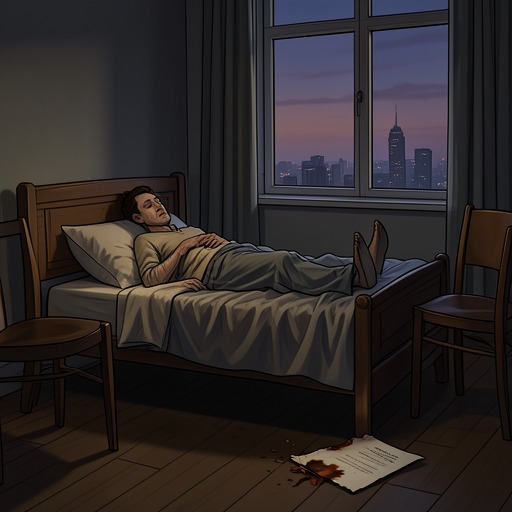
Lin Yanche’s condition changes the meaning of separation. When Su Qingrou asks whether something is wrong, he admits that it is, though he forces a smile and softens the severity of his answer by saying that he should not die. His appearance and manner are described as those of an old man who has lost his thoughts and no longer sees a point in struggling, waiting only for his life to end. The illness makes every emotional decision occur under the shadow of mortality rather than ordinary romantic uncertainty.
Su Qingrou responds by telling him to have a good time with Song Yun’er. She recognizes that Song Yun’er has waited for him for a long time and argues that he cannot simply let her go. Her words are both an act of release and a form of direction: she does not claim him for herself, but neither does she erase the emotional history among the three of them. The scene leaves Lin Yanche without a clear verbal answer; he merely gives a derisive laugh and walks away. His silence preserves the unresolved tension between the life he has shared with Su Qingrou and the future Song Yun’er still hopes to obtain.
Song Yun’er’s Renunciation
Song Yun’er’s later declaration is the concept’s most explicit enactment. Lu Xun reminds her not to forget the original purpose for which she came and warns that distraction will prevent her from accomplishing anything. Her concern for him has become an interference with that purpose, showing how attachment continues to redirect her actions even after the relationship’s prospects have narrowed.
She then says that she has already spoken with Yama and cannot persuade him. Since he wants to protect Su Qingrou in this way, she will let go. The statement is accompanied by profuse tears, so her renunciation is not emotionally complete or painless. It is also deliberately addressed to more than one listener: the words are meant for Lin Yanche and for Lu Xun as well. The gesture thus combines personal grief with public recognition. Song Yun’er wants her withdrawal to be heard and understood, but she nevertheless accepts that Lin Yanche’s choice will not be overturned by her persistence.
Her release is immediately treated as both an ending and a danger. Su Xiangcheng feels that Lin Yanche has finally been set free from Song Yun’er’s pursuit, yet recognizes that his life may end at any moment. Letting go therefore does not restore ordinary happiness. It removes one form of conflict while leaving the larger threat of death intact, making emotional closure inseparable from the awareness that there may be little future in which to enjoy it.
Debts That Cannot Be Settled
The relationship between Lin Yanche and Su Qingrou gives the concept its most complex formulation. When Su Xiangcheng asks what Lin Yanche still has with her sister, he does not answer by naming a conventional romantic promise. Instead, he describes their history as a confusion of what she owes him and what he owes her, a tangle too old and painful to put into an orderly account.
His chosen response is not to settle the debt but to remain able to see Su Qingrou and be near her for the rest of his life. This desire is quieter than his earlier possessiveness and less openly coercive, yet it remains an attachment. He wishes to relinquish demands for repayment without relinquishing proximity. The distinction matters: letting go here means abandoning the attempt to make the past morally legible, not ceasing to care.
The calmness of Lin Yanche’s gaze is crucial to the scene. For once, it contains no obvious malice, and his relationship to Su Qingrou is framed through an acceptance of contradiction: injury and obligation, estrangement and longing, guilt and devotion remain together rather than being reduced to a single verdict. Lu Xun then asks Su Xiangwan to let the two develop as they wish and pleads on Lin Yanche’s behalf. His intervention reinforces the idea that the relationship cannot be solved from outside by assigning one person ownership of the other’s future.
Trauma, Care, and the Meaning of Release
The broader narrative places this ethic beside experiences that make attachment fearful and urgent. Su Xiangcheng recalls that her mother had a terminal illness and left the family because she did not want to implicate them; the child’s drawing of her parents holding her hand preceded the mother’s walk onto the balcony. The memory links love with abandonment, guilt, and an irreversible loss that the family did not openly explain to the child. Such a history helps clarify why care in the novel can become desperate protection rather than calm trust.
Lu Xun carries a different childhood wound. At twelve, he was kidnapped, drugged by his captors, and nearly lost his life; afterward, he developed resistance to various drugs. He recounts the event with an unwavering gaze, as though describing someone else, suggesting that distance is one of the ways he contains the pain. His history makes his protective behavior intelligible without turning it into a justification for control: fear can produce vigilance and endurance, but it can also make release feel like surrender.
The body repeatedly interrupts attempts at emotional resolution. Su Xiangwan becomes so weak and feverish that she collapses before she can press the elevator button. Lu Xun later brings hot milk to the frightened Su Xiangcheng, holds her, and reassures her that he has been there all along. These acts of care offer temporary safety, but they also show why the novel refuses to treat dependence and release as opposites. A person may need protection in one moment and still require freedom in another; staying near someone can be tender, coercive, or both, depending on whether the other person’s will is respected.
Letting Go and Wishing Others Well consequently remains an unfinished achievement rather than a stable final state. Song Yun’er says she will release Lin Yanche, but she does so through tears and after repeated failed attempts to move closer. Lin Yanche abandons the demand to untangle his debts with Su Qingrou, yet still wants to see her for the rest of his life. The concept’s force lies in this unresolved balance: love becomes more humane when it stops forcing an outcome, but it does not become painless, nor does it erase history, illness, fear, or desire.